Debtbound – Chapter 1: The Tallyman’s Error
10 min read
Progression fantasy & LitRPG
share this story
The first rule of the tally floor was that the numbers were never wrong.
People were wrong. People forgot payments, lost receipts, lied about what they'd borrowed and wept about what they owed. The ledgers of House Merren did none of these things. Each one was bound in grey hide, chained to its desk, and balanced to the last quarter-dram of Ash, and if a customer's memory disagreed with a ledger, the customer's memory lost.
Kell Arden had copied entries for House Merren for six years, and in six years he had found exactly four errors. Three were his own. The fourth belonged to a clerk named Wessic, who was dismissed the same afternoon and whose name nobody on the floor said out loud anymore.
So when the widow Voss put her bundle of receipts on the counter and said the House had her husband's debt wrong, Kell already knew how the morning would go.
"Eleven hundred drams," she said. "That's what Toman owed when he died. I have it here. Every receipt, every payment, his own hand." Her fingers were pressing the bundle flat, as if the papers might fly off and leave her with nothing. "Your notice says fifteen hundred and forty."
Master Odric didn't look at the receipts. He looked at the ledger, because that was the whole of his religion. He was a narrow man with ink-stained cuffs and the bland patience of someone who had delivered the same sentence a thousand times.
"Increase," he said. "Your husband's account carried increase at one part in forty, assessed quarterly. Death doesn't pause it. The debt passed to you on the day he died, with eleven weeks of increase accrued and a transfer fee of —" he tilted his head at the page — "sixty drams."
"A fee. For dying."
"A fee for transfer of obligation," Odric said. "Madam, every spell your husband ever cast was borrowed. The Ash he drew to mend bones and dry rot — that came from somewhere. It must return to somewhere. The House merely keeps the count."
Kell kept his eyes on his own desk and his quill moving, because that was the second rule of the tally floor: the count was not your business. Your business was the copy. But he had Toman Voss's file in front of him that very hour — that was the bitter joke of it, the dead man's account had come up the queue for quarterly transcription — and something in the column of figures kept snagging his eye the way a splinter snags wool.
The increase had been recalculated.
Not added. Recalculated. Backwards. Someone had gone through four years of quarterly assessments and reworked each one at a higher rate, then carried the new totals forward as if they had always been true. The hand was neat. The arithmetic was perfect. If you only checked the bottom of each page against the top of the next — which was all a transcribing clerk was permitted to check — it balanced beautifully.
Eleven hundred drams of true debt. Fifteen hundred and forty on the page.
Kell's quill had stopped. He made it move again.
At the counter, the widow Voss was being shown where to make her mark on the revised schedule of obligation. She made it. People always made it. The alternative was default, and everyone in the city of Vell knew what default looked like, because the Ashen came out at dusk to sweep the steps of the very Counting Houses that had unmade them — grey, silent, politely starving, working off in death what they had failed to pay in life.
Her husband had been a bonesetter. He'd borrowed Ash to knit other people's fractures. Now his widow would spend nine years paying for a number someone had invented.
Not your business, Kell told himself, and copied the invented number into the fair ledger in his very best hand.
He told himself that through the morning queue: a carter consolidating three small debts into one large one, at terms that made Kell's teeth ache. A girl of maybe nineteen taking her first draw — forty drams against her own soul to light a forge-spell, signing the soulbond with the brisk cheer of someone who has been told the increase is only one in forty and has not yet done the arithmetic across thirty years. A street-mage renewing his license to channel, paying his quarterly in coin because paying in labor was for people who had given up.
He told himself that at the midday bell, eating bread on the back steps with the other juniors while the seniors ate actual food somewhere with a fire. Brann from the third desk was there, not eating, which meant his family was on short loaf again. Brann had four children and a wife whose lungs had needed two healings last winter, eighty drams each, and a debt that grew faster than his wages did. He did the cheerful talk anyway. Men on the tally floor were all fluent in cheerful talk.
"You look like a man doing sums he doesn't like," Brann said.
"I'm always doing sums I don't like," Kell said. "It's the job."
It wasn't a lie. It was just aimed at the wrong sums.
Because here was the thing about Kell Arden, the thing that made him useful to House Merren and useless to himself: he could not cast. Not wouldn't — couldn't. His ledger was frozen. He had inherited his father's account at fourteen the way the widow Voss had inherited her husband's, except his father's account had been one thousand four hundred drams of pure unsecured borrowing, and the House did not extend credit to a soul already drowning. No credit, no Ash. No Ash, no magic. He'd been dry since before he needed to shave.
Fourteen years of payments had brought one thousand four hundred down to nine hundred and seventy. The increase ate most of what he gave them. He'd worked it out once, properly, with quill and paper, the way the forge-girl hadn't: at his current wage, he would make his final payment at the age of sixty-one. The page was still in his room. He'd never had the heart to burn it; it felt like it would be rude to the truth.
So no — the count was not his business. The count was his cage. There is a difference, and the difference is that you know a cage very, very well.
Which is why the Voss file wouldn't let him alone. He knew what honest increase looked like the way a jailer's son knows the sound of keys. And that afternoon, with the file already transcribed, already balanced, already not his problem, he requested the master tallies for the V-accounts anyway, on the pretext of verifying a carry-over.
The third rule of the tally floor: nobody checks the checker. The master tallies came to his desk in their chained grey hide, and nobody looked twice.
He found six more.
Six more accounts where the increase had been quietly reworked backwards. All of them dead men's debts in the first weeks after transfer to a widow, a son, a sister — the exact moment when nobody on earth could contest the numbers, because the only person who'd known the true history was in the ground. The amounts were never greedy. Eighty drams here, two hundred there. Small enough to be increase. Large enough, across what he guessed must be hundreds of accounts in a House this size, to be a river.
Someone inside House Merren was farming the dead.
Kell sat very still at his desk while the floor emptied around him, juniors banking their lamps, the chained ledgers going dark one by one. He was aware of his own breathing. He was aware that he was holding a piece of knowledge the way you hold a hot coal — that the last man to find an error on this floor had been dismissed by sundown, and that the error Wessic found, now that Kell thought about it, now that he really thought about it, had also been in a transferred account.
He should close the book. Bank his lamp. Go home, eat, sleep, wake, copy, and be at this desk until he was sixty-one, which was, after all, the plan.
Instead he put his palm flat on the Voss page — he could never afterward say why, except that the widow's fingers had pressed her receipts flat the same way, as if truth were a thing that could blow off a table — and he thought, with a tired clerk's whole heart: show me what he actually owed.
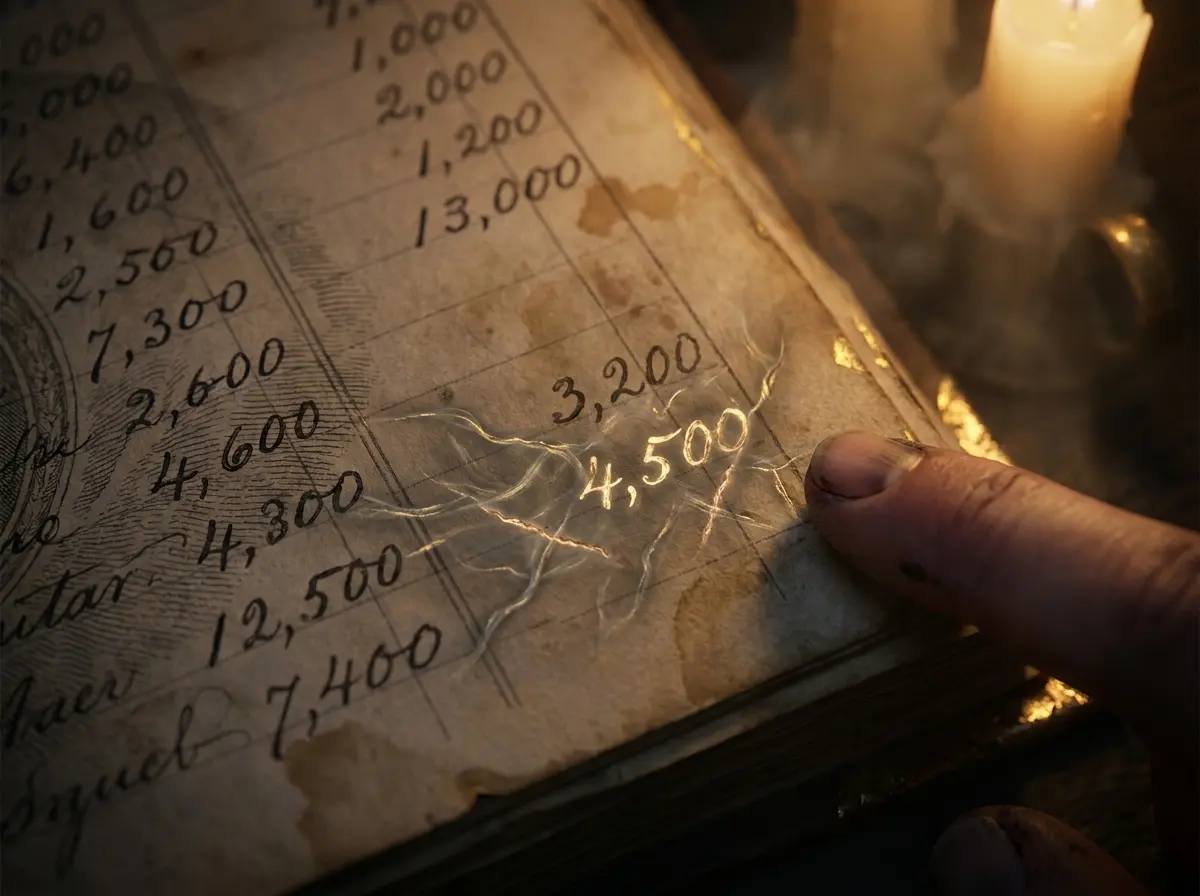
The page went deep.
There is no better word for it. The paper stopped being a surface and became a window, and under the neat false figures Kell saw — script. Living script. Lines of grey light, fine as spider silk, running under the ink the way veins run under skin, and where the lines crossed they knotted into figures that were not written in any hand because they were not written at all. They simply were owed. He was looking at the debt itself. Not the record of it. The thing.
Eleven hundred drams, said the soulscript, in light. And beside it, in dimmer, sicklier strokes, like scar tissue over the truth: the forgery, stitched on top, four years of false increase grafted onto a dead man's account by someone who had — Kell could see it, see the joins, see where new script had been spliced into old like bad carpentry — by someone who could touch the soulscript too.
He took his hand off the page.
The light went out. Paper was paper. The tally floor was an empty room full of chained books, and a junior clerk was sitting in it alone with his heart going like a forge bellows, because every child in Vell was taught the same catechism and Kell could recite it half-asleep: the soulscript is read once, by its owner, at the moment of death, when the Ledger is opened and the account is called. The living did not see it. Could not. The Auditors of the high Houses spent decades and fortunes building instruments — lenses of pressed ash, engines of brass and prayer — to glimpse what Kell had just read by putting his hand on a page and asking.
He looked at his hand. It was an ordinary hand with ink on the second finger.
Then — because a man who has just been handed the impossible will always, always test it on the thing that matters — he pulled his own file. A clerk wasn't permitted his own account, but the A-tallies stood three shelves down and the floor was empty and his hands were already pulling the grey hide open, finding the page he'd known by heart since he was fourteen. ARDEN, KELL, IN TRANSFER FROM ARDEN, MERIC, DECEASED. One thousand four hundred drams of origin. Nine hundred and seventy outstanding. His whole life, in two figures.
He laid his palm on his father's name.
The page went deep, and the soulscript rose, grey and fine and terrible, and Kell read his own debt the way only dead men were supposed to — and stopped breathing.
Because there was scar tissue on his page too.
The splice was old. Older than the Voss forgery, older than any of the six, the joins gone smooth the way a scar goes smooth, almost — almost — invisible even in the light of the true script. Someone had reworked his father's account fourteen years ago, in the weeks after Meric Arden died.
Under the graft, in clean grey light, the soulscript said the debt of origin: four hundred drams.
Four hundred. Not fourteen hundred.
Kell Arden had paid for his cage three times over, and had been scheduled to keep paying until he was sixty-one, and downstairs in the dark the great bound master-Ledger of House Merren ticked on, balanced to the quarter-dram, perfect, beautiful, and rotten through.
He sat in the empty counting hall for a long time, hand flat on the page, lamp burning down, while the dusk bell rang and the Ashen came out into the streets of Vell to sweep the steps of the men who owned them.
Then he got out a fresh sheet of paper, and he sharpened his quill, and he began — in his very best hand — to copy what only the dead could see.