
Debtbound — Chapter 2: A Debt Not His
10 min read
Progression fantasy & LitRPG
share this story
A Debt Not His
Kell did not sleep the night he read his own soul, and the page he copied it onto did not leave his coat. Not at home, where it lived against his ribs while he lay staring at the ceiling beam. Not the next morning on the tally floor, where it sat folded over his heart like a second, more honest ledger while he transcribed the accounts of strangers in his very best hand.
Four hundred drams of origin. Not fourteen hundred. He kept doing the arithmetic the way you keep touching a cracked tooth. At one part in forty, assessed quarterly, on the true principal, with fourteen years of his payments — he'd have been clear at twenty-six. He was twenty-eight. He had been free for two years and nobody had told him, because the only witness was written on the inside of his own soul, and the soul, as the catechism said, gives testimony once.
The rage was not what he'd expected rage to be. It was quiet, and it was patient, and it sat down at his desk with him like a colleague.
He was careful. He wanted that understood, later, by whatever judge mattered: he was careful first. He did not pull the V-tallies again. He did not stare at the senior clerks one by one over his quill, wondering which of them could stitch false script onto a dead man's account. He found out anyway, in the way of careful men, that the requisition log could not be un-signed: there it was when he returned the master tallies, his own name, ARDEN, K., AGAINST V-ACCOUNTS, VERIFICATION OF CARRY-OVER, in the book that any senior could read, and one of them — statistically, almost certainly — would.
A hot coal in one pocket. His own name in a logbook he couldn't reach. Kell was a clerk; he knew exactly what it looked like when a balance began to run against you.
He told himself he needed time, and a plan, and proof that would survive being held by hands more important than his. All of that was true. Then the week made it irrelevant, because on Thursday Brann's wife stopped being able to climb the stairs.
Brann told it at the midday bell the way he told everything, cheerfully, which was how the juniors of House Merren said help.
"Winter chest, that's all. Same as last year. She sits down halfway up and has a rest, like a duchess." He was tearing his bread into very small pieces and not eating any of them. "Healer says the left lung's gone spongy again. Eighty drams does it. Did it twice before."
"And the House?" Kell asked, already knowing.
"Reviewed my account this morning." Brann smiled at his bread. "I'm forty drams from threshold. They won't lend within forty of threshold, on account of — what was the phrase. Prudential care for the borrower." He laughed, once, with nothing in it. "They're protecting me, Kell. From her lungs."
Threshold. The line past which a soul's debt exceeded its assessed worth, past which default stopped being a risk and became a schedule. The Houses wouldn't push you over it with new lending — that much was true, and it photographed well in the charter — they simply let you stand against it while life did the pushing.
"Coin?" Kell said. "The healer would take coin."
"The healer would take ninety in coin, because coin's not secured." Brann finally ate a piece of the bread, mechanically, fuel and nothing else. "I have eleven. I'll find it. Margit's sister has a ring; there's a man on Tannery Row does private notes." He said it lightly. Everyone knew what a private note from Tannery Row carried for increase. There were worse rivers to drown in than the House's, and Brann was lining up to jump in one, cheerfully, because his wife couldn't breathe.
"Don't go to Tannery Row," Kell heard himself say. "Give it two days. Accounts get reviewed. Errors get found."
Brann looked at him with the particular flatness of a man who has worked six years on the tally floor. "No," he said. "They don't."
That night Kell stayed late over a stack of D-accounts that didn't need him, until the floor emptied and the lamps banked down to his one, and then he pulled the file of BRANN, OSEY, JUNIOR CLERK OF THIS HOUSE, and laid his palm on it, and asked.
The page went deep. He was ready for it this time, which is to say his heart still slammed but his hand stayed flat.
Brann's soulscript was honest. That was the first thing — no scar tissue, no splices; the forger farmed the dead, and Brann had been unlucky enough to stay alive. The debt was real, all six hundred and ten drams of it, two lung-healings and a roof and a bad winter of short wages, knotted into the grey light in figures that simply were.
But under the figures ran the increase, quarter by quarter, fourteen years of it, and Kell — who had checked carry-overs until his eyes ached, who knew honest arithmetic the way other men knew prayers — went down the chain of assessments one knot at a time. And there it was. Not fraud. Worse, in its way, because it was policy: every quarterly assessment rounded up to the whole dram. A quarter-dram here. A half-dram there. Compounding, every fraction of it, for fourteen years, on Brann's account and — Kell understood with a clerk's cold vertigo — on every account in every ledger of every Counting House in Vell. The catechism said the Ledger balanced to the quarter-dram. It did. The quarter-drams just all rolled one way.
On Brann's account, fourteen years of rounding and its compounded increase came to ninety-one drams.
Ninety-one drams of arithmetic that should never have existed. Take it away, and Brann stood a hundred and thirty-one clear of threshold. Room enough for an eighty-dram healing with the House's own blessing.
Kell sat with his hand on the page and his pulse in his ears, and had the conversation with himself that he would go on having, in one form or another, for the rest of his life.
It's not yours to touch.
It wasn't theirs to take.
Reading is one thing. No law forbids the impossible. But changing it—
Is correcting. Every figure I move is a figure that was wrong.
And if you're caught?
Caught by whom? By the one other person who can see this script — the one who built my cage out of a dead man's name?
That last thought didn't settle the argument. It just made the argument feel like it had picked a side already, somewhere behind his back, sometime around Thursday, when his friend started tearing bread into pieces too small to mean anything.
Kell pressed his palm flat, found the first rounded assessment, fourteen years down the chain — and pushed.
The script pushed back.
It was not like writing. Writing is obedient. This was like setting a bone: the figure resisted, the whole chain of knots above it resisted, because every assessment leaned on the one before and the Ledger — he felt this in his teeth, in the roots of his hair — the Ledger wanted to balance. He couldn't simply make ninety-one drams not exist. The light wouldn't have it; the strands slid out from under his will like wet rope. What the script would permit — what it almost seemed to recognize — was correction: this knot, retied at its true figure; the chain above it, re-run, knot by knot, each one resettling with a sensation like a tumbler going home in a lock. He was not deleting. He was auditing, in the one ledger where an audit was real.
It took him three hours. It took him — and this he didn't understand until afterward, until he stood up and the room tilted and his hands wouldn't close — something else, too. Reworking living script was spellwork. Spellwork drew Ash. And Ash, as Master Odric liked to say, came from somewhere and must return to somewhere.
He knew, even before he did it, with the sick certainty of a man checking his pocket for a key he can already feel is gone. He pulled his own file. Laid his palm on his father's name. Asked.
Under the old scar, under the figures he now knew by heart, the soulscript had grown a new line. Fresh. Unscarred. Written in no hand at all.
DRAWN AGAINST BEARER: FOURTEEN DRAMS, UNSECURED.
INCREASE: ONE PART IN EIGHT, ASSESSED MONTHLY.
One in eight. Monthly. Kell did the arithmetic on instinct, the way other men flinch: at that rate, unpaid, fourteen drams became a hundred inside two years. No House charged one-in-eight. Tannery Row barely dared one-in-twelve. This was the rate you charged when the collateral was the whole borrower, and the lender — he searched the script for a counter-party, for a House sigil, for any name on the other side of the line, and found nothing, a creditor's space that was simply dark — when the lender did not need to be named, because there was no possible default it could not collect.
His gift was a loan. Every impossible thing he did would be borrowed at the worst terms in the world, from something that kept its own books, and there was no teller's window where he could walk up and pay it down, because the debt did not exist anywhere a House could see.
Kell put the ledger back on its shelf, banked his lamp, and laughed — once, quietly, in the dark of the counting hall — because the joke was genuinely good. The one man in Vell who could free anyone from debt could free anyone but himself. The Ledger balanced. The Ledger always balanced.
He thought, worth it, and was surprised to find he meant it.
The review came through two days later, in the ordinary post, in the ordinary way: ADJUSTMENT ON AUDIT, ACCOUNT OF BRANN, O., CORRECTION OF COMPOUNDED ASSESSMENT, CREDIT 91 DRAMS. A junior runner read it out twice because Brann made him. Then Brann sat down at his desk, in front of everyone, and put his face in his hands, and the tally floor pretended very hard to be busy, because men fluent in cheerful talk have no vocabulary at all for this.
The healing was approved by Friday. On Saturday, Brann reported, Margit climbed the stairs without sitting down, "like a duchess who's late for something," and on Monday there was bread at the midday bell that got eaten instead of torn.
"Clerk's error," Brann said, wondering, watching Kell sideways. "In the customer's favor. First one in the history of the world."
"Accounts get reviewed," Kell said. "Errors get found."
"That's what some fool told me last week." Brann was quiet for a moment. "Whoever did the finding," he said, to his bread, "I hope his own sums come out right someday."
Kell thought of the new line on the inside of his soul, compounding at one in eight in the dark, and kept his eyes on the middle distance. "I'm sure they will," he said. "The Ledger balances."
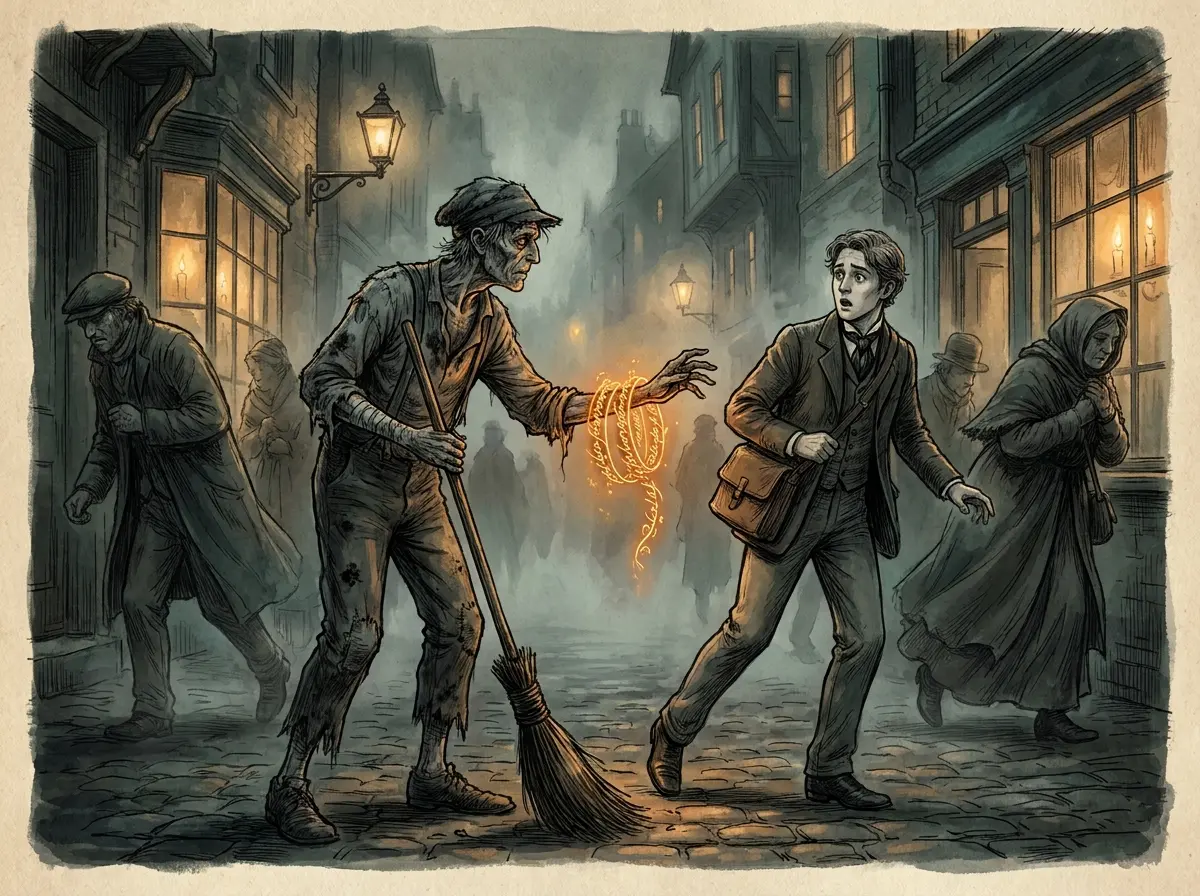
He noticed the Ashen on the walk home.
Noticing an Ashen was itself a strange act — the whole craft of living in Vell was not noticing them, the grey figures at the steps and gutters, present the way drainpipes are present. This one was sweeping the front of a chandler's on Lampwrights' Row, the same stretch Kell had walked four thousand evenings, and what broke the surface of his attention was simple and wrong: the broom had stopped.
Ashen brooms did not stop. The labor was credited by the hour and the hours did not rest.
It stood with the broom upright in its grey hands, and its head turned, smooth as a clock, and it looked at him. Not past him, the way they looked at everything — at him, with eyes like banked lamps, calm and politely starving. Kell's feet stopped without consulting Kell.
The street did what streets in Vell did around the Ashen: it flowed away, unseeing, a man and his unmade mirror suddenly alone in a channel of fog and lamplight.
The Ashen propped its broom against the chandler's wall, with terrible neatness. Then it crossed the cobbles to him — they were not permitted to approach, some unsworn law of the city said they did not approach, they never approached — and stopped one pace away, close enough that Kell could see the ember-seams glowing faintly along its forearms, and could smell it, which was the worst of it, because it smelled of nothing at all.
It held out its arm.
Around the thin grey wrist, fine as spider silk, a shackle of living script turned slowly in the dusk — the foreclosed balance, the death-debt, the account being worked off hour by credited hour. Kell had seen the soulscript twice in his life, both times by asking. He had not asked. He could read this one anyway, the figures standing up out of the light as if they had been waiting for literate company: OUTSTANDING, 2,304 DRAMS. LABOR CREDIT, ONE-QUARTER DRAM PER HOUR.
A thousand years of sweeping. Give or take.
The Ashen stood holding out its wrist the way a customer holds out a note at a teller's window, patient, correct, its banked-lamp eyes on Kell's face, and Kell understood — with a cold that started in his ankles and climbed — that the news had traveled, in whatever country the script was a language of: somewhere in Vell there was a teller again. The window had opened. The dead had felt the draft.
"I can't," Kell said. His voice came out a clerk's voice, small and procedural. "I don't — there's a rate. You don't understand what it costs—"
The Ashen did not lower its arm.
Behind it, down Lampwrights' Row, in doorways and gutters and at the foot of the chandler's steps, one by one, with a sound like the city quietly setting down its tools — the brooms were stopping.