
Debtbound – Chapter 3: Interest
10 min read
Progression fantasy & LitRPG
share this story
The Ashen did not free easily, and Kell did not free it.
That was the truth of the night on Lampwrights' Row, and he made himself hold it without flinching, the way he held everything now. He had stood in the channel of fog with the grey figure's wrist held out to him and the brooms going still all down the street, and he had read the foreclosed balance — two thousand three hundred and four drams, a thousand years of sweeping — and he had reached for it the way he'd reached for Brann's rounding, expecting the script to recognize him, expecting the tumblers to go home.
The script had recognized him. That was the horror of it. It had turned toward his will like a face turning toward a voice. And then it had simply — held. Whatever bound an Ashen was not an error to be corrected and not an assessment to be re-run. It was a foreclosure, sworn and sealed, with a counter-party on the other side of the line, and the counter-party was a Counting House, and the House's claim sat in the soulscript with the weight of a cornerstone. Kell pushed on it the way a man pushes on a cathedral. He felt the Ash leave him — felt the dark line on his own soul lengthen, the unsecured loan ticking up to feed an effort that did nothing — and the foreclosure did not move a hair.
He had taken his hand away. He had said, "I can't. Not yet. I don't know how yet." And the worst part, the part he carried home and could not set down, was that the Ashen had lowered its arm with a slowness that on a living face he would have called understanding, picked up its broom, and gone back to sweeping. As if it had merely come to confirm a rumor. As if not yet were an answer it had heard before and was prepared to wait out, having, after all, a thousand years.
He had checked his own file when he got home, by lamplight, sick with the need to know the price of a miracle he hadn't even performed. The dark line had grown. Fourteen drams of borrowing from the night of Brann's correction had become, with the wasted effort on the Ashen, twenty-two. Twenty-two drams, unsecured, one part in eight, assessed monthly, owed to a space in the script where a creditor's name should be and was not.
He was, he calculated, lying awake, getting deeper into debt by performing magic he wasn't sure worked, on behalf of people who couldn't pay him, in a city that would hang him for the attempt.
It was, he thought, the most honest job he'd ever had.
The summons came on the ninth day, and it came correctly, which was how Kell knew to be afraid.
Nothing on the tally floor was ever blunt. There was no shout, no hand on the shoulder. There was a runner with a slip, and the slip said only that Senior Tallyman Corvin requested verification of a carry-over, and would Clerk Arden attend the east mezzanine at the third bell. A request for verification. The same pretext Kell himself had used to pull the dead men's accounts. He understood the choice of words the moment he read them, the way you understand a chess move played slowly enough to be a sentence: I know what you did, and I am going to do it back to you, and we are both going to call it verification.
He had nine days' warning he hadn't recognized as warning. He'd spent them watching the wrong door. He'd been bracing for the forger — for whichever senior had stitched false increase onto the dead — to come at him for pulling the V-tallies. But the requisition log didn't say why he'd pulled them. It said only that he had. And the forger, if the forger had any sense, would not draw attention to those accounts for all the gold in the high Houses. The forger would stay perfectly still.
Corvin was not the forger. Kell understood that, too, climbing the east stair with his heart doing its forge-bellows work and his face arranged into a clerk's pleasant nothing. Corvin was something he had not budgeted for: an honest man who had noticed an anomaly and meant to resolve it.
That was so much worse.
The east mezzanine held the audit desks, where the House checked itself, and Senior Tallyman Corvin sat at the largest of them with a single ledger open and a single requisition slip beside it, squared to the edge of the desk as though the angle mattered. He was perhaps fifty, grey at the temples, with the still hands of a man who had stopped needing to gesture a long time ago. When he looked up, Kell felt it the way the Ashen's look had felt: not past him. At him.
"Clerk Arden. You verified a carry-over against the V-accounts. The eleventh, last month."
"Yes, Senior."
"Which carry-over?"
The trap was so simple and so total that Kell almost admired it. There had been no carry-over. He had invented the pretext to pull the master tallies. If he named an account, Corvin would check it, find the carry-over honest, and ask why it had needed a junior's verification at all. If he confessed there was none, he confessed the pretext, and the pretext was the whole crime.
"The Voss account, Senior," Kell said. "Transfer of obligation. I was transcribing it and the increase looked — heavy. I wanted to see it carried against the master before I copied it fair. I didn't want to copy an error."
It was the truth. It was even, technically, his job — or near enough that a charitable man could call it diligence. Kell watched Corvin weigh it, and watched the weighing take longer than a lie would have, because the truth has an awkward density that lies don't, and good auditors can feel it.
"Diligence," Corvin said, trying the word.
"I found four errors in six years, Senior. Three were mine."
A flicker, there — almost a smile, gone before it formed. "And the fourth was Wessic's." Corvin laid one still hand flat on the ledger between them, and Kell's whole skin went cold, because he knew that gesture; he had invented his life around that gesture. "You know what happened to Wessic."
"He was dismissed."
"He was dismissed," Corvin agreed, "for finding an error in a transferred account, and reporting it through the proper channel to a senior who happened to be the source of it. He did everything correctly. Correctness is what destroyed him." Corvin's hand did not move from the ledger. "I tell you this because you seem to me a careful young man, and careful young men in this House sometimes mistake the danger. The danger is not being wrong, Arden. The House survives being wrong; it has whole mezzanines for being wrong. The danger is being right about the wrong account, to the wrong person, in writing."
Kell said nothing. Saying nothing was the only safe sentence he had left.
"The Voss increase was reassessed," Corvin went on, quietly, "four years ago, in the weeks after the husband died. I know, because I checked it this morning, after I read your requisition. The reassessment is internally consistent. It balances. Every figure leans correctly on the figure before it." He paused, and for the first time something moved under the stillness, something tired and very old. "It is also, I would stake my pension, a lie. I cannot prove it. There is no error in it to find. It is a clean lie, Arden, and there is only one kind of man in this House who can write a clean lie into a transferred account, and he does not sit at a junior desk, and he does not get caught by careful boys who pull master tallies and sign their own names in the log."
The mezzanine was very quiet. Below them the tally floor murmured, four hundred quills, the sound Kell had fallen asleep to in his head every night for six years.
"You're warning me," Kell said.
"I am verifying a carry-over," said Corvin, and squared the requisition slip another degree against the edge of the desk. "Which is honest. Go back to your desk. Do not pull another master tally without a written order. And Arden—" Kell, half-risen, stopped. "If you ever do find the error I can't," Corvin said, not looking up, "do not report it through the proper channel. The proper channel is how Wessic died."
Kell went back to his desk. He copied accounts in his very best hand. He did not pull a master tally.
He thought about Corvin the way you probe a wound to find its edges. Here was a senior auditor — honest, careful, decades deep — who had spent years certain there was a clean lie in the House and entirely unable to touch it, because the lie left no error, because the only proof of a forged soulscript was the soulscript itself, and the living could not read it. Corvin had instruments, rank, a pension to stake, and the whole audit mezzanine, and he was helpless. Blind in exactly the place Kell could see.
And Kell had, folded against his ribs, a sheet of paper on which he had copied the true Voss balance out of the living script — eleven hundred drams, the figure no instrument in Vell could have produced. Proof. The one piece of proof that existed in the world. Worthless, because the moment he showed it, the only question anyone sane would ask was how did a junior clerk obtain a figure the Auditors cannot, and the only true answer ended at a gallows, and the proper channel, in any case, was how Wessic died.
He had the truth and could not spend it. Corvin had the standing and could not find it. Between them lay the exact shape of a thing Kell did not yet have a word for, and would spend the next several weeks pretending not to think about, the way you pretend not to think about a door.
The pretending lasted until the woman from the second clerks' tenement came to his actual door, three nights later, having heard — in the way these things travel through the dry quarters of a city, mouth to mouth, too good to be true and therefore told everywhere — that there was a man at House Merren who could fix a debt.
Her name was Sela. She mended nets. She had borrowed across four small notes over six years, from the House and from two private lenders on Tannery Row, and the four debts had grown into each other like roots under a wall until she could not pay any one of them without defaulting on the rest, and the interest on all four together now took more than she earned, which is the particular trap that has no floor: the place where you pay every day and owe more every day, and the only direction is down, and everyone tells you it's your own fault for borrowing, as if breathing were borrowing.
"I don't have it," she said, before he could speak, hands twisting in her apron. "I know how it sounds. I don't have anything. I heard you don't — that you don't ask for—" She stopped. Started again, with the dignity of someone who has rehearsed not crying. "My boy signs his own first note next spring. I don't want him to start owing into mine. I want mine to be — separate. Clean. So when I go, it goes with me and not onto him."
She did not want to be free. She had done the arithmetic the way the dry do; she knew free was not on the table. She wanted her drowning not to flow downhill to her son.
Kell let her in. He should not have. He could hear Corvin's voice — do not pull a master tally, do not be right in writing — and this was worse than a master tally, this was the work itself, performed in a tenement, on a stranger, on credit from the dark line growing on his own soul. He let her in anyway, and sat her down, and put his hand near hers on the table, not touching, and said, "Tell me the four notes. The amounts. As near as you know them."
He could not read her soulscript without a ledger to read it through — that, he was learning, was the limit; the script lived in the soul but he reached it through the bound record, the copy was the window. But he did not need her script tonight. He needed her four debts, and he had begun, lying awake doing arithmetic he couldn't pay, to see a shape he could perhaps make from them.
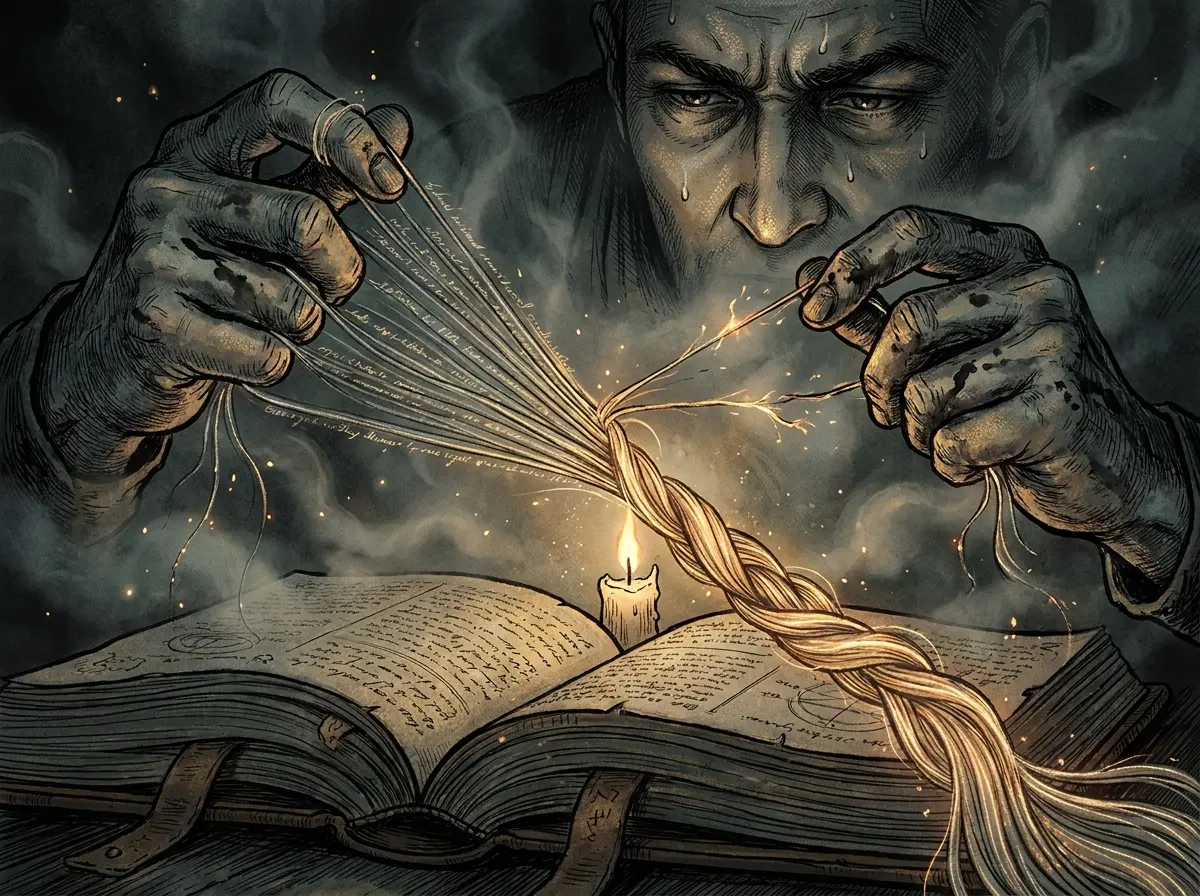
Not erasure. The Ledger would not erase, he knew that now in his teeth. But the night of the Ashen had taught him the foreclosure held because it was one claim, sworn, with a single counter-party. Four small tangled debts were the opposite: four counter-parties, four rates, four maturities, leaning on each other, none of them sworn into anything as solid as a foreclosure. Loose script. And loose script, Kell suspected — sitting in a net-mender's kitchen with his heart going and the dark line ticking up on his soul — loose script could perhaps be braided. Drawn together. Consolidated into a single obligation that did not flow downhill, that ended where the borrower ended, that a son would not inherit because it would be sworn to terminate with the soul that bore it.
He would have to reach it through a ledger. He would have to do it at the House, at night, off the books, in a building where an honest auditor was already watching him and a clean liar was somewhere in the walls, and he would have to pay for it, drams he did not have, at one part in eight, monthly, to a creditor with no name.
"Come to the House," Kell heard himself tell her. "The side door on Scrivener's Lane. After the dusk bell, the day after tomorrow. Bring nothing." He paused. "And don't tell anyone it was me. Tell them — tell them you found a clerk's error. In your favor."
Sela looked at him the way Brann had, the way the Ashen had, the look he was collecting like coins in a jar he could never spend: the look of a person handed something they had stopped letting themselves want.
"The first one in the history of the world," she said.
"They're getting more common," said Kell, and did not yet know how true he had just made it, or how many of them would be standing in the fog on Scrivener's Lane by the time the season turned, brooms and nets and short loaves, the whole quiet downhill country of the indebted, learning the one thing that the Counting Houses of Vell had built four hundred years of marble and chain to ensure no one ever learned: that the Ledger could be made to balance the other way.