Everything Must Go – Chapter 7: The Hair Wreath, Part One
Mystery stories
share this story
The first snow comes on the second of December, wet and heavy, and by morning Kiln Road is a white tunnel under the maples and the barn roof is ticking as it warms.
I've been reading one ledger a week. That's the rule I made after the storage unit, standing in the barn at dawn with the last page of 2026 under my hand: one a week, start to finish, every line, the way he wrote them. Not skimming for HELD. Not hunting. Reading. If I skim, I'll find what I'm looking for and miss what he was telling me.
I'm on 2019 now. It's a good year for the business and a bad one for my patience. Hal's name is in it forty-one times. A consigned highboy. A run of quilts. Two barn clearances split down the middle, H.B. half, W.S. half. A dinner in March, entered for some reason with the receipt stapled to the page, two steaks at a place in Rhinebeck, and under it in green ink: H. paid. Told him about the knee. I don't know whose knee. I read it anyway.
The county sends a reminder the same week, on yellow paper this time instead of white, which is how the county tells you it's serious. Real property tax, delinquent. Parcel 14.2-3-11, Kiln Road. Balance $11,300.00. Final date for payment before enforcement proceedings: December 15.
I sit at the desk and do the arithmetic I've been not doing since October. The Hart job paid forty-two hundred. The Koenig house paid thirty-one. The garage full of outboard motors in Rosendale paid nine hundred and a box of fishing lures Theo refuses to give back. After the van insurance, the propane, Theo's wages and groceries for two people who mostly eat at the Kill Diner, there is six thousand nine hundred dollars in the business account.
I'm forty-four hundred dollars short, with thirteen days to go.
I put the yellow paper under the 2019 ledger, so I can't see it, and keep reading.
Lena calls on the Thursday while I'm on November.
"The storage place kept the October footage," she says without hello. "Camera over the counter. Cash, two envelopes, a man in a tweed coat and a flat cap, takes the cap off to sign the book." A pause. "It's him."
"Did you talk to him?"
"I had coffee with him. At the Kill Diner, which he picked. Very friendly. He said he'd paid your father's unit out of friendship, because Walt would have hated to see strangers pawing through his things at auction, and he didn't want to burden you while you were grieving." I hear her drink something. "He said he'd have told you eventually. He said it in a way that made me feel slightly rude for asking."
"The gate log. The scratches on the lock."
"He said he went to check the unit was secure after the paperwork, and couldn't remember the combination for the padlock, and gave up. He laughed about it. Getting old." She lets that sit. "He knew I'd come, Mae. He'd already decided what he was going to say before I sat down. I've interviewed people like that. They're very relaxing to talk to and you come out with nothing."
"So that's it."
"That's not anything. That's me telling you I'm still second." She hangs up the way she always does, before I can thank her.
The Vosburgh house is on River Road, half a mile past the bridge, a white Greek Revival with four square columns and a fanlight over the door, the kind of house painted on Christmas cards for people who have never lived in one. The Vosburghs built it in 1838 and never sold it. Miss Harriet Vosburgh died in it on the twenty-ninth of November at the age of ninety-seven, the last of them to carry the name in Callow Falls.
I know the name before I know the house. It was on the frame that went missing from Eleanor Hart's back parlor: Mr. J. Vosburgh, paperhanger, for papering the parlor complete, $41.00. Harriet was his great-granddaughter. In this valley everything is somebody's great-granddaughter.
Her great-nephew Peter meets me on the porch. He's fifty-four, the grandson of Harriet's brother Edwin, a high school band director from Poughkeepsie with a soft voice and a scarf his students obviously knitted for him. He looks like a man who has been handed a forty-room house and a deadline.
"Hal Brewer called me the morning after she died," he says. "Before the funeral home did. He said he'd take care of the sale and recommended you for the clearing. I hope that's all right. Everybody says he's the man to call."
"Everybody does," I say.
"What was she like?"
He thinks about it properly, which I like him for. "Strict. Funny, if you were paying attention. She taught Sunday school for fifty years and never once said the word God outside of church. She sent every kid in the family a two-dollar bill on their birthday until she was ninety-five, with a note that said Don't spend it all in one place, which, with two dollars, was a joke it took me till college to get." He looks up at the house. "She never married. People used to say she was waiting for somebody who died in the war. She never said. She wasn't a person you asked."
We walk it. Clockwise. The house is cold and very clean and full of things nobody has moved since the Second World War. In the front hall a tall clock that stopped at ten past four. In the dining room a set of Canton china in a corner cupboard. In the library, shelves of farm almanacs back to 1840, every year in order, with Vosburgh written inside each cover in a different hand.
The parlor is at the back, facing the river, and on the long wall over the sofa, in a deep walnut shadowbox with a convex glass front, is the wreath.
I've cleared houses with hair work before. Brooches, mostly, and the occasional watch chain braided out of somebody's grandmother. Twice I've seen a full mourning wreath. Never one like this.
It's a horseshoe, open at the top, nearly two feet across, built on fine wire and made almost entirely of human hair. The hair has been wrapped and looped and twisted into flowers, leaves, buds and little curling tendrils, and every flower is a different person: dark brown, chestnut, a red that has faded to copper, grey, white, a blond so pale it's almost silver. Seed pearls and tiny jet beads sit at the hearts of some of the flowers. Under each one, pinned into the velvet backing on a slip of paper no bigger than a fingernail, is a name and a year in brown ink.
"My great-great-grandmother started it," Peter says behind me. "After her husband died in 1882. The idea was that you added someone when they passed. The oldest are out at the ends. The center is whoever died last. When somebody new died, they moved the center flower to the side and put the new one in." He touches the glass, very lightly, the way you'd touch a sleeping baby. "Aunt Harriet learned how from her grandmother. She was the one who kept it going. She's not in it, of course. Nobody was left to put her in."
I read the labels from the left. Jacob. 1882. The paperhanger. Hannah. 1901. Cornelius. 1918. A run of names I can feel from the dates, the flu, a war, a farm accident. Mother. 1952. Edwin. 1979. Peter's grandfather. And near the middle, side by side, two flowers almost touching.
On the left, a dark chestnut rose, the hair still glossy after eighty years. Agnes. 1946.
In the very center, smaller than all the others, a little bud made of hair so fine and so pale it looks like spun sugar. Baby hair. Nobody's hair is like that after the age of two.
June. 1946.
Which is wrong. By the rule Peter just explained, the center belongs to whoever died last, and Mother. 1952 and Edwin. 1979 both died after 1946. They should be in the middle. Instead they've been worked in out toward the ends, between the older flowers, carefully, so the shape stays even. Whoever kept this wreath for the last eighty years added every new death around that little bud and never once moved it out of the center.
"Who's June?" I ask.
Peter is quiet for a moment.
"I don't know," he says. "There's no June in our family. I asked Aunt Harriet once when I was a kid, and she sent me outside."
The family Bible is in the library, on a stand of its own, the size of a cinder block. The births and deaths are written in the front in seven different hands over two hundred years. Agnes Vosburgh, born the ninth of January, 1927. Died the third of March, 1946. Pneumonia. Harriet Vosburgh, born 1929. No death yet; nobody left to write it.
There's no June. Not born, not married, not dead.
But somebody made a flower for her out of a baby's hair, and put it in the place of honor, in the center of a wreath that has only ever held the dead.
The woman knocks on Saturday morning while Theo and I are wrapping the Canton china.
She's in her early forties, in a green parka and hospital clogs, with dark hair pulled back and a manila envelope held flat against her chest with both arms. When I open the door she looks past me into the hall, at the stopped clock, at the stairs, as if she's checking them against a picture in her head.
"I'm sorry," she says. "I know this is a strange thing to do. I read the obituary in the Freeman. My name's Nora Keene. I'm a nurse at Vassar Brothers in Poughkeepsie." She takes a breath. "I think Harriet Vosburgh might have been my great-grandmother. Or my grandmother's something. I don't know what. That's why I'm here."
Peter comes out of the library. He hears the last part. I watch his face go through three things, fast, and settle on wary.
We sit her down in the kitchen, because the parlor feels wrong, and Theo makes coffee on the old stove because nobody else can work it. Nora puts the envelope on the table and doesn't open it.
"My grandmother was June Keene," she says. "She was adopted. She was born in Albany in March of 1946 and placed with a family in Poughkeepsie when she was about three weeks old. She always knew. She never knew anything else." Nora turns her cup around on the table. "She died in 2019. The next year New York changed the law so adoptees and their descendants could get the original birth certificate instead of the amended one. So I sent away for it. For her. I don't know why. It took eleven months."
She opens the envelope and slides out a photocopy.
It's a 1946 New York State certificate of birth, typed on a manual typewriter with the e slightly high. A female child, born at a private address in Albany on the third of March, 1946. Father: blank. Under Mother, in capitals:
HARRIET VOSBURGH. AGE 19. RESIDENCE: CALLOW FALLS, N.Y.
Peter makes a sound that isn't a word.
"Aunt Harriet never had a child," he says. "She never married. She was the town spinster for seventy years, she taught Sunday school, she was..." He stops. "She was seventeen in 1946. She was born in 1929."
"I know," Nora says quietly. "I did the math. It doesn't fit. Nothing about it fits. But that's the name on the paper, and it's the only name I've got." She looks at me, not at Peter, which I'll think about later. "I'm not here for money. I want to be really clear about that. I know how it looks. I just want to know who she was."
"The baby," I say.
"My grandmother." She nods. "Her name was June. The family named her that. They said she came in March but she always felt like June to them."
Theo, at the stove, has gone completely still with the coffeepot in his hand. He's looking at me over her head. I know what he's thinking because I'm thinking it.
"Ms. Keene," I say. "Would you come into the parlor for a minute? There's something I'd like you to see."
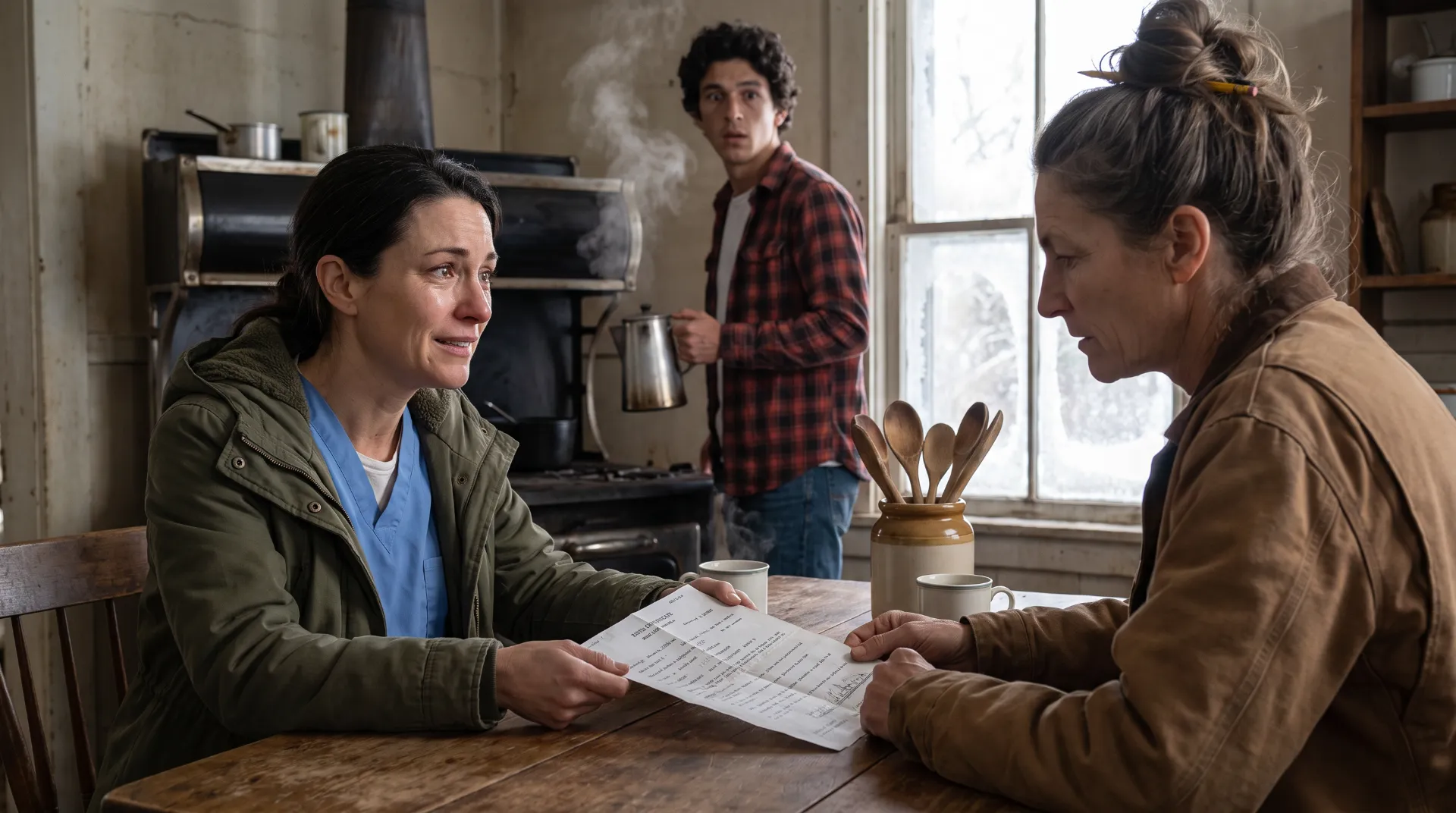
Nora Keene stands in front of the wreath for a long time without saying anything. She doesn't touch the glass. She reads the labels the way I did, left to right, all the dates, until she gets to the middle, and then she stays there.
"That's her," she says finally. "That's her hair."
"We don't know that."
"I know. I know we don't." She wipes her face with the back of her wrist, quickly, like someone used to doing it on a shift. "But somebody in this family cut a baby's hair in 1946 and kept it for eighty years. Somebody named her June."
Peter is in the doorway with his arms folded. His voice, when it comes, is strained but not unkind.
"I'm sorry. I really am. But I need to tell you both something, because you'll hear it anyway." He unfolds his arms and takes out his phone. "The wreath isn't part of the estate anymore. Hal Brewer told me on Thursday. Aunt Harriet sold it to him in October. Privately. For a collector of mourning art in Connecticut. Twenty-eight hundred dollars. He's coming to pick it up on Monday."
"In October," I say.
"He sent me a photo of the bill of sale." Peter holds the phone out. "So I wouldn't be surprised."
It's a single sheet on Brewer & Lowe letterhead, the little engraved church with the gavel. Received from H. Brewer the sum of $2,800 for one Victorian hair wreath in walnut case, sold as seen. Dated the eleventh of October. And at the bottom, a signature: Harriet A. Vosburgh, in a careful, upright, slightly old-fashioned hand.
I look at it for a long time.
"Peter," I say. "When did your aunt have her stroke?"
"The second week of September. She was in hospice at the house from then on. She couldn't..." He stops. I watch him hear what he's about to say before he says it. "She couldn't use her right hand. She couldn't hold a spoon. The nurse fed her."
Nobody says anything. In the hall, the tall clock goes on showing ten past four.
I take my notebook out of my coat and write down what I see, not what I think it's worth. Bill of sale, 10/11. Signed H. A. Vosburgh. H.V. right hand paralyzed since mid-Sept.
Then I underline the date, twice, the way my father underlined the word HELD.
Peter drives Nora to the diner for lunch, because, he says, if they're going to be related he'd like to find out over pie. They're both being careful with each other. I like them for it.
Theo and I stay with the china. Around two, when the light in the parlor goes low and gold across the river, I go back in alone with the inventory sheet and my father's loupe.
I don't touch the glass. I look at the case. Walnut, hand-cut dovetails, the glass front set into a hinged frame with two small brass hooks. I've seen a dozen of these. The back is always the same: a thin board panel, papered over with brown kraft and gummed tape to keep the dust out, sealed once by whoever framed it and never opened again, because nobody wants to touch a dead family's hair.
I lift the case an inch away from the wall on its wire and look behind it with my phone light.
The brown paper is old, the color of strong tea, brittle at the edges. The gummed tape around three sides of it is the same, cracked and lifting. On the fourth side, along the bottom, there's a strip of tape that's whiter than the rest. Newer. It's been laid down carefully over the old, very straight, by somebody with steady hands and a reason to want it to look like it had never been touched.
I photograph it with a pencil beside it for scale. I put the case back exactly as it was.
"Somebody opened the back," I tell Theo in the kitchen.
"Recently?"
"This year. Paper tape yellows. That strip hasn't had time." I'm looking around the kitchen while I talk, because kitchens are where people leave things in plain sight. There's a calendar from the oil company, a list of phone numbers taped inside a cupboard door, a jar of wooden spoons. On the refrigerator, under a magnet shaped like a cow, there's a clipboard.
Hudson Valley Hospice. Visitor Log. Please sign in.
The hospice nurses were here from September until the twenty-ninth of November, and they were strict about their log. Every visitor, every day, signed in and out. The minister. The nurses themselves, initials only. A neighbor with soup. Peter, every Sunday, in a band director's flourishing hand.
On the eleventh of October, in a long, confident signature I've seen on a hundred auction checks:
H. Brewer. In 2:05. Out 3:40.
An hour and thirty-five minutes. The day of the bill of sale. In a house where the only other person awake was a nurse in the kitchen, and the woman who owned the wreath couldn't hold a spoon.
Theo reads it over my shoulder and swears quietly. I let him.
I take the clipboard off the fridge, photograph every page, front and back, and put it back under the cow exactly where it was. Then I call Lena from the porch, in the cold, with the river going by grey under the bridge.
"I've got something that isn't string," I say.
"I'll be the judge of that," she says. "Read it to me."