Everything Must Go – Chapter 1: The Green Book
15 min read
Mystery stories
share this story
Dennis Hart meets me on the porch with the keys already off his ring.
There are eleven of them on a loop of green yarn, and every one has a paper tag. FRONT. BACK. CELLAR. SHED. CHEST. The handwriting is small and upright, and it belongs to a woman who died nineteen days ago at ninety-one.
"Ten days," Dennis says. "Hal told me you could do it in ten."
"Ten if nothing's in the walls." I take the keys.
He doesn't smile. He's fifty-eight, in a quilted vest and suede loafers that have never met gravel, and he has parked his Audi at the bottom of the drive with the nose pointed at the road. People park like that at funerals. He hands me a folded contract. I already know what it says, because Hal's office drew it up and sent it to me on Friday, but I read it again on the porch while Dennis checks his phone.
Everything in the house goes to Brewer & Lowe Auctioneers for the January sale. Sutter Estate Services clears, sorts, packs, hauls and sweeps. Flat fee of four thousand two hundred dollars, half up front.
An estate sale in a house this size would pay me thirty percent of the gross. On a decent weekend that's three times the fee. I know it, Dennis doesn't care, and Hal counted on both.
The county wants eleven thousand three hundred dollars in back taxes on my father's barn by the fifteenth of December. I sign on the porch rail.
"She kept everything," Dennis says. "Labeled, filed, alphabetized. Right up until the last few months."
"What happened in the last few months?"
He stops on the second step. "She got confused. Started saying the back parlor made her sick. Headaches, her stomach. She had the aide shut the room up, towels under the door, the whole thing." He shakes his head. "She thought the walls were trying to kill her."
"Did a doctor see her?"
"Heart failure. She was ninety-one, Ms. Sutter." He says my name like he's reading it off an invoice. "If you find cash, call me. People hide cash."
The Audi backs out. Behind me the van door slams, and Theo comes up the walk with two coffees from the Kill Diner and his phone already up.
"Don't," I say.
"I'm just getting the exterior."
"The heir hasn't signed a release."
"The heir," Theo says, "just left skid marks on a dead woman's driveway." But he lowers the phone and hands me a coffee, which is how I know he'll film anyway and post nothing until I say so. We have an arrangement. His account is called Dead People's Stuff and has forty-one thousand followers. In exchange for never posting anything that identifies a house, he gets to film the strange things we find inside them. Some months the account brings in more calls than the Yellow Pages ad my father paid for until the day he died.
The Hart house is a Second Empire pile from 1872, three storeys under a mansard roof, slate shingles in fish-scale rows, a porch that wraps two sides and sags on the north. Somebody painted it plum and cream in the eighties and nobody has painted it since. From the walk I count four broken shutters and one window with a bedsheet tacked over it from the inside, ground floor, back left.
I write that down.
My father had one rule about houses, and he said it so often that it's on the inside cover of every notebook I own, in his green ink and his draftsman's capitals: WALK IT BEFORE YOU TOUCH IT. CLOCKWISE. WRITE WHAT YOU SEE, NOT WHAT IT'S WORTH.
He died in February in the barn, between a Hoosier cabinet and a crate of Fiestaware. I was the one who found him. I'm still wearing his coat, which is too wide in the shoulders and smells of two-stroke oil and Lava soap, and every morning I put it on and tell myself I'll buy my own once the taxes are paid.
I unlock the front door with the key marked FRONT.
The house is clean.
That's the first thing, and it bothers me more than dirt would. Most of the houses we clear have been dying as long as their owners. You find the room where the person gave up: the dishes, the mail in drifts, the chair with the shape of a body pressed into it. Eleanor Hart's front hall has a runner vacuumed in one direction and a hall table with a brass tray for keys. The mail in the tray is from the week she died, sorted by size.
Clockwise. The front parlor first: horsehair sofa, two lady's chairs, a Steinway upright with a hymnal open on the stand. The keys are dusted. The piano stool is set at the height of a small woman. I write: Steinway upright, c. 1905?, ebony, ivories intact, tuned recently (check sticker). The tuner's sticker inside the lid says June.
Dining room. A table for ten with all its leaves stored underneath in felt sleeves. A sideboard full of Haviland in a cornflower pattern, a hundred and twelve pieces according to the typed inventory taped inside the door. Eleanor Hart did my job for me forty-five years early and dated it: Inventory of dining room china, rev. March 1981.
"Okay," Theo says behind me. "That's a little scary."
"That's a gift."
"It's a gift from a woman who typed a list of her plates. Aunt Mae, she revised it."
The kitchen has a pantry with mason jars of dried beans, rice and flour, every lid labeled and dated. The newest date is August. After August there is nothing new in the pantry at all.
I stand there longer than I need to. In nineteen years of claims I learned to look for the place where a record stops, because a record that stops usually means a person who stopped. Something changed in this house in August.
Theo has drifted ahead. He's at the end of the back hall, where the light goes brown, and he says, "Hey," in a voice I don't like.
The door to the back parlor has a bath towel rolled along the bottom and blue painter's tape run all the way around the frame, top and sides, overlapping at the corners. Someone did it carefully. The tape is the good kind, the kind contractors buy. I press a fingernail into the corner and it gives and sticks again.
"That's not old," I say.
"How can you tell?"
"Old tape goes brittle. It lifts at the edges and the glue turns orange." I peel the strip back slowly. "This went up a few weeks ago. Maybe a month."
"Dennis said the aide sealed it."
"Dennis said the aide sealed it sometime in the last few months. Eleanor died nineteen days ago." I pull on a pair of nitrile gloves from my back pocket. I have carried gloves in that pocket since my first water-damage claim in 2006, and I've never found a reason to stop. "So either the aide came back after the funeral, or somebody re-taped it."
"Or the aide did it twice."
"Or that." I write it down. Back parlor door: towel, painter's tape, recent. Name of aide? Who has keys?
The door opens inward with a long, dry complaint.
It's the bedsheet room, the one I counted from the walk. The light comes through the sheet weak and tinted, and it takes my eyes a moment to understand why everything is green. The walls are papered floor to ceiling in a pattern of ferns, dark fronds on a ground of bright, chemical green, a green no plant has ever made. It's faded to pond water where the sun reached it and still violent in the corners where it didn't. Nobody redecorated this room in a hundred and fifty years.
There's furniture under dust sheets. A secretary desk, a fainting couch, a glass-fronted case of shells. On the long wall facing the window there's a rectangle of brighter paper about two feet by three, with two nail holes at the top corners. Something hung there for a long time and came down not long ago, because the dust on the floor beneath it is scuffed in an arc.
"Don't touch the walls," I say.
"I wasn't going to touch the walls."
"Don't lean on them either."
Theo, who has been leaning on the door frame, straightens. "Why?"
"Because I don't know what's in that green." I don't, yet. I know what I've read in a hundred claims files about old houses. I know that a woman who dated her pantry to the week stopped in August, and spent the last months of her life telling people this room was making her sick, and everyone decided she was confused. Adjusters get paid to wonder whether everyone is right.
I photograph the rectangle on the wall, the nail holes, the scuffed arc of dust. I photograph the window: the sheet is fixed to the frame with upholstery tacks, and the sash behind it has been painted shut. I write it all down. Then I close the door and press the tape back as well as it will go.
We finish the ground floor by eleven and the second floor by one. Theo eats a gas-station sandwich on the back steps while I walk the third floor alone. It's mostly trunks, and a dressmaker's form with a half-finished jacket pinned to it. The jacket is wool, dove grey, the sleeves basted in. A paper pattern is folded on the form's shoulder, dated in Eleanor's hand: Sept.
I stand in front of the form longer than I stood in the pantry. A confused woman doesn't start a jacket in September. A frightened one might. You make things to prove to yourself there will be a next month.
Eleanor's bedroom is on the second floor at the front, the best room in the house, with morning light through two tall windows. The bed is made. A cedar blanket chest stands at its foot, the old kind with iron strap hinges and a lock plate shaped like a shield. I already have the key: CHEST, on the green yarn, in the same upright hand.
Theo comes up the stairs two at a time when I call him, wiping mustard off his fingers onto his jeans. "Is it cash? Tell me it's cash."
"Gloves," I say, and toss him a pair.
The lock turns easily. Someone kept it oiled. The chest smells of cedar and lavender, and the top layer is quilts, four of them, folded with tissue between: a Double Wedding Ring, a Log Cabin, a Sunbonnet Sue that some child loved half to death, and a crazy quilt in velvet and silk with E.M.H. 1951 worked in feather stitch. Good quilts. Hal will put them in the textile session and get a few hundred apiece. I lift them out one at a time and lay them on the bed.
Under the quilts is a flat package the size of a small tabletop, wrapped in black oilcloth and tied with butcher's twine in a crossed knot.
Theo's phone is up. I don't stop him.
The twine is new, white, still stiff. The oilcloth underneath is old and cracked along the folds. I cut the twine with the knife on my keyring, fold the oilcloth back, and look at the book for a while before I touch it.
It's a folio bound in dark cloth gone brown at the edges, with a spine of cracked leather. It's huge. I measure it because I measure everything: twenty-two inches by thirty. Stamped in gilt on the front board, most of the gold rubbed away, is a title I have to tilt toward the window to read.
SHADOWS FROM THE WALLS OF DEATH.
"Oh, come on," Theo says.
I open the front board. The title page is plain type, no illustration. Shadows from the Walls of Death: Facts and Inferences Prefacing a Book of Specimens of Arsenical Wall Papers. Under it, the author's name, Kedzie, and the year, 1874. The next several pages are an essay. I don't read it. I turn past it with two gloved fingers, by the corner, and come to the first specimen.
It's a sheet of wallpaper pasted to the page. Small brown leaves on a cream ground, pretty, the kind of paper you'd put in a nursery.
The next page is a green trellis of morning glories. The next is a block print of blue and gold diamonds. The next is a green so loud it looks wet.
"Aunt Mae," Theo says quietly. "What is this?"
"Arsenic," I say. "Wallpaper with arsenic in the colors. Somebody collected it to show people what to tear down." The second part is a guess from the title, but only partly. In 2014 I worked a claim on a farmhouse in Schoharie where the insurer refused a mold remediation because the lab found arsenic in the plaster dust instead. The lab report had a page of history at the back. Scheele's green. Paris green. Victorian wallpaper so poisonous that people blamed it for sickrooms full of children. I remember that report because I had to explain it to a grandmother whose grandchildren had slept in that room for six summers.
"Is it going to kill us?"
"Not through gloves. Don't touch your face. Don't lick your finger to turn a page, which I know you do."
"I don't do that."
"You did it with the Haviland inventory an hour ago."
He's already typing. I keep turning. I'm counting, because counting is how I keep my hands steady. Sixteen specimens. Twenty. On the twenty-seventh I stop.
It's the parlor. Dark fern fronds on a ground of bright chemical green. Not something like it. The same paper, the same repeat, the same fronds curling the same way. In 1874 a doctor in Michigan pasted this into a book as an example of what never to put on your walls, and two years earlier, a family named Hart had put it on theirs.
"There's like four of these in the world," Theo says. He holds the phone out. "Four known copies. Michigan State has one, University of Michigan has one, Harvard's medical school, and the National Library of Medicine. He printed a hundred and mailed them to libraries, and the libraries got scared and threw them out. Aunt Mae. This is number five."
"This is a book in a cedar chest."
"That's what I said."
"You said it with an exclamation mark." I hand the phone back. What I'm thinking isn't a price. It's that there is no price, which is worse. A thing with no sale record is worth whatever the two people who want it most are willing to do. In my old job we had a word for an object like that. We called it an exposure.
I keep counting. Forty. Sixty. At seventy-one I find what I've been half expecting since I saw the new twine.
The book is sewn in gatherings, and between the seventy-first specimen and the seventy-fifth, three leaves are missing. They didn't fall out. A blade went down the gutter close to the stitching and took them out clean, leaving three stubs about a quarter inch wide.
I put on my reading glasses and bend close.
The edges of every page in this book are the color of weak tea, a hundred and fifty years of air working on the paper. The cut edges of the three stubs are white.
"Theo. Look at this. Don't touch it."
He looks. "So someone cut pages out."
"Recently. Paper yellows at the edge first. Give it a few more years and these would match the rest." I photograph the stubs from three angles with a pencil beside them for scale. "Somebody took three pages out of this book in the last year or two, wrapped it back up, tied it with new string, and put it at the bottom of a locked chest."
"Eleanor?"
"Maybe." I look at the specimen just before the gap, number seventy, and the one just after it. Both green.
"Why would you cut pages out of a poison book?"
"To have the poison without the book." I say it before I've decided to, and Theo goes quiet in a way he hasn't since he was eleven.
I don't like having said it. I write down what I see instead. Lot 1. SHADOWS FROM THE WALLS OF DEATH, Kedzie, 1874. Folio, 22 x 30 in. Pasted specimens. No. 27 matches back parlor paper. Three leaves cut out after no. 71, fresh white edges. Wrapped in oilcloth, tied with new white twine. Locked cedar chest, master bedroom.
Then I sit on the edge of a dead woman's bed with the book across my knees and think about the contract on the porch rail.
Everything in the house goes to Brewer & Lowe. The book is in the house.
"We have to tell somebody," Theo says.
It's three-thirty. We've wrapped the book back in its oilcloth without the twine, which I've bagged, and put it back in the chest under the crazy quilt. I've locked the chest and put the key in my coat pocket instead of back on the yarn. We're in the kitchen because it's the room furthest from the back parlor.
"We're going to."
"Like, the cops."
"And tell them what? A ninety-one-year-old woman died of heart failure, and we found an old book in her blanket chest."
"A poison book with pages missing, in a house with poison walls, where she said the walls were making her sick."
"Said to who?"
He opens his mouth and shuts it.
"To Dennis," I say. "Who told me. Who wants the house empty in ten days and everything sold through Hal." I rinse my coffee cup in Eleanor's sink out of habit, then wish I hadn't. "If I call the county tomorrow, the first thing a deputy does is call Dennis. The second thing Dennis does is call Hal. By Wednesday that book is sitting in a case in the vestry at Brewer & Lowe with a reserve on it, and the three pages are still wherever they are."
"So what do we do?"
"We do the job. We pack the dining room. I find out who the aide is and who had keys. And you don't post anything."
"I wasn't going to post it."
"You were going to post it tonight with a sound that goes bum, bum, bum."
He looks at the floor and runs a hand through his hair, which is answer enough.
We pack the Haviland. It's slow, honest work, the kind I like: newsprint for the plates, tissue for the cups, a hundred and twelve pieces checked off against a list made in 1981. Theo is good at it when he stops talking. The light in the dining room goes from white to gold. At ten past four I've got a gravy boat in one hand and a sheet of newsprint in the other when I hear tires on the gravel.
It isn't the Audi.
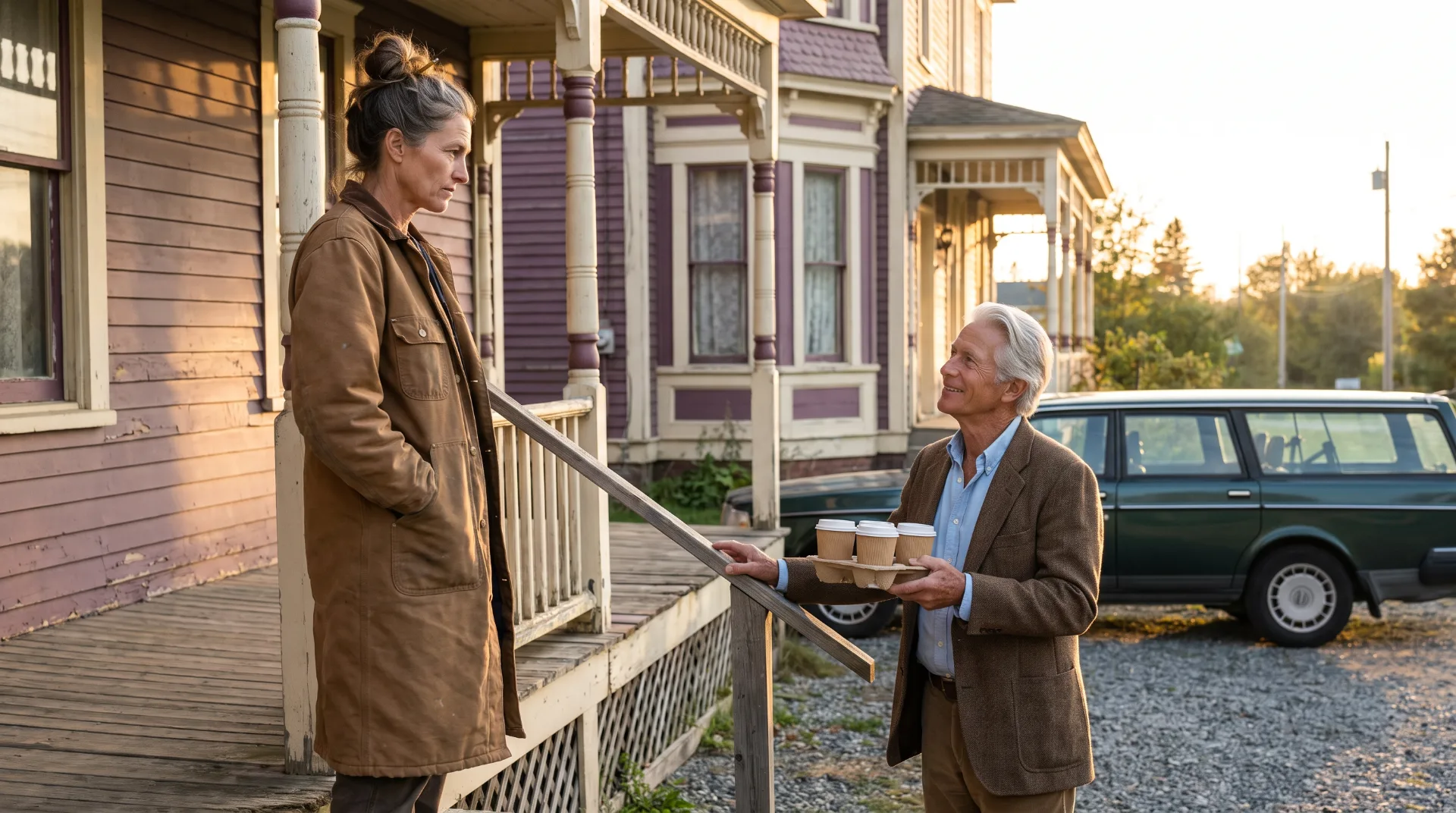
A dark green Volvo wagon pulls up behind my van and parks nose in, close to the porch steps. The man who gets out takes his time. He reaches back into the car for a cardboard tray with three cups in it, closes the door with his hip, and looks up at the house for a long moment, the way he looks over a lot before he opens the bidding.
"Is that Hal?" Theo says.
I put the gravy boat down.
Hal Brewer is sixty-eight and has looked sixty-eight for about fifteen years. Tall, straight, silver hair swept back off a tanned forehead, a tweed jacket that cost more than my van is worth. In February he stood at the front of the Methodist church on Main Street and spoke about my father for twenty minutes without notes. Half the town cried. So did I. He was Walt's closest friend for forty years, and he has known me since the day I was born.
I meet him on the porch. He holds out the tray.
"Kill Diner. Black for you, and I took a guess on Theo." He smiles past me. "Theo. How's your mother's knee?"
"Better," Theo says from the doorway. "She's walking."
"Good. Tell her the Brewers send their love." Hal turns back to me, and his face settles into the expression he wears at viewings, sympathetic and patient. "How's the house treating you?"
"It's a clean house."
"Eleanor was a remarkable woman. She ran the historical society for thirty years. Your father and I cleared her sister's place in '98, did he ever tell you?" He sips his coffee. "Dennis says ten days. I told him you're the best in the valley. I hope that was all right."
"It got me the job."
"It did." He nods through the window at the boxes in the dining room. "You're on the Haviland already. Good. That's a Wednesday lot." Then, as easily as if he were asking whether the porch light worked: "And Eleanor's wallpaper book. Have you come across it yet?"
I have told no one. Theo has told no one. The book has been out of the chest for less than two hours, and the only people who have seen it are standing on this porch.
Behind Hal, Theo has his phone in his hand, and I watch him check it. He looks up at me and gives one small shake of the head. Not posted. Not sent. Nobody.
Hal is waiting. His smile is exactly as warm as it was a second ago. His eyes haven't left my face.
"I appraised it for her," he says helpfully. "Years ago. Big thing, black wrapping. Green inside. You can't miss it."
The key to the cedar chest is in my coat pocket, my father's coat pocket, and my hand has closed around it without my telling it to. I can feel the edge of the paper tag. CHEST. In her small, upright hand.
"Not yet," I say.