Everything Must Go – Chapter 8: The Hair Wreath, Part Two
Mystery stories
share this story
Hal comes for the wreath at ten on Monday morning, in the green Volvo, with two of his yard men in a box truck behind him and a padded crate already built to size.
Lena is on the porch when he pulls in. So is Peter. So am I.
I watch him take it in from the driver's seat before he gets out: the deputy's Explorer parked across the end of the drive, the executor on the step with his arms folded, Walt Sutter's girl in Walt Sutter's coat. He doesn't hesitate. He gets out smiling, with a cup of coffee, and comes up the walk the way he comes up every walk in this valley, like a man arriving at a party in his honor.
"Deputy. Peter. Mae." He looks at the three of us. "This looks serious."
"The wreath stays, Mr. Brewer," Peter says. His voice shakes a little at the start and steadies. "I'm the executor. I haven't agreed to any sale, and I don't believe my aunt did either."
"Of course." Hal nods, sympathetic. "I understand completely. Harriet was very frail by October. I should have explained." He sips his coffee. "She couldn't manage a pen on her own, so she asked me to guide her hand. It's quite common with stroke patients. The nurse was in the house."
"The nurse was in the kitchen," Lena says. "I spoke to her yesterday. Beverly Ahn. She says you sat with Miss Vosburgh alone for an hour and a half, and she didn't see anything signed, and Miss Vosburgh didn't speak while you were there because Miss Vosburgh hadn't spoken since September."
Hal looks at her with polite interest, as if she's told him something about the weather in another state.
"Then I'm afraid it'll be my word," he says. "And Harriet's, God rest her, which nobody can ask for now." He turns to Peter, and his voice drops, warm and fatherly. "I'm not going to press a grieving family over twenty-eight hundred dollars, son. Keep it. Consider the sale void. I'll tell my collector it fell through." He looks at the house, at the river, at the parlor windows. "She loved that thing. Maybe it belongs here."
He shakes Peter's hand. He nods to Lena. He doesn't look at me at all, which is how I know he's angry.
The box truck backs out with the empty crate still in it.
"That's it?" Peter says, when the Volvo's gone. "He just leaves?"
"He just leaves," Lena says. "And if this ever goes in front of anybody, a sixty-eight-year-old auctioneer who's been on the church board for thirty years says a dying woman asked him to help her hold a pen, and a jury believes him, because he's Hal." She looks at me. "He knows that. That's why he left. He doesn't fight when he can't win. He waits."
"For what?"
"For you to get tired," Lena says, and goes to her car.
Peter and I stand in the parlor afterward, in front of the wreath, with the river going by grey behind the glass of the windows.
"Why does he want it?" Peter asks. "Twenty-eight hundred dollars. Hal Brewer sells a single chair for more than that."
"I don't think he wants the wreath," I say.
"Then what?"
I think about the new strip of tape along the bottom of the case. About Eleanor Hart's framed bill, gone from a wall in the night. About a hollow nickel and a page in my father's handwriting with no lot numbers on it.
"I think he wants whatever people keep behind things," I say. "He's been in this business a long time. He knows where they keep it."
Ruth Kessler knew the Vosburgh sisters the way everyone over eighty in Callow Falls knew everyone: from church, from school, from funerals.
"Agnes was the pretty one," she says. We're in the historical society basement, and she has the 1946 Callow Falls Courier out on the table, the bound volume, enormous and smelling of mice. "Everybody said so. Harriet was the clever one. That's how it went in those days, you got one word and you kept it."
She turns pages carefully, with a fingertip at the corner.
"Agnes went to stay with an aunt in Albany in the fall of 1945. For her health, they said. Harriet went with her to keep her company." She stops at the first week of March 1946 and turns the book toward me. "And then this."
A paragraph in the obituary column, nine lines long. Miss Agnes Vosburgh, 19, elder daughter of Mr. and Mrs. Cornelius Vosburgh of River Road, died on Sunday at the home of her aunt in Albany after a brief illness, of pneumonia. Services were held privately. Interment in the family plot at Callow Falls Rural Cemetery.
"Privately," I say.
"Closed casket, closed church, family only. My mother was furious, she'd baked." Ruth almost smiles. "Harriet came home on the train by herself two weeks later. Sixteen. Seventeen. She never talked about it. She never talked about much of anything after that, if I'm honest."
"Was there a boy?"
Ruth looks at me over both pairs of glasses. She's quiet for long enough that I think she isn't going to answer.
"There was a Brandt boy from Rosendale," she says finally. "Tommy Brandt. He used to drive over in his father's truck on Saturday nights. He was killed on Okinawa in May of 1945." She closes the Courier. "People talked. People always talk. Then Agnes died, and nobody wanted to talk anymore, because talking about a dead girl like that is ugly. So they stopped. And after a while they forgot they'd ever started."
"You didn't forget."
"I'm a historian," Ruth says. "Forgetting is the only thing I'm not allowed to do."
She puts the Courier back on its shelf, then stops with her hand on the spine.
"You know, your father asked me all of this," she says. "Two years ago. Sat right where you're sitting. Same questions, same paper. Agnes, Albany, the Brandt boy." She frowns. "I asked him why, and he said a client wanted to find a relative, and he couldn't say more. I assumed he meant some cousin in Ohio." She looks at me. "He didn't mean a cousin in Ohio, did he?"
"I don't know yet," I say, which is true, and which is getting harder to say.
Nora wants the hair tested. Peter, to his credit, says yes before I've finished explaining what it would mean.
"If she's family, she's family," he says. "I'd rather know than spend the rest of my life wondering if I was a jerk to my cousin."
Theo does the research, which in Theo's case means four hours on his phone and two phone calls to a lab in Albany that does genealogy work for adoptees. He reports back to us in the Vosburgh kitchen with the air of a man who has just become an expert in something.
"Okay. So. Hair you cut off a head doesn't have a root. No root, no nucleus, basically no regular DNA, the kind that says you specifically." He looks at his notes. "That's not totally true anymore, there's new sequencing stuff that can sometimes pull more out of a hair shaft, but it costs thousands and takes months and the lady said for an eighty-year-old baby hair, don't hold your breath. What they do instead is mitochondrial DNA. There's tons of it, even in the shaft."
"And that tells you what?"
"Your mom's line. Only your mom's line. You get your mitochondrial DNA from your mother, she got it from hers, all the way back. Dads don't pass it on at all." He frowns at his phone. "So it can tell you if two people come from the same line of mothers. It can't tell you which mother."
I write that down and underline it. I don't know yet why.
To get a hair out of the wreath, we have to open the case. We do it on Wednesday, on the dining table, with Lena present and filming on her phone, because I want a record that nobody from Brewer & Lowe can argue with. Peter lifts the panel. I cut the new strip of tape along the bottom with a scalpel and fold the brown paper back.
Behind the velvet, pinned to the inside of the backboard, is a small pocket made of the same brown kraft paper, glued along three sides, the size of a playing card. On the front, in Harriet's careful upright hand: For June's children, if they come.
The pocket is open at the top. It's empty.
Lena films it from three angles. Nobody says Hal's name. Nobody has to. An hour and thirty-five minutes alone with a woman who couldn't speak, and a strip of new tape along the bottom of a case that hadn't been opened in eighty years.
Peter sits down on a dining chair as if his legs have gone.
With a pair of tweezers, very gently, I take three hairs from the back of the little pale bud, where it won't show. They go into a paper envelope. Nora swabs the inside of her cheek. Peter goes upstairs and comes back with Harriet's hairbrush, still on her dresser, still full of white hair. The lab charges extra for a rush. Theo pays for it with the money from the outboard motors before I can stop him, and won't discuss it.
The results come back on Monday.
The lab's letter is two pages and very clear. The mitochondrial profile from the hair labeled June matches the profile from Nora Keene. Both match the profile from Harriet Vosburgh's hairbrush. The three samples are consistent with descent through a common maternal line.
Nora reads it at the kitchen table and puts both hands over her face.
Peter reads it twice. "So it's true," he says. "Aunt Harriet. At sixteen. And they sent her baby away and put her sister in the ground and she kept the baby's hair in the middle of that thing for eighty years." He presses the heels of his hands against his eyes. "God. She sent me two-dollar bills."
Theo looks at me across the kitchen. I don't look back. I'm reading the second page of the letter again, the last line, the one in smaller type that labs always put at the bottom where nobody reads it.
Mitochondrial DNA is shared by all individuals in a maternal lineage and cannot distinguish between maternally related individuals such as siblings, or a mother and her child.
That night I break my own rule and take down 2024 again.
I read it in October, the four HELD lines and the March pages and the lot numbers, hunting. I didn't read it the way I read 2019. Tonight I start in January and go line by line with the ruler, and somewhere around eleven o'clock, in September, between a clearance in Kerhonkson and a haul of Hummel figurines nobody wanted, I find a line with no lot number and no price.
VOSBURGH, H. River Rd. Search for a child, b. Albany 3/3/46. Co. records, St. Peter's, Children's Aid. FOUND: J. Keene, Poughkeepsie, d. 2019. G'dau. N. Keene, R.N., Vassar Bros. Told H.V. No fee.
I read it four times.
He found her. In September of 2024, two years before anyone knocked on the door on River Road, my father went to Albany and sat in county records rooms and church offices and an adoption agency with a name from 1946, and found a baby girl born on the third of March, and followed her to Poughkeepsie and to a grave and to a granddaughter who was a nurse. And he came back and sat in Harriet Vosburgh's kitchen and told her. And he didn't charge her.
And he never said a word to me. Not about this, not about any of it.
I call Nora in the morning, early, before she starts her shift, and read her the line.
There's a long silence on the phone. When she speaks, her voice is careful.
"In the fall of 2024," she says, "an older man came to the hospital. To the nurses' station on my floor. He asked for me by name. I was in with a patient, so he left a card with the charge nurse and said to call if I ever wanted to talk about my grandmother. Just that. My grandmother." She breathes out. "I thought it was a scam. Somebody selling genealogy, or one of those inheritance letters. I threw the card in my locker and forgot it."
"Do you still have it?"
"I'm looking at it," she says. "I went and got it after I read the obituary. That's why I came." I hear her turn it over. "Sutter Estate Services. Kiln Road, Callow Falls. W. Sutter. There's a phone number. And on the back, in pen, in capitals: She would like to meet you. Whenever you're ready."
I have to put the phone down on the desk for a second.
"Mae?"
"I'm here."
"I wasn't ready," Nora says. "Not then. I'm sorry. I wasn't ready, and then she had the stroke, and then she died, and I read about it in the paper."
"You came," I say. "That's what she asked for. If they come."
I ask them both to meet me at the cemetery that afternoon. I don't explain why on the phone. Some things you have to stand in front of.
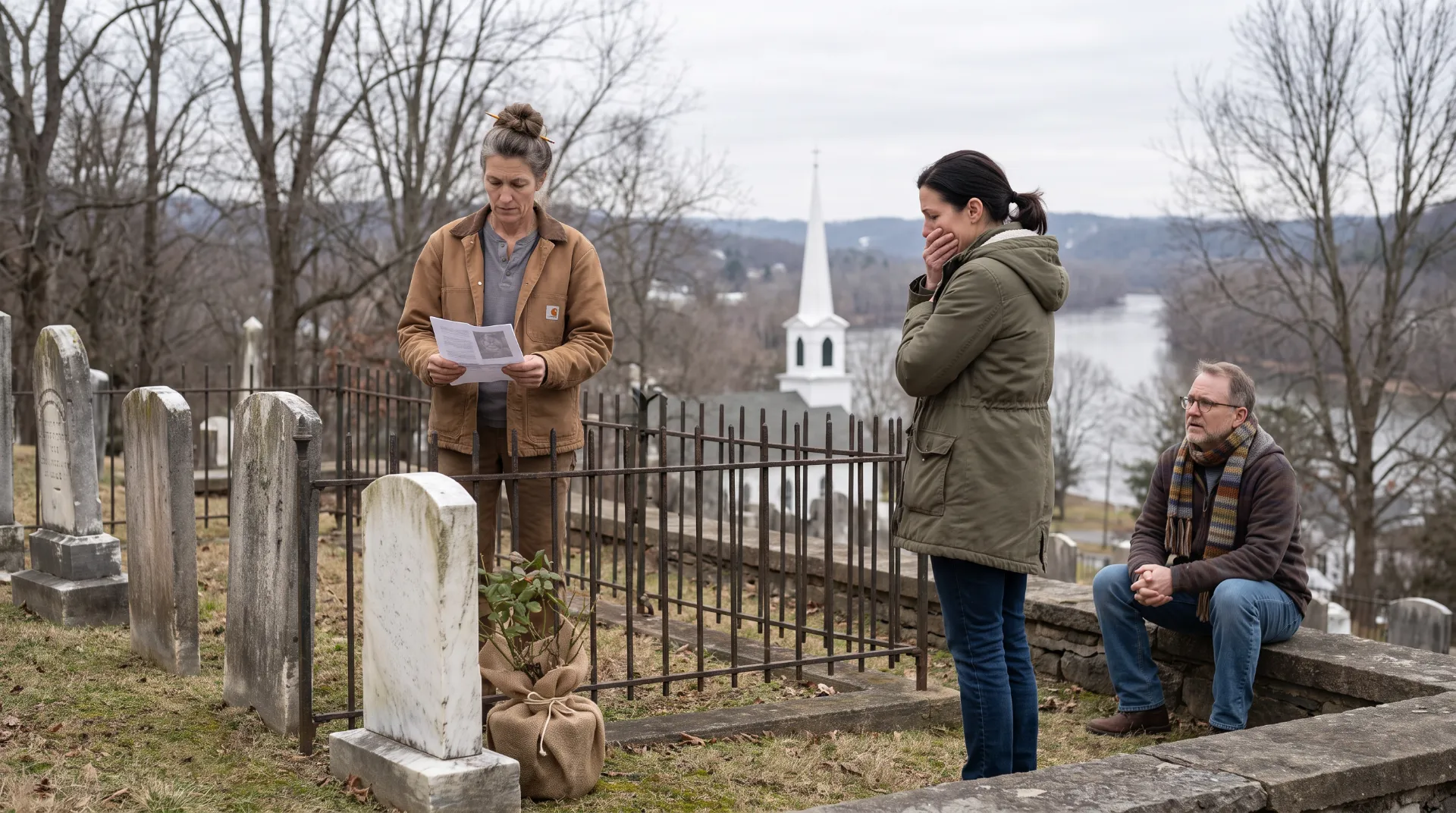
The Callow Falls Rural Cemetery is on the hill above the river, behind the Methodist church, a slope of old stones leaning in every direction like people who've been talking too long. The Vosburgh plot is near the top, inside a low iron fence: Jacob the paperhanger, Hannah, Cornelius and his wife, Edwin. A big granite family stone with the name across it, and small headstones in a row.
Agnes's is the smallest. White marble, worn soft. AGNES M. VOSBURGH. JAN. 9, 1927. MAR. 3, 1946.
At the foot of it, somebody planted a rosebush a long time ago. It's been cut back hard for the winter and wrapped in burlap against the frost. The wrapping is new. Somebody did it this autumn, carefully, with twine.
"Aunt Harriet's," Peter says. "She did that every November. I used to drive her up here. She'd never let me help."
Nora stands at the iron fence with her hands in her parka pockets. I take the photocopy of the birth certificate out of my coat and hold it where they can both see.
"Mother: Harriet Vosburgh. Age nineteen," I read. "Harriet was born in 1929. In March of 1946 she was seventeen. Agnes was born in January of 1927. In March of 1946 she was nineteen."
Nobody says anything. Down the hill a truck goes over the bridge.
"The certificate says the baby was born on the third of March," I go on. "Agnes's stone says she died on the third of March. The paper says pneumonia. The town said pneumonia. The funeral was closed and private and nobody saw her." I fold the certificate. "And the lab says June and Harriet share a mother's line. Which they would if June was Harriet's daughter. And which they'd also have if June was the daughter of Harriet's sister, because Harriet and Agnes had the same mother. The test can't tell the difference. It says so in the last line, in small print."
Nora has gone very pale.
"In the wreath," I say, "June isn't next to Harriet. Harriet isn't in it. June's next to Agnes. Same year. Side by side."
Peter sits down on the low stone wall of the plot, the way he sat down on the dining chair.
"Agnes," he says. "Not Harriet. Agnes had the baby and died."
"I think so. I think she died that day, having her. I think somebody wrote the wrong sister's name on the certificate, and the town was told pneumonia, and the baby went to Poughkeepsie, and a sixteen-year-old girl came home on the train by herself with a lock of her niece's hair in her pocket." I look at the rosebush in its burlap. "Harriet wasn't June's mother. She was just the one who stayed."
Nora turns away from the fence and walks a few steps down the hill and stands there with her back to us. Peter gets up after a minute and goes to stand beside her, not too close. Neither of them says anything. I leave them to it.
I take one last photograph, of Agnes's stone, with a pencil beside it for scale. My father would have done the same.
That's what I know. Here's what I don't. I don't know why somebody wrote Harriet's name on that paper instead of Agnes's. I don't know who the father was, though I can guess, and Ruth can guess better. And I don't know what Harriet Vosburgh wrote and sealed behind a wreath for June's children, if they came, which is the only thing in this whole story that would tell us, and which has been gone since a man sat beside her bed for an hour and thirty-five minutes on the eleventh of October.