Debtbound – Chapter 9: The Impossible Edit
Progression fantasy & LitRPG
share this story
The lamplighter held out his wrist, and Kell read it properly.
He had read foreclosures before. He had read the porter's, and Iver Hauk's, and a hundred others through Hessa's canvas pages in eleven days, and they had all looked the same: a closed account sealed under a round, heavy figure of light, the way a deed is sealed under wax. The seal sat on top of everything. It did not move. On Lampwrights' Row, the first night, he had pushed on Tobin Marsh's seal with his whole will and felt nothing give, and he had gone home owing eight drams for the privilege.
This time he did not push on the seal. He read it.
A seal is a sentence. Every clerk knows that, though most of them stop reading after the first clause. This one said, in the dense grey grammar of sworn script: FORECLOSED THIS DAY, THE BEARER'S OBLIGATION OF 2,290 EXCEEDING HIS ASSESSED WORTH OF 2,100. It was an oath, and the oath had a recital, the way every charter instrument had a recital. Whereas the bearer owes this. Whereas his worth is that. Therefore.
Kell sat very still at Hessa's table with his palm on the sister's handwriting.
He could not move the seal. Nobody could move the seal; it was sworn, it had a single counter-party, and the counter-party was House Merren. But the seal did not stand on nothing. It stood on its whereas. And its whereas was the figure two thousand two hundred and ninety, which was not true. Underneath the seal, under nine years of sealed grey quiet, the scar was still there: three hundred and thirty drams of invented increase, grafted one knot upstream of the obvious joint, with one small honest flaw left near the top for any auditor to find.
A sworn instrument whose recital is false is not an instrument. It is a forgery with a seal on it.
"Hessa," Kell said. His voice came out odd. "When a House forecloses on a false figure, what happens to the foreclosure?"
Hessa looked at him for a long time from beside the bread oven, a pencil in her hand.
"Nobody knows," she said. "Nobody's ever been able to show a figure was false."
He did not do it that night. He wanted that understood too, later, by whatever judge mattered. He sat with it.
The first thing he did was write his own worth into the book. He had never known it. Frozen accounts were still assessed; the House reviewed every soul it held paper on, whether or not that soul could cast, and the review lived in the soulscript like everything else. He turned to his own entry at the back of the ninth volume, under GUEST, and laid his palm on his own name, and asked the question he had been afraid of for fourteen years.
WORTH ASSESSED AT LAST REVIEW: 1,150.
He wrote it down in pencil, small, and then he did the sum he had been avoiding since the night in the stacks when the silver-haired man read his dark line like a wine label. Both lines were written on the same soul, and the soul had one worth. The public line, the forged one, stood at nine hundred and seventy. The dark line stood at forty-four. Together, one thousand and fourteen. Against eleven hundred and fifty.
A hundred and thirty-six drams. That was the whole distance between Kell Arden and a broom.
He sat with that as well. Hessa put bread in front of him and he did not eat it, and she did not make him. Iver stood in shed three across the lane with his left hand held a little forward. Tobin Marsh stood in the doorway with his lamplighter's pole and did not lower his arm, all through the night, until near dawn Kell said to him, out loud, "Tomorrow," and the lamplighter lowered it with the same slowness he had used on Lampwrights' Row the first night, and went back to shed six to stand at rest.
"You've done the arithmetic," Hessa said, when the lamp was low.
"There's an obvious move." Kell rubbed his eyes. "My public account is forged. Fourteen hundred where it should be four. Correct it and I'm owed money, and the margin goes from a hundred and thirty-six to something like a thousand." He laughed without much in it. "But the man who forged it can read his own work. The moment I touch that splice he'll know there's one person in Vell who could have done it, and he knows my desk and my face and my rate."
"So you won't."
"Not for me. Not yet." He looked at the book. "Tobin's graft is the same hand. Touching it says the same thing."
"Then what's the difference?"
He thought about it honestly, because she had asked honestly.
"Tobin's been sweeping for nine years," he said.
Hessa nodded once. Then she asked the question he had known was coming since the first night, and had been hoping she would be too proud to ask.
"Read Iver's."
He did not pretend to misunderstand her. She brought the first volume out of the warming cupboard, the soft brown one, and opened it to the page with her own handwriting on it, thirty-one years younger and very careful: IVER HAUK, COOPER. TAKEN IN THE WINTER OF THE GREAT FROST. 1,900. Kell laid his palm on it. The page went deep, slower than ever through a book that old, and under Hessa's careful letters he found Iver Hauk's account and the round grey seal over it, and he read the seal's recital the way he had read Tobin's.
FORECLOSED THIS DAY, THE BEARER'S OBLIGATION OF 1,900 EXCEEDING HIS ASSESSED WORTH OF 1,850.
He went down under the seal, through the account, every assessment of the cooperage loan and its increase, quarter by quarter, looking for the scar. He looked for a long time. He looked one knot upstream of every obvious joint. He looked for the small honest flaw the hand always left for an auditor to feel clever about.
There was nothing. The steam-box had cost what it cost. The cooperage had closed its second floor. The increase had been assessed at one part in forty every quarter, rounded up the way the Houses rounded everything, and the rounding came to eleven drams over the whole life of the loan, and without the eleven drams Iver Hauk would still have crossed his line by thirty-nine. The figure under the seal was true. The seal stood on it the way a building stands on rock.
Kell took his hand off the page and made himself look at her.
"It's honest," he said. "It's a cruel, ordinary, honest foreclosure. There's nothing under it to correct."
Hessa looked at the page for a while. Then she closed the book with both hands and put it back in the warming cupboard, behind the other eight, and stood with her palms flat on the oven door.
"I knew that," she said. "Thirty-one years, I knew that. I wanted a clerk to tell me." She did not turn round. "Free the lamplighter. Iver says so."
There was a practical difference too, and he made himself plan it like a clerk. The discharge would be loud. Correction was silent, a knot retied in place, but unmaking a sworn foreclosure would release whatever the seal had held, and released script went somewhere, and the instruments on the Weighhouse Bridge existed to notice exactly that. Ashen Town would light up on every needle in Vell.
"They come every Sunday anyway," Hessa said, when he told her. "What will they do, take our dust twice?"
"They'll come for me."
"Then you'd better be quick," said Hessa, "and you'd better be gone before the carts."
So they arranged it the way the dry quarters arranged everything, by word of mouth and without paper. The sister came at dusk: Ada Marsh, thin, in a dyer's shawl, her hands stained blue to the wrist from the yards. She had written the entry nine years ago at fourteen and had added her receipts to the margin at eighteen, when she understood what they meant. She did not ask Kell whether it would work. She sat on the bench by the oven with her stained hands knotted in her lap and watched the door.
Tobin came at full dark, with his pole, and stood where he had stood the night before.
Kell put both palms on the page.
The graft came first, and it was ordinary work. That surprised him most, afterward: how ordinary the first hour was. He found the false chain the way he had found Brann's rounding and the chandler's widow's transfer fee, one knot upstream of the obvious joint, and he left the decoy flaw near the top exactly where the forger had put it, because it was true in its way and because he did not want to give the hand any satisfaction. Then he went down the nine-year-old chain of increase assessment by assessment and retied every knot at its honest figure. Three hundred and thirty drams of invention came out of Tobin Marsh's account the way a splinter comes out, slowly and then all at once.
The figure under the seal changed. 2,290 became 1,960.
He felt the cost book itself, small and familiar: eleven drams for the correction, onto the dark line, rounded the usual way. Fifty-five. The strap took in a hole. He had expected it and did not stop.
Then the seal noticed.
It did not move. It strained. The whole heavy round of it, the oath with its recital, sat on top of the corrected figure the way a roof sits on a wall that has just been taken out from under it, and the script began to argue with itself in a grammar Kell had never heard. FORECLOSED THIS DAY, THE BEARER'S OBLIGATION OF 2,290, said the seal, and underneath it the account said 1,960, and the two could not both be true, and the Ledger had to balance. He felt it decide. It was the most frightening thing he had ever felt through a page, worse than the Ashen's wrist, worse than the stacks: a vast and impersonal attention turning, considering, choosing which of two true-looking things was true.
For the length of that choosing, Kell was aware of something else at the edge of the page, faint and far away, the way a clerk at a crowded counter is aware of being watched from the mezzanine. It was not the creditor. The creditor's dark was where it always was, behind his breastbone, patient, adding. This was a hand. The hand that had written the graft nine years ago was, somewhere in the city, in a good coat, feeling one of its old splices come undone the way a mason feels a wall he built shift in the night. Kell could not see it. He was sure of it anyway. He held the corrected figure and did not let go.
It chose the account.
The seal cracked along its recital. Kell held on. He did not know what he was holding; he only knew that if he took his hands off the page the seal would settle back onto the false figure out of habit, and the chance would be gone. So he held the corrected figure true with everything he had, the way he had held Sela's four cords, and the Ash poured out of him to pay for it. Sixty. Sixty-five. Sixty-eight. He tasted iron. His nose bled onto the canvas and he moved his palm an inch so as not to blot Ada's handwriting.
The seal came apart.
It did not break. It unwound, thread by thread, the oath unsaying itself from the last clause backward, therefore and then whereas and then whereas again, until there was nothing on top of Tobin Marsh's account but his account. The light under Kell's hands went from a heavy round of grey to an ordinary page of ordinary script, the ledger of a lamplighter who had borrowed for his mother's lungs and paid most of it.
And then the rest of the arithmetic ran by itself, because the Ledger balances.
A void foreclosure carried void charges. Nine years of UPKEEP, ASSESSED went out of the account like the graft had, every quarter of it, because they had been charges of an instrument that had never lawfully existed. What remained were nine years of labour credit at a quarter-dram an hour, sweeping Lampwrights' Row in the dusk, posted now against a living man's true debt and its increase. Kell watched the figures run down the page and did not quite believe them until they stopped.
The balance closed at nothing.
Then the dark line booked its fee, and that he believed at once. CHARGE FOR RELEASE OF A SWORN CLAIM: FIFTY DRAMS. One hundred and eighteen.
He took his hands off the page.
In the doorway, Tobin Marsh lowered his arm.
The ember seams along his forearms had gone dark. Kell saw that first: the faint red light at every joint, which he had seen on every Ashen in Vell his whole life, simply was not there. The rest of him stayed exactly as it had been. The grey skin stayed grey. The gauntness stayed. Nine years of Sundays, the fabric dust swept off the floor of shed six, had gone somewhere up the river road in brass-bound carts, and the Ledger, which balanced everything, did not balance that.
The lamplighter looked down at his own hands for a long time. Then he leaned his pole carefully against Hessa's wall, crossed the kitchen to the chair nearest the oven, and sat down.
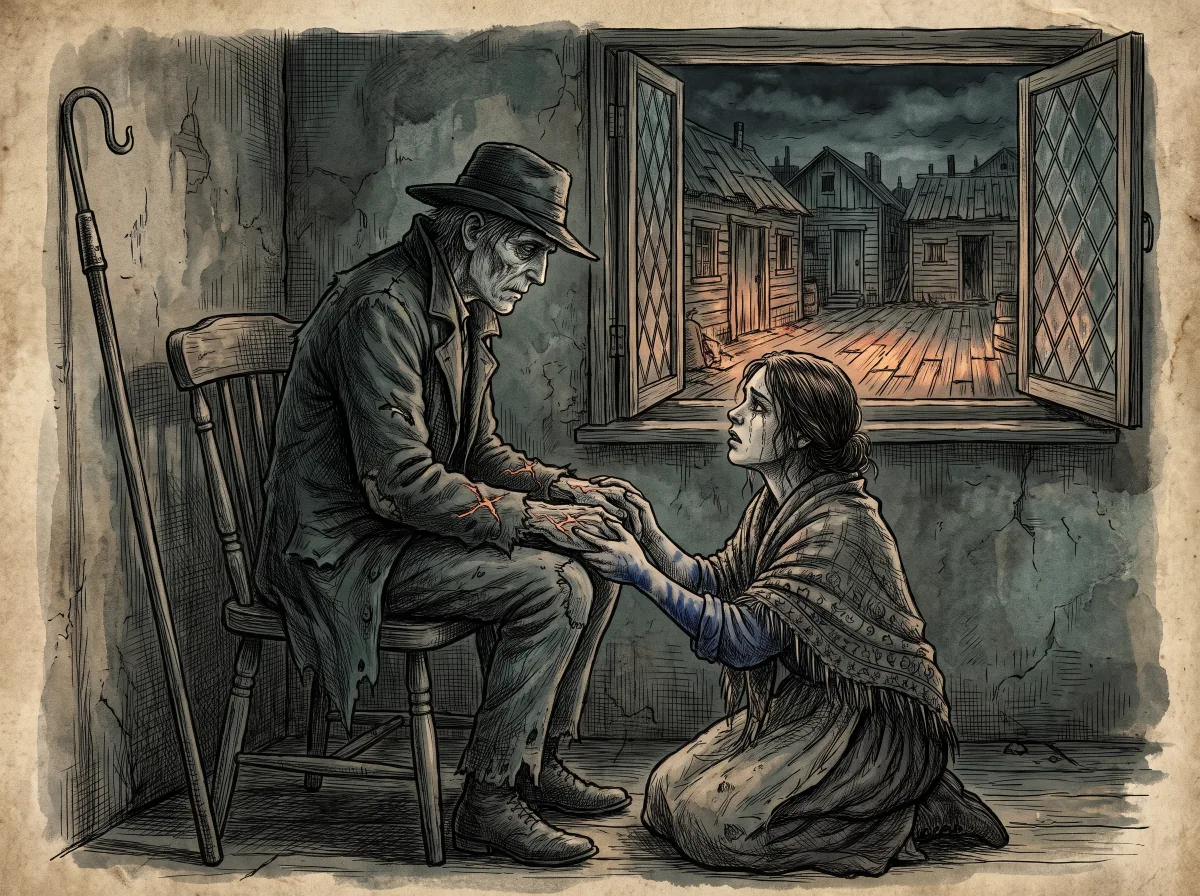
Ada made a sound Kell would hear for the rest of his life. She went across the floor on her knees and took her brother's grey hand in both of her blue ones, and held it, and did not say anything, and Tobin Marsh looked at her with eyes that were no longer banked low.
"Ada," he said.
His voice was nine years unused, dry and cracked. It was the first word an Ashen had spoken in Vell in four hundred years, and it was her name.
He tried another word and it did not come. He tried to stand and his knees did not know the order of it anymore after nine years of being told when to bend. Ada held him down in the chair with her blue hands on his shoulders, laughing and crying at once, and told him to sit, he was to sit, he had been standing long enough. He let her. He sat. His grey hand stayed in hers, and the knuckles moved, slowly, closing around her fingers. Nobody had ordered them to.
"Will he stay like this?" Ada asked Kell, without looking away from her brother. "Grey. Will it go?"
Kell looked at the account under his palm, closed at nothing, and at the grey hand in her blue ones, and did not lie to her, because she had kept receipts at eighteen.
"I don't know," he said. "The debt's gone. What they took off him every Sunday isn't in the book. I can't read what isn't written."
Ada nodded, once, the way Hessa nodded, and went back to holding on.
Hessa turned away to the oven and stood with her back to the room and her hands flat on the warm iron. Kell sat at the table with blood drying on his lip and the book open in front of him and did the last sum of the night, because it was what he had.
Nine hundred and seventy, and one hundred and eighteen. One thousand and eighty-eight, against eleven hundred and fifty. Sixty-two drams between him and the sheds. He had spent seventy-four drams of margin on one man. He wrote the figure in his own entry, in pencil, small, and he found that he did not regret a grain of it, and he filed that too.
The discharge reached the sheds a moment later.
It came up through the floor of the kitchen first, a dry warmth under his boots, and then Hessa said "Look," very quietly, and he looked through the window. Across the cinder lane, in shed six and shed three and all down the seven rows, the fine grey dust between the floorboards, the dust the masked men's brooms always missed, was glowing. Faint, ember-gold, flecked deep down, the same last spark Kell had watched die in a pawnshop candlestick, except that it was not dying. It was lit, all at once, in every shed in the last bend, the way a page lights when you put your palm on it and ask.
Every Ashen in every shed had turned to look at the kitchen window.
Out over the water, on the Weighhouse Bridge, the line of instrument lamps that walked the bridge road every night had stopped walking. One by one, along the parapet, they turned toward the bend. Somewhere up on the bridge a bell began to ring, small and procedural, and then another took it up on the far bank, and then one Kell could only just hear from the direction of the Upper Walk.
"Gone before the carts," Hessa said, without turning from the window. "That's what I said."
Kell was already on his feet, closing the ninth volume over his own name. Behind him, Tobin Marsh was saying his sister's name again, as if to make sure it still worked.
Every needle in Vell was pointing at the last bend.
Next chapter: The Enforcer. The script makes way for some men. Kell is about to meet one. Posted next week.