Everything Must Go – Chapter 2: The Green Book, Part Two
14 min read
Mystery stories
share this story
I don't sleep, so at six I'm in the barn office with the space heater ticking and the photographs of the three white stubs open on my laptop.
The office is the front bay of the barn, where my grandfather kept the milk cans. My father put in a window, a desk he bought at a school auction in 1986, and a shelf of ledgers. There are eleven of them, one for every year since he stopped trusting the computer, green cloth covers, the year on each spine in his capitals. I haven't opened one since February. I know what's in them: lots, hauls, buyers, fees. I also know that the first thing I'd see is his handwriting, and that I'd sit here for an hour afterward doing nothing.
I look at them. I leave them where they are.
At eight I call Hudson Home Care in Kingston. The coordinator has a voice like a closing drawer and tells me she can't release staff names to the public.
"I'm not the public," I say. "I'm the contractor clearing the Hart estate. Mrs. Hart's aide left personal items in the house, and I'd like to return them before everything goes to auction." This is not true yet. It will be true as soon as I find something of hers, and in a house that size I will.
Nineteen years of calling people who didn't want to talk to me taught me that the best thing to do after a sentence like that is nothing. I wait. She sighs.
"I'll pass on your number."
The aide calls back at nine-fifteen. Her name is Dolores Kraus, she'd prefer Dee, and she'll meet me at the Kill Diner at ten if I'm buying, because she's between clients and between clients she doesn't get paid.
"Fair," I say.
"I'll know you," she says. "You're Walt's girl. You've got his jaw." She hangs up before I can decide what to do with that.
Dee Kraus is sixty-three, wears bright pink scrubs under a parka, and has already ordered when I arrive: two eggs over hard, rye toast, coffee, a side of bacon she points at and says is mine. She has the voice of someone who quit smoking in the nineties and never told her lungs.
"If the nephew sent you," she says, "you can tell him I gave his key back at the funeral like he asked, in front of the priest."
"Dennis didn't send me. Hal Brewer got me the job. Dennis just wants it done in ten days."
"Of course he does." She salts her eggs. "What do you want, then?"
I decide to give her the thing I'd want if I were her. "I want to know if she was confused."
Dee puts the salt down.
"She did the Saturday crossword," she says. "In pen. Every Saturday until the last one. Does that sound confused to you?"
"No."
"Everybody wanted her confused. The doctor, the nephew. It's easier. Old lady says her walls are poisoning her, you nod and you call it the heart." She pushes the eggs to the side of the plate. She hasn't eaten any. "Her head hurt. Her stomach. Her hands tingled, she said, like they'd been asleep. All of it started in August."
"What happened in August?"
"A man came about the house tour. The historical society does the old houses every spring, and he wanted to photograph the back parlor for the brochure. Original paper, original everything, she was proud of that room." Dee taps the table. "He took a strip off by the window. To test it, he said. Steamed it right off the wall with a little steamer he'd brought in a bag, and put it in an envelope, and thanked her very much."
"Did you get his name?"
"She called him the society man. Tall. Nice coat. Polite. I was making lunch." She looks at me. "After that the room smelled. Like wet plaster and something under it. That's when the headaches started."
I write August: man, house tour, steamed strip by window and underline steamed. A hundred-and-fifty-year-old paper that sat dry on a wall is one thing. The same paper heated and peeled and left open to the air is another. I don't know the chemistry. I know which version an insurer pays for.
"You sealed the door," I say.
"Towels. She asked me to and I did it." Dee shrugs. "Towels, Mae. Not tape. I don't own tape."
I don't say anything. I let that sit on the table between the ketchup and the bacon.
"There was a picture on the long wall in that room," I say after a while. "About two feet by three."
"The bill." She almost smiles. "The paperhanger's bill from 1872, in a frame, with a little scrap of the same paper behind the glass. She'd show it to anybody. Forty-one dollars for the whole room, labor included." She frowns. "It was there on the fifth. I dusted it. I dusted that frame every week for six years."
"It's gone."
"Then somebody took it after the fifth." She says it flatly, the way you report a weather fact. Eleanor died on the seventh. Dee found her.
I don't make her tell me about the seventh. She tells me anyway: the wing chair in the front parlor, glasses on, the crossword on her knee finished in pen, the coffee cold. Dee doesn't cry. She picks up a strip of my bacon and puts it down again without eating it.
"One more," I say. "In September Dennis came up."
"Oh, he came up." She leans back. "They had it out in the dining room. I was in the kitchen, I heard all of it. He said she could pay for me and everything else with one book. She said it was promised. He said promised to who, and she wouldn't say. Next morning she had me carry that big green book down from the parlor shelf, wrapped up in oilcloth, and lock it in the chest at the foot of her bed. Took both of us. It weighs as much as a child."
"Promised," I say.
"Her word."
"Who had keys to the house, Dee? Besides you and Dennis."
She thinks about it honestly. I watch her count.
"Her. Me. The nephew. And your father had one."
I keep my pen moving so my face has something to do. "When?"
"Years back. He did an appraisal for her, the whole house, room by room. She liked him. She gave him a key so he wouldn't have to wait on the porch." Dee looks at me with something that isn't quite pity. "He never gave it back, far as I know. Didn't need to. Nobody thought about it."
The county substation is a one-storey brick box next to the post office, with a flag, a bench nobody sits on, and a front desk that is also Deputy Lena Ortiz's desk on weekday mornings.
She sees me through the glass door before I open it. She doesn't get up.
"Ms. Sutter."
"Deputy."
She checks her watch, which is how I know she remembers me. We have met exactly three times. Eight years ago I was the adjuster on a kitchen fire in Saugerties, a small frame house owned by a widow named Marisol Ortiz, and I denied the claim because the electrician's report found knob-and-tube wiring in the walls and the policy excluded it in writing. The second time was the appeal. The third time was in the parking lot of the Ulster County Courthouse, where her daughter, in uniform even then, told me my decision was correct on paper and walked away before I could answer.
It was correct on paper. I've read it again since. It's still correct.
"I'm clearing the Hart house," I say.
"I heard." She doesn't ask me to sit. I sit anyway, in the plastic chair across the desk. "Eleanor Hart died of congestive heart failure at ninety-one. Her own doctor had seen her eleven days before and signed the certificate. It was an attended death, there's no medical examiner, and there is no case."
"I didn't say there was a case."
"You're sitting in my chair with a notebook."
I put the notebook on her desk, open, so she can read it upside down if she wants to. She doesn't look at it. I tell her anyway, in order, the way I used to write a summary for a claims manager who had nine other files on his desk. Painter's tape around a door the aide sealed with towels. A frame gone from a wall it hung on for decades, sometime after the fifth. A rare book with three pages cut out recently, at the bottom of a locked chest. A man in August who steamed a strip of arsenic paper off a wall and took it away in an envelope.
"Arsenic," Lena says.
"The wallpaper. It's in the book, the same pattern. I can show you."
"I'm sure you can." She leans back. "What you're describing is an old woman with a pretty room and a lot of visitors. Somebody took a picture off a wall. That's what heirs do, Mae. They walk through the house before the vultures come and take the things they want."
"I'm the vulture."
"I didn't say that." She almost smiles and doesn't. Then she turns to her monitor, types something, and reads for longer than a no requires.
"October twelfth," she says. "Eleven forty at night. A Mrs. Pruitt on Orchard Hill Road called in a flashlight moving around the back of the Hart house. Deputy Kowalski went up. Front and back doors locked, no sign of forced entry, windows secure. He wrote possibly family and left."
"Possibly family," I say.
"Locked doors and no forced entry means somebody had a key, and family usually has a key." She looks at me now. "So does an estate contractor."
"I got my keys on Monday morning."
"I know. Dennis Hart told us." She lets that land. She has already made one phone call about me this week, and she wants me to know it.
I reach into my coat pocket and put the evidence bag on her desk. It holds a length of white butcher's twine, still stiff, cut once.
Lena looks at it. Then at me. Then she laughs, suddenly and out loud, a real laugh that surprises both of us and makes the mail carrier outside glance in through the glass.
"You bagged string," she says.
"It was on the book. It's new. The oilcloth under it is a hundred years old."
"You bagged string." She shakes her head, and the laugh goes as fast as it came. She doesn't hand the bag back. She opens her desk drawer, puts it in, and closes the drawer. No receipt, no case number. "Bring me something that isn't string, Ms. Sutter, and I'll take a statement. Until then you're a woman with a notebook who doesn't like the way a room feels."
"That's most of my old job."
"I know," she says. "I was there."
Theo shows up at the barn at seven with a pizza from the place on Route 32 and a question he's been holding since lunch.
"Why does that deputy hate you?"
"She doesn't hate me." I take a slice. "I denied her mother's fire claim eight years ago. Old wiring. The policy didn't cover it."
"Were you right?"
"Yes."
"Did her mom lose the house?"
"She sold the lot to a developer and moved in with Lena." I eat. The pizza is too hot and I eat it anyway. "Being right isn't the same thing as it being fine, Theo. That was most of the job. You learn to live in the gap."
He thinks about that, which I appreciate, and then he thinks about something else, which I appreciate more.
"So who had keys?"
I tell him what Dee told me. Her, Dennis, Eleanor. My father.
Theo puts his slice down. "Grandpa had a key to the Hart house?"
"Years ago. For an appraisal."
"And it's where?"
That's the question I've been not asking myself since ten o'clock this morning. I get up and go to the wall behind the office door.
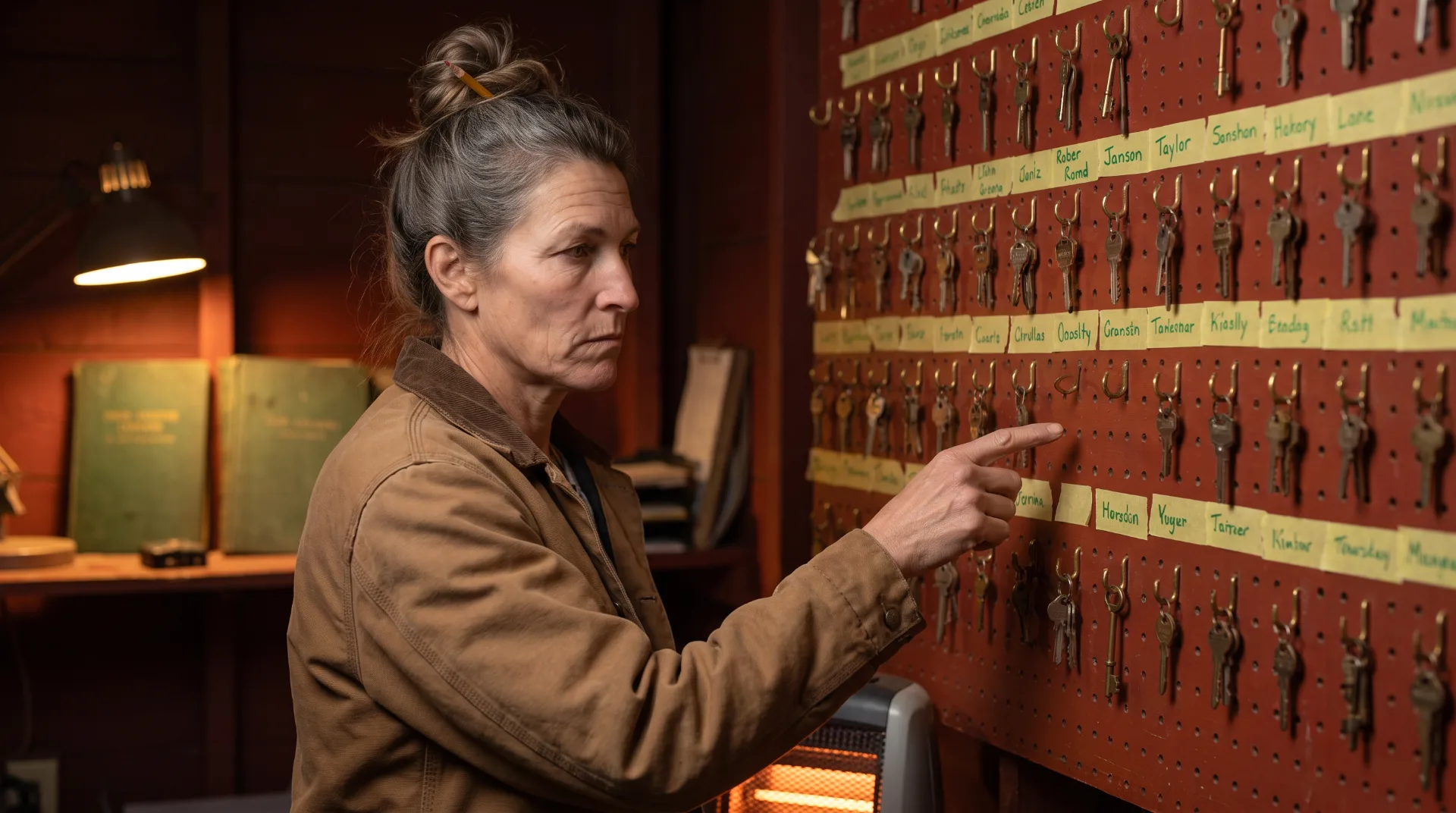
My father kept a key board. It's a sheet of pegboard painted barn red, with brass cup hooks in rows, and under every hook a strip of masking tape with a name on it in green ink. Clients who trusted him to let himself in. Some of the names are twenty years dead. Some of the houses have been sold three times. He never took a strip down, because, he said, you never know who'll call.
I go along the rows with my finger. ABERNATHY. BLOOM. CASTELLANO. DEWITT. Most hooks have a key on them, some have two. The tape is old and yellow, and the ink has gone brown on the oldest ones.
HART is in the third row. The tape is the same age as the others around it. The ink is the same green.
The hook is empty.
"Maybe he gave it back," Theo says behind me.
"Then he'd have taken the tape down. He took the tape down for everything he gave back." I point at two pale rectangles on the pegboard where strips used to be. "He was a lot of things. He wasn't untidy."
"Maybe it fell."
I get down on my knees and look under the desk with my phone light. Dust, a pencil, a 2017 calendar from the feed store, a dead wasp. No key.
When I stand up, Theo is looking at me with the face he had at eleven, when his dog went missing and the adults kept saying things like maybe it fell.
"Who's been in here?" he asks. "Since February."
I want to say nobody. I make myself count, the way Dee counted at the diner.
Me. Theo. Jess, once, to bring me casseroles I didn't eat. The county assessor in April, who never left the front bay. And in March, for three Saturdays in a row, Hal Brewer, who came with coffee and two of his yard men and helped me sort my father's inventory into what to sell and what to keep, because I couldn't make myself do it alone and he said Walt would have done the same for him.
He stood exactly here. I remember him reading the names on the tape out loud, smiling, telling me a story for every one.
"Aunt Mae?"
"Eat your pizza," I say. "It's getting cold."
I don't sit back down. I stand in front of the empty hook for a while longer, then I take a photograph of it, with a pencil beside it for scale, out of habit and because I don't know what else to do with my hands.
On Wednesday morning Theo meets me at the Hart house with his laptop under his arm and the look he gets when he's found something on the internet that he thinks is evidence.
"Don't be mad," he says.
"I'm always mad. Show me."
He opens the laptop on the dining table, between two stacks of boxes marked HAVILAND in my handwriting. It's Monday's footage from the back parlor, slowed down, the frame where his phone swung across the floor under the bright rectangle on the wall. He's zoomed in until the dust turns to grain.
"There," he says. "In the arc."
In the scuffed dust there's a print. Half a heel and part of a sole, smooth, no tread at all. Not a sneaker. Not a work boot. A leather sole on a man's dress shoe, narrow, with a sharp square edge to the heel.
"Loafers," Theo says. "Dennis wears loafers. Suede ones. I clocked them when he left skid marks."
"Suede uppers. The sole could be anything."
"It's leather. Look at the edge."
I look at the edge. He's not wrong. I don't tell him he's not wrong, because it's ten past nine and the subject of his theory is pulling into the driveway in an Audi.
Dennis comes in without knocking, which is his right. He has a coffee from somewhere in Albany and the expression of a man who has budgeted twenty minutes for this. He walks through the dining room looking at the boxes, not at us.
"Good. Hal says the Haviland goes in the first session." He glances at his watch. "Anything I should know about?"
I've thought about how to do this since the diner. In the end I do it the way I used to do recorded statements: one plain question, then silence.
"You were up here in September. You and your aunt argued about money."
He stops. His shoes, I notice, are brown leather loafers today, not suede. He sees me notice.
"Who told you that?"
"It doesn't matter who told me. I'm clearing the house. I need to know what's in it and who thinks they own it."
Dennis puts his coffee down on a box, which I would normally object to. He rubs his eyes.
"Her care cost seven thousand four hundred dollars a month," he says. "The aide, the visits, the meal service. She had about a year of savings left at that rate. I'm her executor, and her only family, and I'm the one who would have had to sell this house out from under her if the money ran out." He says it to the window, not to me. "So yes. I told her she had a book that would pay for a year of everything. She said it was promised. That's all she'd say. Promised."
"Promised to who?"
"That's what I don't understand." He turns back. "I assumed she meant Hal. Because Hal told me she'd already sold it to him."
Theo, who has been very quietly closing his laptop, stops closing it.
"When?" I say.
"In 2019. At Thanksgiving. He took me aside after dinner, very kind about it, said he didn't want me to be surprised later. Eleanor had sold him the wallpaper book for eleven thousand dollars to help with the roof. He said he'd keep it safe for the right buyer." Dennis shakes his head. "So when she said promised, I thought she was confused. That she'd forgotten she'd sold it. That's when I started to think she was going." He picks up his coffee and puts it down again. "Why are you asking about the book?"
I don't answer right away. I'm thinking about Monday on the porch, about Hal's voice when he said I appraised it for her, years ago. Not I bought it. Not it's mine. A man who paid eleven thousand dollars for something says so.
"Because it's upstairs," I say. "In the cedar chest at the foot of her bed. Locked."
I've watched a lot of people get news they didn't expect. Some of them perform it. Dennis doesn't have the time or the talent. The color goes out of his face from the forehead down, and for a second he looks his age and his aunt's both.
"That's not possible."
"I'll show you."
I take him up. I unlock the chest with the key from my coat pocket, lift out the quilts, fold back the oilcloth. He doesn't touch it. He stands at the foot of his aunt's bed with his hands in his vest pockets and reads the title twice, moving his lips the second time.
"He told me she sold it," he says. "He showed me the check stub."
"Did you see the check?"
"I saw the stub. In his book. Eleven thousand." He looks at me. "Why would he lie about owning it?"
Behind him, in the doorway, Theo is looking at Dennis's brown loafers and then at his phone, and then at me, and I watch his theory leave his face the way air leaves a tire. A man who thought the book was sold seven years ago didn't need to break into the house to look for it.
I fold the oilcloth back and lay the crazy quilt over it, and lock the chest, and put the key back in my pocket.
"I don't think he lied about owning it," I say. "I don't think he ever said he owned it. I think he let you believe it."
Dennis is quiet for a moment. Then he asks the question I've been asking myself since the diner, and asks it better than I would have.
"Then what did Hal pay her eleven thousand dollars for?"