Debtbound – Chapter 8: Ashen Town
Progression fantasy & LitRPG
share this story
The porter was sweeping Cooper's Stair when the notices went up. He was still sweeping it at the third bell, when Kell had read his own name on four walls and run out of walls.
Kell knew him by the coat. It was the chandler's widow's coat, her dead husband's good brown wool, which Kell had carried across the river wards three weeks ago and left on a stair-head for the family of a man four names down a list. The porter's wife had put it on him after the foreclosure. Families did that. The Houses allowed the Ashen to be clothed, since it cost the Houses nothing and was recorded nowhere, and the coat hung off the grey shoulders now with its cuffs turned back twice.
He swept the third landing from left to right, steady and square, the way the porter had probably carried crates.
Kell stood in the mouth of the alley with his collar up and ash still in the seams of his knuckles and did the sums he did instead of panicking. Sela's room was out: the letter under his floorboard mapped her street. Brann's was worse. Every tenement in the dry quarters stood within three streets of a teller's window, every teller's window carried the notice, and every person in those tenements owed somebody something. Five hundred drams of credit was eleven years of Brann's wages. It was a widow's whole life. Kell did not believe the people on his list would sell him. He believed it the way he had once believed the numbers were never wrong, firmly and on no evidence he could audit.
The broom stopped.
He had grown used to that, and it still went through him every time. The porter leaned his broom against the wall with the same careful neatness the Lampwrights' Row Ashen had used, turned his head, and looked up the stair at Kell. Then he walked away from him, downhill, toward the river. At the bottom of the flight he stopped and waited, his banked-lamp eyes on the alley mouth, the turned-back cuffs hanging at his grey wrists.
Kell followed him. Nothing in his column argued for it and nothing argued against, and a man with no address goes where he is led.
They went down by the ways the living didn't use. The porter took him through the dye-yards behind Tannery Row, where the gutters ran blue and red and the smell kept the watch away, then along the river stairs under the Weighhouse Bridge, where Ashen coming off the night shift passed them going up and did not look. Twice Kell heard the gimbal-creak of an instrument on the bridge road above and pressed himself flat to the wet stone until it passed. The porter stood with him. He had no need to hide, since nobody sees an Ashen, and he waited anyway until Kell moved.
The river makes its last bend below the city's lowest ward, and there the ground goes soft and the Houses stop building. Kell had looked down on Ashen Town all his life, a smear of low roofs that the city maps left blank, and he had never once been inside it. Nobody from the tally floor had. There was no teller's window to staff.
The roofs were ledger covers.
He saw that first, because of who he was. Grey hide, the same grey hide as every chained book in House Merren, cut into squares and nailed overlapping onto the low houses. When a House retired a ledger it burned the pages and sold the covers by weight to the tanners, and whatever the tanners couldn't cure ended up down here. A whole district shingled in the bindings of closed accounts. Kell stood at the edge of it and read a row of spines along a gutter out of pure habit. HOUSE MERREN, R-TALLIES, 1 TO 40. HOUSE HALCOT, CONVEYANCES. HOUSE MERREN, R-TALLIES, 41 TO 80.
Between the houses ran long open sheds, roofed and unwalled, and in the sheds stood the Ashen.
They stood in rows, at rest, upright with their arms at their sides, the ember-seams at their joints dimmed to a dull red and their eyes banked low. Forty or fifty to a shed. Kell counted seven sheds. The porter walked into the nearest one, found the end of a row, turned to face the lane, and was still.
"He brought you," said a woman behind Kell. "So you're the one."
She was seventy or near it, small, in a canvas apron with a pencil behind each ear, and she was looking at him the way Master Odric looked at a customer: a figure to be checked against the page.
"I'm a clerk," Kell said.
"You're a clerk with five hundred drams on his name." She tipped her head at the shed. "Iver says you're not to be sold. Iver is my husband. Third shed, second row, the one holding his left hand a little forward. He's held it like that for thirty-one years. He was a cooper. You learn a man's hands." She moved the pencil from behind her right ear to behind her left, where there was already a pencil. "I'm Hessa. I keep the book."
"Iver says," Kell repeated.
"They don't speak, if that's what you're asking. They don't need to. Live here long enough and you learn which of them is standing still because a House told him to, and which one is standing still because he means it." She looked him over: the ash to his elbows, the dried blood at the corner of his nose, the clerk's coat. "Nobody here will sell you. Don't thank us for it. Come inside and I'll show you why."
The reason was arithmetic, and Hessa did it for him at her kitchen table over a kettle that took a long time to boil.
When a debtor foreclosed, his debt did not pass to his family. It was the one mercy in the charter, and it had a hook in it. The account closed into the Ashen, the family walked away owing nothing, and the Houses entered the family's name on a list they kept in common, the register of tainted lines. No House would open an account for a tainted line. No credit, no Ash, no draw, no note, no healing at eighty drams on the quarter, ever. Their children were born dry.
"So the notice says five hundred drams' relief to the informant," Hessa said, pouring. "Relief of what? Nobody down here owes a grain. The Houses saw to that." She pushed a cup across to him. "Five hundred drams of relief is worth exactly as much to me as five hundred drams of river fog. You're the safest man in Vell at this table, and the only reason is that the Houses already took everything they wanted from us."
Kell held the cup and did not drink. Through the window, across a lane of packed cinder, the Ashen stood in their shed.
"Your husband went over threshold," he said.
"Thirty-one years ago this winter. Nineteen hundred drams. He borrowed for a steam-box when the cooperage took on a second floor, and then the cooperage closed the second floor." Hessa sat down. "You know the pamphlet. An Ashen of two thousand drams works it off in sixty years at a quarter-dram an hour, and then he's free to lie down." She smiled at him, tired more than bitter. "I've kept the book twenty-six years. I'll show you Iver's line. You'll want to see it with your clerk's eyes."
The book lived in the warming cupboard of a bread oven, where the damp couldn't reach it.
It was nine books, tied together with tarred cord and bound in canvas because canvas was what Ashen Town had, the first volume gone soft and brown with handling. Every page was ruled by hand into columns. NAME. TAKEN. BALANCE AT FORECLOSURE. WHERE THEY STAND. The last column had no heading except a small chalk circle, and under it the families wrote what they knew: the balance as it stood now, copied whenever one of them could get close enough to a shackle to read it. A year apart. Three years apart. Sometimes once in ten.
Hundreds of hands. Children's hands, learning their letters on it. Kell turned the pages and said nothing for a long time.
IVER HAUK, COOPER. TAKEN IN THE WINTER OF THE GREAT FROST. 1,900. SHED THREE. And in the last column, in Hessa's hand, a run of figures down the years: 1,896. 1,881. 1,874. 1,862. 1,840.
Sixty drams in thirty-one years.
"Upkeep," Hessa said, watching him find it. "The pamphlet doesn't mention upkeep. The House charges the foreclosed account for the cost of the body: the housing of it, the clothing of it, the sheds." She nodded at the rows across the lane. "His labour earns a quarter-dram an hour. His upkeep takes a quarter-dram an hour, less a little, most years. Some years more. The House assesses it and nobody audits it."
Kell had the sum before she finished. At sixty drams in thirty-one years, Iver Hauk would be free in about nine hundred and eighty more. On Lampwrights' Row, with the first Ashen's wrist held out to him, Kell had read UPKEEP, ASSESSED on the shackle and guessed a thousand years without knowing what the word cost.
He had guessed well. He found he hated that more than anything else in the kitchen.
"Will it work for you?" Hessa asked. "The book. Iver says it will."
He looked at her.
"You read through books. That's what they whisper on the stairs. You put your hand on a House's book and see what's written on the soul under it." She laid her own small dry hand flat on the canvas of the first volume, exactly the way he would have, and he understood that she had watched someone do it or had dreamed it often enough to know the gesture. "Nobody up the hill wrote this one. It's still a book of debts."
It worked.
He tested it the only honest way, on himself. There was no page in the Town Book with his name on it, so Hessa uncorked a bottle of ink older than he was, turned to the back of the ninth volume, and held out the pen. He wrote ARDEN, KELL, CLERK in his very best hand. In the second column he began to write TAKEN, stopped, and wrote GUEST instead. Under BALANCE he wrote nothing, because he did not know it, and that was why he was writing.
He laid his palm on his own name.
The page went deep. It went slower than a House page, through canvas and cheap ink and twenty-six years of thumbs, but it went. Under the wet letters his soulscript rose, grey and fine, and behind his breastbone, in the cold country where his creditor kept its terms, the dark line presented itself with its usual manners.
Thirty-nine.
He had counted thirty-five. He had counted it on the roof above his old street, carefully, the way he counted everything: fifty, less thirty for the door, plus five and ten for the fees. He went down the dark line entry by entry, as he had once gone down Brann's rounding, and found the difference exactly where he hadn't looked. The small corrections of the last month, the chandler's widow and three others, two and a quarter drams a night, booked to him while he was busy being afraid of something larger. Four drams spent and never written down.
He remembered the night of Sela's braid, when he had noticed he was no longer exactly sure of his number and called it tiredness. Every debtor at his old counter had gone the same road. First the figure is exact. Then it is approximate. Then it is something you would rather not look at, and then the House looks at it for you.
He wrote 39 in the column in pencil, small. Then, because that was what the book was for, he left room underneath it for the next figure.
He slept in Hessa's loft under a roof of HOUSE MERREN, D-TALLIES, 200 TO 240. He ate what she ate: bread, river eels, the cheap black beer the dye-yards sent down. He learned the district's grammar, which was simpler than the queue's because nobody in it wanted anything from a House. You did not walk between a shed and its Ashen's family house at dusk. You did not touch an Ashen's clothes. If an Ashen's broom stopped near you, you stood still until it moved again.
And he read the book, all nine volumes, a page at a time, palm flat, while Hessa kept a list of who had asked to know what. He corrected nothing. Every correction drew Ash onto his line, and he had not forgotten the needle in its oil or the instruments on the bridge road. He only read, because reading was free. He told mothers what their sons' shackles said. He told a man the balance of a father he hadn't seen since he was four. Twice he had to tell someone the balance had gone up, and he watched them take it and did not know whether he had given them anything at all.
On the first Sunday he saw the carts.
They came down the river road at dawn, three of them, brass-bound and drawn by mules, with the slate-grey seal of the Office of Weights and Instruments on every tailboard. Men in canvas masks went into the sheds while the Ashen stood at rest and came out with sacks. They swept the shed floors, only the floors under where the Ashen stood, never the lanes or the houses. Hessa watched them with her arms folded.
"Sanitation," she said. "Every Sunday since I can remember. The charter calls it the Removal of Fabric Dust." She spat on the cinders, neatly. "They've never once taken our dust."
Kell went into shed three after the carts had gone, knelt at Iver Hauk's feet, and pressed two fingers to the boards along a seam the masked men's brooms had missed.
Fine grey powder, flecked deep down with dying gold.
He had carried a paper fold of the same thing in his coat since the night he put ten drams into a pawnshop candlestick. He took it out now and opened it on his palm beside the pinch from the shed floor. Light from the open side of the shed fell across both. He looked at them the way he looked at two figures that were supposed to differ, and they did not differ. Same grain. Same weight on the skin. Same last spark going out at the bottom of it.
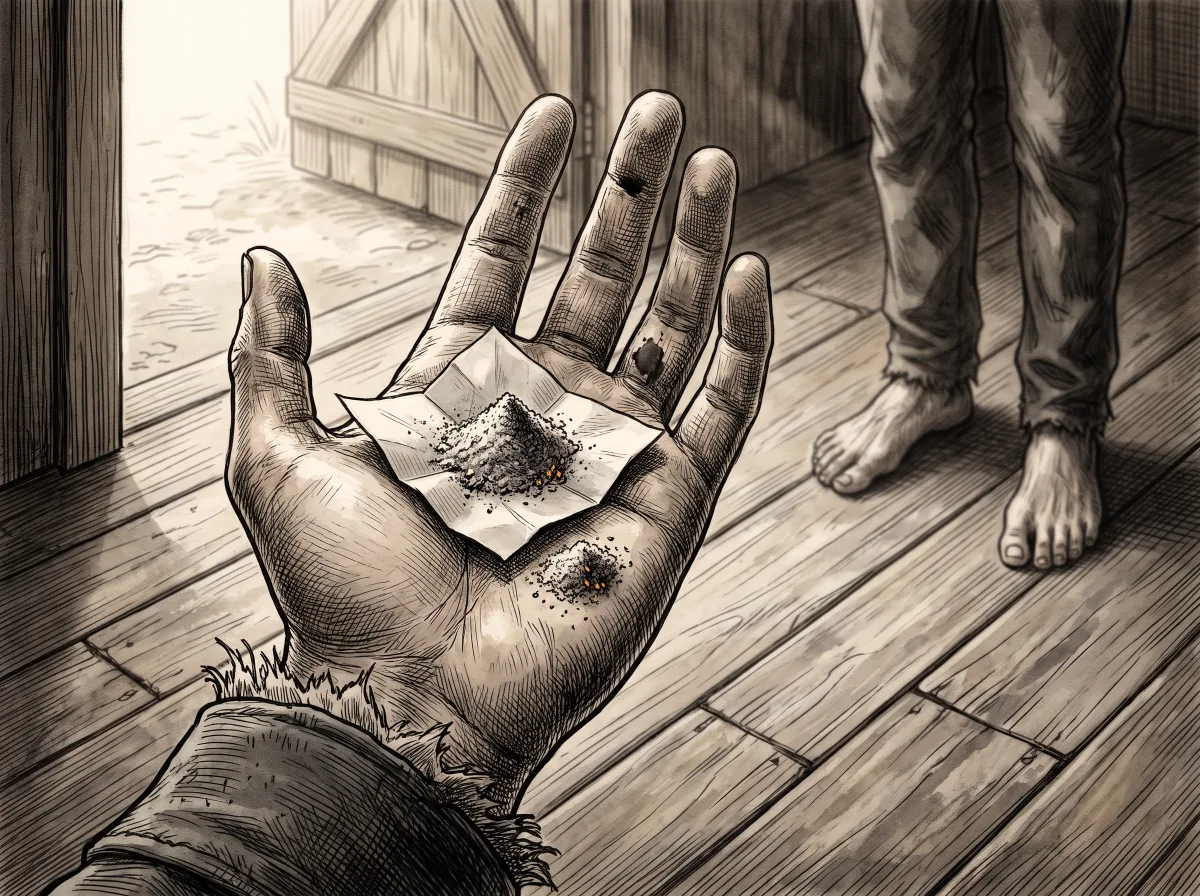
He did not let himself say the next sentence, even inside his head. He was a clerk, and a clerk does not enter a figure he cannot support. He folded both pinches into the same paper, put it back in his coat, and wrote nothing in any column at all.
The boy came on the ninth day.
Kell heard him first: two low knocks on Hessa's door, the queue's grammar spoken in a place that didn't use it. Sela's son stood on the cinders with river mud to his knees and his careful hands empty. He did not come in. He had come to deliver something and wanted it delivered.
"They took Brann," the boy said. "At the midday bell. Two slate coats came onto the tally floor and asked him to verify a carry-over, and he went up to the east mezzanine with them, and he didn't come down." He breathed. "Margit's been to the Office twice. They say he's assisting. The saddler's daughter got a letter saying her account's under review. Our door is watched." He looked at Kell with his account-keeping eyes. "They've got your letter. Everyone on the stairs knows it was under your floor."
Kell stood in the doorway and itemized, because it was what he had instead of falling down. Brann, assisting. The saddler's daughter, under review, the three quarters he had paid for her in coin now a line in somebody's file: a record of who had helped whom. Sela, watched. On the fifteenth he had sat at his table with the advance split four ways and written that letter in his very best hand to protect every name in it, and it had done what any honest record does once it falls into the wrong ledger. It had become a list.
"Corvin," he said. "Has anyone seen Senior Tallyman Corvin?"
The boy shook his head. "He wasn't on the floor when they came. He wasn't on it the day after."
"Thank you." Kell's voice came out level, and some distant part of him was impressed. "Go home by the dye-yards. Don't come back here."
"I'll come back if there's something," the boy said. He went up the cinder lane and did not turn around.
The month turned two nights later, in the loft under the D-tallies.
He felt it arrive. The strap took in another hole, briefly and impersonally, exactly as hard as it needed to. In the morning he went down to the oven cupboard, opened the ninth volume to his own name, and laid his palm on it, and the page went deep and told him what he already knew. Thirty-nine at one part in eight came to four drams and seven-eighths. His creditor rounded it to five.
Forty-four. He wrote it under the thirty-nine, in pencil, small.
Then he sat at Hessa's table with the book across his knees and turned back through the nine volumes to the entry he had been avoiding for eleven days. He had known where it was since the second day.
TOBIN MARSH, LAMPLIGHTER. TAKEN NINE YEARS AGO AT MIDSUMMER. SHED SIX. Under BALANCE AT FORECLOSURE, a sister had written in a schoolroom hand that still pressed too hard: 2,290, PER THE HOUSE NOTICE. Beside it, squeezed small into the margin by the same hand: Our receipts come to 1,960. Worth assessed at his last review: 2,100.
Kell read the three figures twice.
Nineteen hundred and sixty drams by the family's own receipts. Twenty-one hundred of assessed worth. A hundred and forty drams on the safe side of the line. Tobin Marsh had never crossed his threshold. Someone had written him across it with three hundred and thirty drams of invented increase, the foreclosure had been sworn on the invention, and for nine years a lamplighter's Ashen had swept Lampwrights' Row in the dusk until a clerk who could read it walked past.
He laid his palm on the sister's handwriting. The page went deep, and under the canvas and the schoolroom ink, through a window nobody up the hill had built, he found Tobin Marsh's script and the scar on it. Smoothed splices. A graft set one knot upstream of the obvious joint. One small honest flaw left near the top for any auditor to find and feel clever about.
The hand. Years before it wrote a widow's ruin into the V-tallies, the hand had been down here, writing living men into the sheds.
The kitchen darkened. Kell looked up.
Tobin Marsh stood in Hessa's doorway, grey and patient, still carrying the lamplighter's long pole out of habit, his banked-lamp eyes on the open book in Kell's lap. Behind him, across the cinder lane, in shed six and shed three and all down the rows, the Ashen of the last bend had turned their heads toward the kitchen window, every one of them, the way a counting floor turns when the master walks in.
The lamplighter held out his wrist.
Kell did not say not yet. He moved his palm down the page to the figure two thousand two hundred and ninety, where the light was scarred, and began to read it properly.
Next chapter: The Impossible Edit. A foreclosure can't be moved. What it stands on can. Posted next week.