Debtbound – Chapter 12: The Ledger of Ash
Progression fantasy & LitRPG
share this story
Corvin went to the mezzanine at seven and was back at ten, which he had not done once in nine days.
He came up the bindery stairs slowly and stood in the doorway with his hat still on. Kell had been sitting at the table with his palm on the A-tally since first light. He did not need to ask what had happened to his own line; he had been reading it for three hours. He wanted to know what had happened to everything else.
"Halcot closed the Upper Walk at dawn," Corvin said. "Nobody in or out of the annex. They sent for your friend at six. He looked at the floor and told them it was damp, and went home." He took his hat off and looked into it. "At eight Hale went in, with two clerks in no House's colours. They hadn't come out when I left." He set the hat down on the stack of almanacs, where the scrivener had set his. "What does it say?"
Kell turned the A-tally round so Corvin could see the page, though Corvin could see nothing on it but ink. ARDEN, KELL, and the public nine hundred and seventy. Under that, for anyone with the gift, the dark line: five drams, settled. And under the five, in the hand of no hand at all, four lines that had come in the night while Kell slept for the first time in nine days.
ASSIGNMENT UNDER REVIEW.
FLOOR, ANNEX EAST, PLEDGED TO THIS BOOK.
SHORTFALL OF ONE HUNDRED AND TWENTY-SIX DRAMS, DUE FROM THE ASSIGNOR OR HIS SURETY AT THE CLOSE OF REVIEW.
SURETY OF RECORD: THE SENIOR TALLYMAN OF HOUSE MERREN, BY HIS ORDER OF AUDIT.
He read it out. Corvin listened the way he listened to a junior read back a column, head a little on one side, and when Kell had finished he said nothing for some time.
"Pledged," Corvin said at last.
"Halcot's floor was security." Kell had worked it through four times since dawn, and it came out the same each time, which was what arithmetic was for. "The register gave me the floor's worth. It didn't say who held it. Whatever my creditor is, Halcot owes it, and Halcot put its own stones up against the debt." He laid a finger beside the second line. "I wrote a debt onto a floor and paid my creditor with it. The floor already belonged to my creditor. I paid it with its own money and burned a hundred and twenty-six drams of it doing so. Now it wants them back."
"From the assignor," Corvin said, "or his surety." He read the fourth line again in Kell's voice, which was the only way he could read it. "My order of audit."
"You took me into the custody of the audit. A custodian answers for the account he holds." Kell had hoped not to have to say it. "You wrote the order to keep Halcot's hands off me. The book read it too."
Corvin sat down in the window chair. He put his still hands on his knees and looked at them.
"Two hundred and twelve drams on my account at Merren," he said. "Worth a little over nine hundred. A hundred and twenty-six won't put me on a broom."
"It'll put you on the dark book. One part in eight, monthly, rounded up, to something with no window and no name. You'd be a man who couldn't stop paying it." Kell closed the A-tally on his own name. "You've kept clear of interest for thirty years by being careful. I'm not ending that for you with a floor."
"It doesn't say when the review closes."
"No," said Kell. "It doesn't."
It closed that night. Hale came to tell them.
He knocked, which the scrivener had not, three plain knocks at the foot of the bindery stairs just after the lamps were lit, and waited to be let up. He came into Corvin's front room in his long slate-grey coat with his gloves folded in one hand. He looked at the books with polite interest, and then at Kell, and then at Corvin, and he did not sit down.
"Senior Tallyman. Mr. Arden." His voice was as pleasant as it had been in the dye-works gate. "I've come with an invitation. I want to be clear that I don't do this. I've never done it before."
"From the Chancellor?" Kell said.
"From your creditor." Hale took a slip of paper from inside his coat. It was grey, the colour of the dust Kell carried in his pocket, and there was nothing written on it that Kell could see. "It sends notices to the Chancellor's book. I told you I can read them. This one came at noon. The review closes tonight, and the assignor is asked to attend the close in person." He put the slip away. "So is his surety."
"Attend where?" said Corvin.
"Upstairs." Hale said it the way another man might have said the name of a street. "Behind Halcot's annex there's a door that isn't on any register. I was told where it was on the day I signed my book over. I've walked past it every week for nineteen years. Nobody has ever asked me to open it."
Kell looked at him. "And if I don't come?"
"Then the review closes without you, and the shortfall goes to your surety, and I imagine the Senior Tallyman's account will go somewhere I can't follow it." Hale considered. "I don't take you, Mr. Arden. The committees have Senior Tallyman Corvin's paper, and for tonight the Chancellor would rather they kept it. I only walk you there."
Kell stood up. Corvin was already reaching for his hat.
"One more thing, since I was told to say it." Hale turned in the doorway. "Your friend Brann went home at noon. His assistance is concluded."
"Why?"
"Because you're coming upstairs," Hale said. "The House has no further use for a lever on a man who's been sent for."
They went up through the city in the dark, three men walking, nobody stopping them. The Office's lamps on the terraces turned as they passed and turned away again when they saw whose coat it was. The Upper Walk was shut with chains across the road, and the chains were lifted for Hale without a word.
In Halcot's great hall Kell felt the building do what the dye-works yard had done. Every chained ledger on every gallery turned its script away from him, quietly, the way a crowd turns its back on a man being walked out of a court. The stairs under his feet were stairs and nothing more. He could not have read a line in that house if he had laid his whole body on it.
The annex was lit. There was a rope around the reading table now, and inside the rope the polished black floor stopped in a wide ring and became something else: grey, matte, soft at the centre, with the footprints of the morning's examiners pressed into it. Two clerks in plain black sat on stools at the edge of the ring with brushes and small brass pans, sweeping the dust into canvas sacks. Neither of them looked up.
Kell knew the sacks. He had seen them in Ashen Town, every Sunday, on the Office's carts, while the Ashen stood at rest and the shed floors were swept under their feet.
Behind the annex, in the corner where the galleries met, there was a door. It was plain oak with an iron ring, a little narrower than a man's shoulders, and Kell knew from the torn page in his pocket that it did not exist. DOOR, ANNEX EAST, OAK AND IRON, WARDED: 22. That was the great door they had come through. There was no second door on the register of the fabric, and there was no worth in this one when he looked at it, and there was no lock.
"It's never been locked," Hale said. "Nobody comes up."
The stair behind it was stone, narrow, and very long. There was grey dust on every tread, and beside the stair, in a shaft cut through the rock, a hoist rope ran up into the dark with a canvas sack tied to it every twenty feet, rising slowly. Somewhere above them something was taking in the sweepings of a whole city.
Past the hundredth step Kell noticed that the stair had stopped leaning away from him. He looked back. Hale was three steps behind, his face unchanged, and the stone under Hale's polished boots was only stone, and the script in it was turned toward Kell like any other script.
"Your seal," Kell said.
"Says the House requires it." Hale did not slow down. "The House requires nothing up here, Mr. Arden. Up here the House is a debtor."
The stair came out into a round room at the very top of the heights.
There were no windows. There was a dome overhead, lost in the dark, and twelve tall chairs set around the wall under grey dust sheets, as if their owners had gone away for a season some centuries ago and never sent word. In the middle of the floor stood a lectern of plain stone, and on the lectern lay the Ledger.
It was wider than a door. It lay open at its middle, and the pages were grey, and they were not paper. Kell had handled paper every day of his life. These were pressed, fine and even, the grey of the sheds and the candlestick and the ring in the annex floor below, bound between boards of the same grey and chained to nothing. It gave off a faint light of its own, the dull glow the dust in the sheds had given the night Tobin Marsh said his sister's name. There were no lamps in the room. There was no need. Beside it, on a narrow stone shelf, lay a second book, thin, bound in black leather, closed.
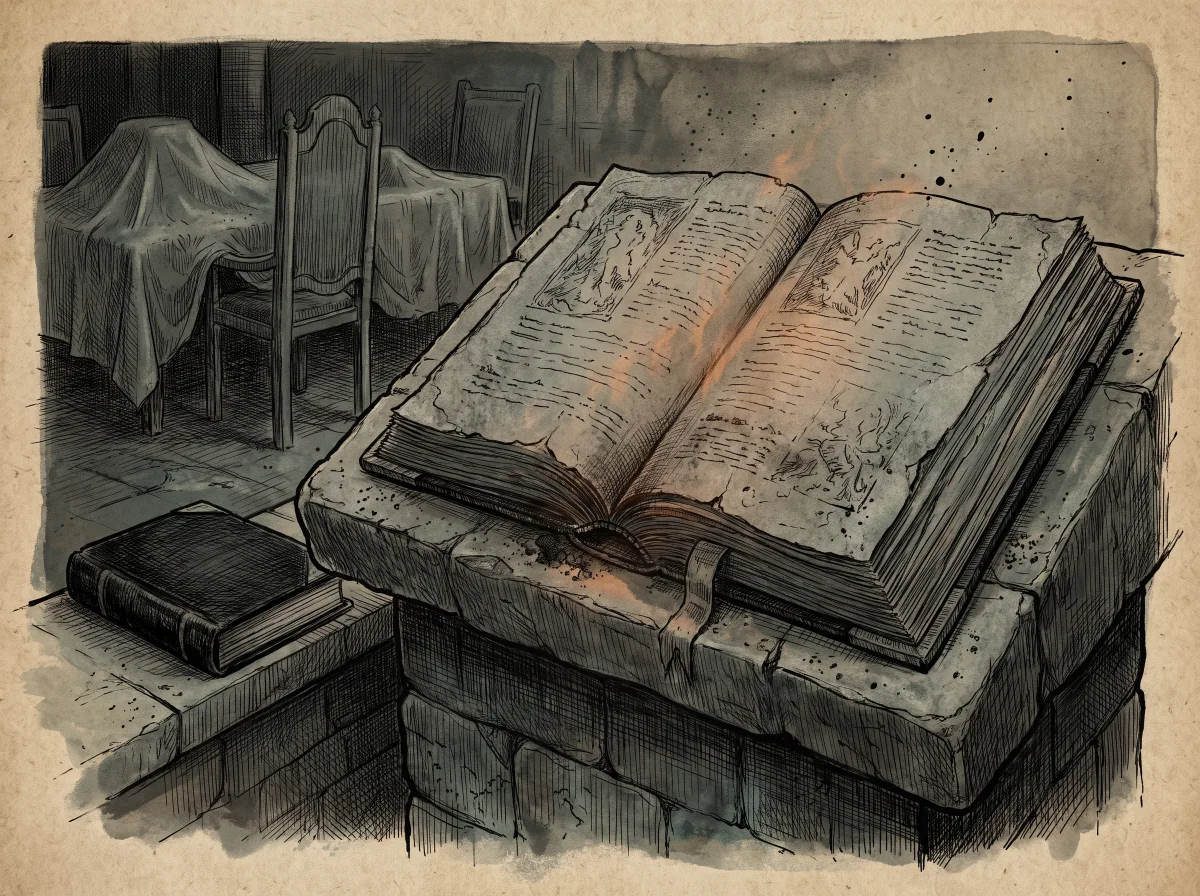
Hale stopped in the doorway at the top of the stair and did not come in.
Kell took the paper fold out of his inside pocket, the one he had carried since the night a pawnshop candlestick went grey on the desk in his rented room. He opened it at the edge of the lectern, beside the nearest page, and looked from one to the other.
There was no difference at all.
"They don't make it," he said aloud. Corvin had come to stand beside him. "The Houses. I asked what they burn to make Ash. They don't burn anything. Things burn on their own when they're made to owe more than they're worth. A candlestick does it in a night. A floor does it in a minute. A man does it standing in a shed, a few grains every week for thirty years." He touched the fold of dust, very lightly, with one finger. "The carts bring it up on Sundays. Somebody presses it into pages. And the pages lend it back out."
"To the Houses," said Corvin.
"To everyone. Every dram anyone in Vell ever drew is in this." Kell looked at the twelve sheeted chairs. "The creditor isn't a man. Nobody ever met it because there's nobody to meet. It's a book, and it's been keeping itself."
He laid his palm on the page.
The page went deep, and kept going.
He had read through grey-hide ledgers and a Town Book roofed with canvas and a torn leaf that remembered its binding. None of them had been like this. Under his hand the whole city opened downward in columns: Halcot's account and Merren's and every House under them, the tally floors, the guild wards, the river wards, the long sheds in the last bend where every Ashen was a small grey sum going down by grains. He saw the farm. It was only a pattern in the columns from up here, a hundred little one-entry accounts carrying skimmed drams up the routing like water up a wick, all of them ending on this page. He saw his own line, very small, five drams and four new entries. He saw Corvin's name in the fourth.
And at the head of the page, in the same grey, in the same hand of no hand at all, older than anything else in the book, he saw the terms.
ONE PART IN FORTY, ASSESSED QUARTERLY. FORECLOSURE AT DUSK. ON DEATH, TO THE SPOUSE, THEN TO THE CHILDREN, THEN TO THE SIBLINGS, WITH A FEE.
They were written in exactly the same way as the figures. Kell had spent fourteen years believing the rules of the Ledger stood somewhere above the Ledger, as a House's charter stands above its books. They were entries. Anything entered could be corrected by a man with the right hand.
He did not touch the first line. He looked at it for a long time, one part in forty, the number every child in Vell learned before they learned to count their own fingers, and he knew that the hand which could correct a floor could reach that line too. Later he would not be able to say whether leaving it was wisdom or fear. He did not write down either.
He went to his own entry instead, to the third line, and to four words in it.
OR HIS SURETY.
The Ledger balanced. He could not take a hundred and twenty-six drams out of the world any more than he could take a dram off Iver Hauk's honest foreclosure. But a term only said who paid. He laid the correction in over the four words in his very best hand, and struck them, and wrote nothing in their place.
It was the hardest work he had ever done. It was harder than the braid in Sela's kitchen and harder than the recital in Hessa's, because the book did not resist him. It let him. It watched him do it without a word, to see where it came out.
The term closed. The fourth line on his account lifted, and was gone, and he felt Corvin's name go out of his column like a hand let go of a rope.
Then the book did its arithmetic.
REVIEW CLOSED. SHORTFALL DUE FROM THE ASSIGNOR, ADDED TO LINE.
FEE FOR AMENDMENT OF TERMS: TWENTY DRAMS.
One hundred and fifty-one.
He did the rest without meaning to, because he always did. Public nine hundred and seventy and dark one hundred and fifty-one made one thousand one hundred and twenty-one, against a worth of one thousand one hundred and fifty. Twenty-nine drams of margin. One part in eight on a hundred and fifty-one was eighteen and seven-eighths, rounded to nineteen on the first of next month. Ten drams of margin after that. The month after, the book would not need to call anything.
Two assessments. He took his hand off the page.
"What did it cost?" said Corvin. He had seen nothing, only Kell's face.
"Twenty," said Kell. "And the hundred and twenty-six."
"That was mine to pay."
"It was never yours." Kell looked at him. "You wrote one clean lie in your life to keep me out of a cell. I won't let a book make you a debtor for it."
Corvin opened his mouth, and closed it, and for the first time since Kell had known him the still hands were not still at all.
Behind them, on the narrow shelf, the black book opened.
Nobody had touched it. Kell heard the board fall back against the stone and turned in time to see the pages turning by themselves, unhurried, until they stopped near the end. He went to it. Corvin came with him. Hale stayed where he was in the doorway, and Kell would remember afterwards that Hale had taken one step back.
It was a list. There were not many names in it, a few to a page, in black ink on cream paper, real ink on real paper, the only paper in the room. There were no figures beside them. Some of the hands were very old.
The last name on the last written page was his.
ARDEN, KELL.
He looked down at the grey Ledger and saw that his line had gone from it. The column where he had been was closed, neatly, the way a clerk closes an account that has been moved to another book. Everything he owed had gone with his name: the hundred and fifty-one, the two favours in the scrivener's hand, his father's scar. All of it was here now, under a name written by someone with a pen.
He put his finger beside the last letter, not on it. The ink was still wet.
There was nobody else in the room.
"I've kept the Chancellor's book for nineteen years," Hale said from the doorway. His voice was the same as always, but quieter. "In nineteen years I've seen four names go into that one."
"What happened to them?"
"I don't know, Mr. Arden. I never saw any of them again, on any page." Hale drew on his grey gloves, one and then the other. "You've met the interest. You haven't seen the principal yet."
Hale walked them down the long stair and out through Halcot's hall, where the ledgers turned their backs again, and through the chains on the Upper Walk. At the top of the terraces he stopped.
"Names on that list aren't the House's to take," he said. "Good night, Senior Tallyman. Mr. Arden." And he went back up the hill alone, a tall grey coat among grey stones, until Kell could not tell which was which.
Corvin and Kell walked down to Scrivener's Lane without speaking. Brann's window, two streets over, had a lamp in it. Kell did not go to it. He did not want Brann's children to see what was walking past their door.
At dawn he sat at Corvin's table and laid his palm on the A-tally, on his father's name, and read his line. It had moved with him. One hundred and fifty-one drams, one part in eight, assessed monthly, rounded up. The two favours. The scar.
And above them, in the creditor's space that had always been simply dark, for the first time in his life there was a hand. Someone had written the name of his new creditor there, small and neat, in a hand he did not know.
PRINCIPAL.
This is the end of Debtbound, Volume 1. Volume 2 is being written.