Debtbound – Chapter 11: Calling In
Progression fantasy & LitRPG
share this story
Corvin kept rooms above a bindery on Scrivener's Lane, which Kell found funny for about a day.
Three rooms, all of them books. Not ledgers; Corvin kept no ledgers at home, he said, because a man who audits all day should be allowed to read something that balances on its own. Histories, almanacs, a shelf of sea stories with cracked spines. A narrow bed in the back room that Corvin gave to Kell without discussion and a chair by the front window where Corvin slept sitting up, if he slept. On paper, Kell Arden was held in the custody of the audit of House Merren. In fact he was eating a senior tallyman's bread and watching the Lane through a gap in the curtain while the bindery's presses thumped through the floor.
On the second morning Corvin brought him the A-tally.
He brought it under his coat, the whole chained volume, with the chain cut. Kell stared at it on the table. In six years he had never seen a master tally leave the tally floor; there were rules about it older than the House, and Corvin had written half the modern ones.
"It's my audit," Corvin said, without looking at him. "An auditor may remove a record for examination. I've examined it." He sat down in the window chair. "Read your line. I want to know exactly where we are."
We. Kell filed that and laid his palm on his father's name.
The page went deep. ARDEN, KELL, and under the old scar and the public nine hundred and seventy, the dark line, with its patient manners. One hundred and twenty-six drams. And beneath it, new, in the hand of no hand at all, one word he had never seen written on a soul before.
CALLED. And under that: DUE IN FULL, THE FIRST OF THE MONTH.
Nine days.
They did the arithmetic together, which was the strangest part of those days and, Kell would think later, the best. Two clerks at a table, one of them wanted by every instrument in the city, going down a column of options the way they had each gone down ten thousand columns of other people's.
"Coin," said Corvin.
"The creditor isn't a House. There's no window. You can't push coin across a counter that doesn't exist."
"Transfer. Your candlestick."
"Ledgered vessels with worth at least as large as what I put in. A hundred and twenty-six drams of worth." Kell spread his hands at the room. "And every transfer discharges, and Hale finds me by the discharge, and the vessel burns to ash and someone owned it."
Corvin was quiet for a moment. Then he got up, went to the shelf by the bed, and came back with a plain silver watch and a small walnut writing desk, the kind that folds, with brass corners worn smooth. He set them on the table between them.
"Watch is on Merren's book at nine. The desk at thirty-one. It was my wife's." He sat down again. "There are some sea stories that might go two or three apiece. It isn't a hundred and twenty-six. It's a start."
Kell looked at the desk. He knew what a candlestick looked like at dawn after it had held ten drams. He saw this desk the same way, a cone of grey on Corvin's table with the brass corners lying in it.
"No," he said.
"It's a desk."
"It was your wife's." He pushed it gently back across the table. "If I start burning what people love to keep myself off a broom, I'm the farm. I'm just a smaller one."
Corvin looked at him for a long time with his tired auditor's eyes and then took the desk back to the shelf and set it down very carefully, and did not argue, which Kell understood was the most respectful thing anyone had done for him in years.
"Your own account, then," Corvin said. "The forged one. I'd give a great deal to watch you correct it."
"It doesn't pay a call." Kell had worked this out on the first night. "A correction moves my worth margin. A call doesn't look at margin. It looks at the line. If I fixed the public account tonight I'd be owed a thousand drams by House Merren and still be foreclosed on the first for a hundred and twenty-six to something with no name." He laughed, a little. "It'd be a very rich Ashen."
They sat with that.
The days went the way days go when they are being counted. Corvin went to the mezzanine every morning and came back every evening with the news, which was never good and never quite bad. Brann was still assisting. The committees were still considering. The saddler's daughter's account had been reviewed and found to be in order, which meant someone had decided she was no use as a lever, which Kell chose to take as a mercy. Hale's office had filed Corvin's audit order with the inter-House committees under a heading Corvin did not repeat.
Kell read his line every morning. It did not change. A called line does not compound; it simply waits.
On the sixth day he took out the ivory card.
He had carried it since the night in the stacks, in the inside pocket where he kept the paper fold of grey dust and the torn page from the Halcot annex, the three strangest objects he owned. He had never once taken it out in front of anyone. He laid it on Corvin's table now, small and blank, and Corvin looked at it, and Kell watched him understand what it was without being told, the way an auditor understands a document by its weight.
"Whose?"
"The man who writes clean lies for House Merren," Kell said. "Press your thumb to it, he said, and the card will know."
Corvin's still hands went flat on the table.
"A boy told me not to touch it," Kell said. "He was right. He's been right about everything." He looked at the card. "I've got three days."
"There's another way," said Corvin. "There's always another way. We haven't found it."
"We've found every way there is. We wrote them down." Kell turned the alum bill over where the column was, in pencil, small, every option crossed out in two different hands. "You taught me that. When every line in the column is closed, the column is closed."
He waited until the eighth night anyway, because he was a careful man to the end. Then he sat at Corvin's table with one candle lit and pressed his right thumb to the blank ivory.
Nothing happened that he could see. The card did not warm or glow. He only felt it in the script: a very small entry, made somewhere, in a hand he knew better than his own. It was not a debt. It was a note, in a margin: Called.
The scrivener came up the bindery stairs an hour after midnight, without knocking, as if he had a key, which Kell later learned he did.
He had not changed. Silver hair, beautiful coat, the face that had spent sixty years being pleasant on purpose. He came into Corvin's front room shaking rain off his hat, looked around at the books with real interest, and then looked at Corvin, standing by the dark window, and his pleasantness did a thing Kell had not seen it do before. It sharpened.
"Senior Tallyman," the scrivener said. "We've never been introduced. I've read so much of your work."
"And I of yours," said Corvin. "For thirty years. I could never find it."
"No," the scrivener agreed, warmly. "You couldn't. You wrote your own clean lie last week, I hear. On audit paper. I read it on its way to committee." He set his hat on a stack of almanacs. "It was very good, for a first. You put the falsehood in the recital and kept the paper true. That's the whole trick, really. Welcome to the trade."
Corvin's hands, folded on his arms, did not move. Kell had seen the man's face when he spoke of Wessic. He did not want to see what it was doing now, and he looked anyway, and it was doing nothing at all, which was worse.
"He stays," Kell said to the scrivener. "Whatever you're going to say, he hears it."
"Of course he does." The silver-haired man sat down across the table from Kell, uninvited, and laid one long hand flat beside the ivory card. "Lesson two, then. You'll want it quickly. You've got two days and a called line, and Hale is looking for anything you do that glows."
Lesson two took a quarter of an hour to explain, and Kell understood it in the first minute, and spent the rest of the quarter hour wishing he had not.
"You've been paying retail," the scrivener said, "because you've been working on your own account. Every correction you make, every braid, every transfer, you draw the cost yourself and your creditor books it. That's what a working is: a draw against the one who works it. But the script doesn't care who works. It cares where the entry lands." He turned his hand over, palm up. "Write a debt onto another account. Not a correction. A new obligation that never existed: so many drams, owed by that account to you. The cost of writing it lands where the debt lands. You pay nothing. Then assign what you're owed to whoever you owe. Your creditor takes assignments; everything up that chain does, that's how the farm feeds it. Called line, settled. Retail, avoided."
"And the account you wrote it on," said Corvin from the window.
"Pays," said the scrivener. "Someone always pays retail, Senior Tallyman. I told your clerk that the first night. The only question in my trade is who." He looked back at Kell, and his eyes were quite kind. "That's why the freshly dead. A man three days in the ground can't contest an entry. His widow can, but she won't know there's anything to contest, and if she did, who would she take it to? The proper channel?" He smiled at Corvin. "I have a dockworker for you. Died on Tuesday, a hoist chain. A hundred and thirty drams onto his transfer, a week of increase, nobody will ever look twice. It's the kindest page I've got."
Kell thought of the widow Voss pressing her receipts flat on the counter, as if the truth were a thing that could blow off a table.
He took the torn page out of his inside pocket and laid it on the table between them.
It was one leaf from a bound register, torn out by its edge in the dark while ward-light sharpened and boots rang on the gallery stairs. REGISTER OF THE HOUSE FABRIC, EAST WING, it said at the head, and below, in Halcot's beautiful archival hand: DOOR, ANNEX EAST, OAK AND IRON, WARDED: 22. SCONCE, BRONZE, PAIRED: 6. TABLE, READING, BLACKWOOD: 15. FLOOR, ANNEX EAST, BLACK STONE, POLISHED: 410.
The scrivener looked at it for a long time. For the first time since Kell had known him, the pleasantness went all the way out of his face and did not come back on its own; he had to put it back with visible care, the way a man straightens a picture.
"A page from a bound register," he said quietly. "Torn from the binding. You think the window holds."
"Pages remember their bindings. I've read through a book held together with tarred cord." Kell put his palm on the torn leaf. It went deep, slowly, through the ragged edge, and under it the annex floor of House Halcot lay written in grey light, four hundred and ten drams of assessed worth, polished black stone under a reading table. "A House isn't a widow. Nobody's grandson inherits a floor."
The scrivener sat back. Then, quite unexpectedly, he laughed: a real laugh, short and surprised, the first honest sound Kell had heard him make.
"Thirty years," he said. "Thirty years, and I never once thought to bill the building."
He taught Kell the writing then, with his long hands moving above the page without touching it, the way a master shows a junior how a column is carried without taking the pen. It was not like correcting or braiding. It was like forging a signature, which the scrivener said was exactly what it was: you wrote a debt in the account's own hand, so the account would think it had always owed it.
ANNEX EAST, OWING TO BEARER: ONE HUNDRED AND TWENTY-SIX DRAMS.
Kell wrote it into Halcot's floor in his very best hand. He felt it take. There was no cost to him at all, which was the most frightening thing about it: two months of the strap taking in holes, and now nothing, the cost of the working going down through the torn page and across the city into four hundred and ten drams of black stone.
Then he assigned it. He found the dark line behind his breastbone, the called line, CALLED, DUE IN FULL, and he set against it what the annex owed him, the way you set a note against a debt at a teller's window, and the dark took it.
SETTLED BY ASSIGNMENT, said the line. And then, because it always did: FEE FOR SETTLEMENT BY ASSIGNMENT: FIVE DRAMS.
Five drams. His line, after two months, stood at five.
Across the city, on the Upper Walk, in a chapel of an archive where Kell had been caught nine minutes reading, a polished floor of black stone began to go grey in a ring around a reading table. He could feel it through the page. Not fast. A hundred and twenty-six drams out of four hundred and ten, eaten from the middle outward, the black going matte, then pale, then soft, until there was a cone of grey dust on black stone.
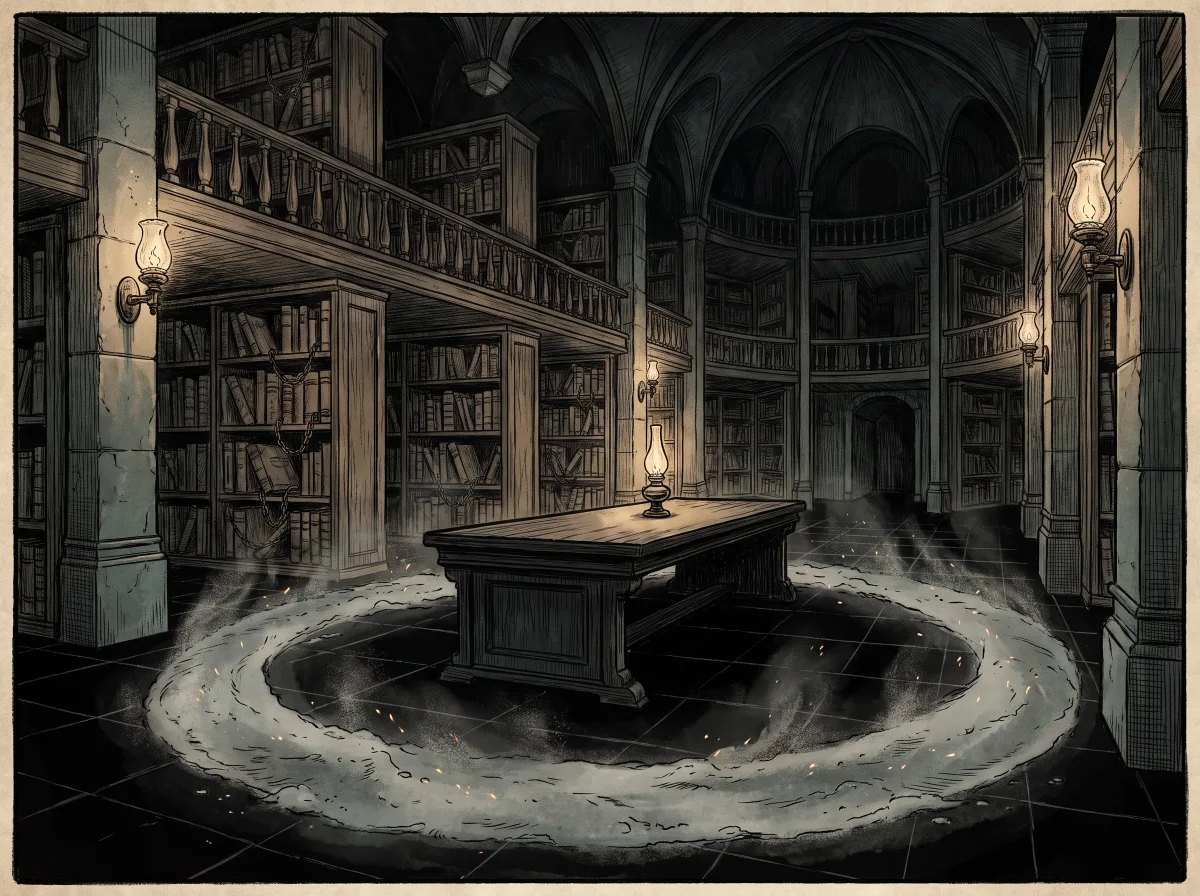
"They'll see that in the morning," said Corvin.
"They'll see a floor," said the scrivener. "They'll send for me to look at it. I'll tell them it's damp." He was already standing, putting on his hat. "Now. My fee."
Kell had known it was coming. He had known since he took the card out of his pocket. He was still not ready for the way it arrived.
The scrivener did not write in the A-tally. He did not need a book. He laid two fingers on the back of Kell's right hand, light as a man testing a page for dryness, and Kell felt it go into him: two entries, written on his soul directly, in a hand that needed no window because it had been writing on souls for thirty years.
He read them anyway, the moment the fingers lifted, through the A-tally under his other palm.
OWING TO THE SCRIVENER: ONE SERVICE, AT HIS CALLING. For the lesson.
OWING TO THE SCRIVENER: ONE SERVICE, AT HIS CALLING. For the floor of House Halcot, which he would now have to explain.
Kell knew the hand. He would have known it among ten thousand. Smoothed joins, the economy, the patience, the one small honest flaw left in each line for an auditor to find and feel clever about. He had read that hand for the first time on his father's account, fourteen years after it was written, in an empty counting hall with a lamp burning down.
"Two favours," the scrivener said pleasantly from the door. "Nothing today. Nothing this year, perhaps. You'll know when." He looked at Corvin, and at the books, and at Kell, and something in his face was almost fond. "Your line was called and you've paid it, Mr. Arden. Most men can't say that. Don't let it go to your head."
He went down the bindery stairs. Corvin stood by the window a long time without moving.
Kell sat at the table with his palm on his father's name. The dark line read five. Under it, in the hand that had written his father's ruin, two new lines said he owed it twice.
Next chapter: The Ledger of Ash. A floor in Halcot goes grey, and somebody very high up goes looking for whoever billed it. Posted next week.