
Neon ashes, starborn lies. Where love becomes a weapon
30 min read
Sci-fi stories
share this story
Chapter 1: The City That Ate Its Own Light
The sky over Klythera Station never truly went dark; it only changed flavors—violet smog at dawn, bruised orange at dusk, and a constant snowfall of ad-screens shedding static like dandruff. The station had been built to celebrate prosperity, but now it celebrated survival with ration sirens and propaganda hymns. Whole neighborhoods were powered by improvised grids: stolen solar, cracked fusion cells, and the occasional miracle of a working reactor that nobody claimed to own. Below the wealth decks, the air was thin and bitter, and people walked like they were apologizing for taking up space. Above them, the Heliarchate—the regime that claimed the stars by divine contract—held parties in greenhouse domes where imported birds still sang, unaware the rest of the city was starving. In the underlevels, where the pipes sweated and the walls sweated and even the shadows seemed hungry, resistance wasn’t a banner. It was a whisper. It was a hand passing a data-slate in the dark.
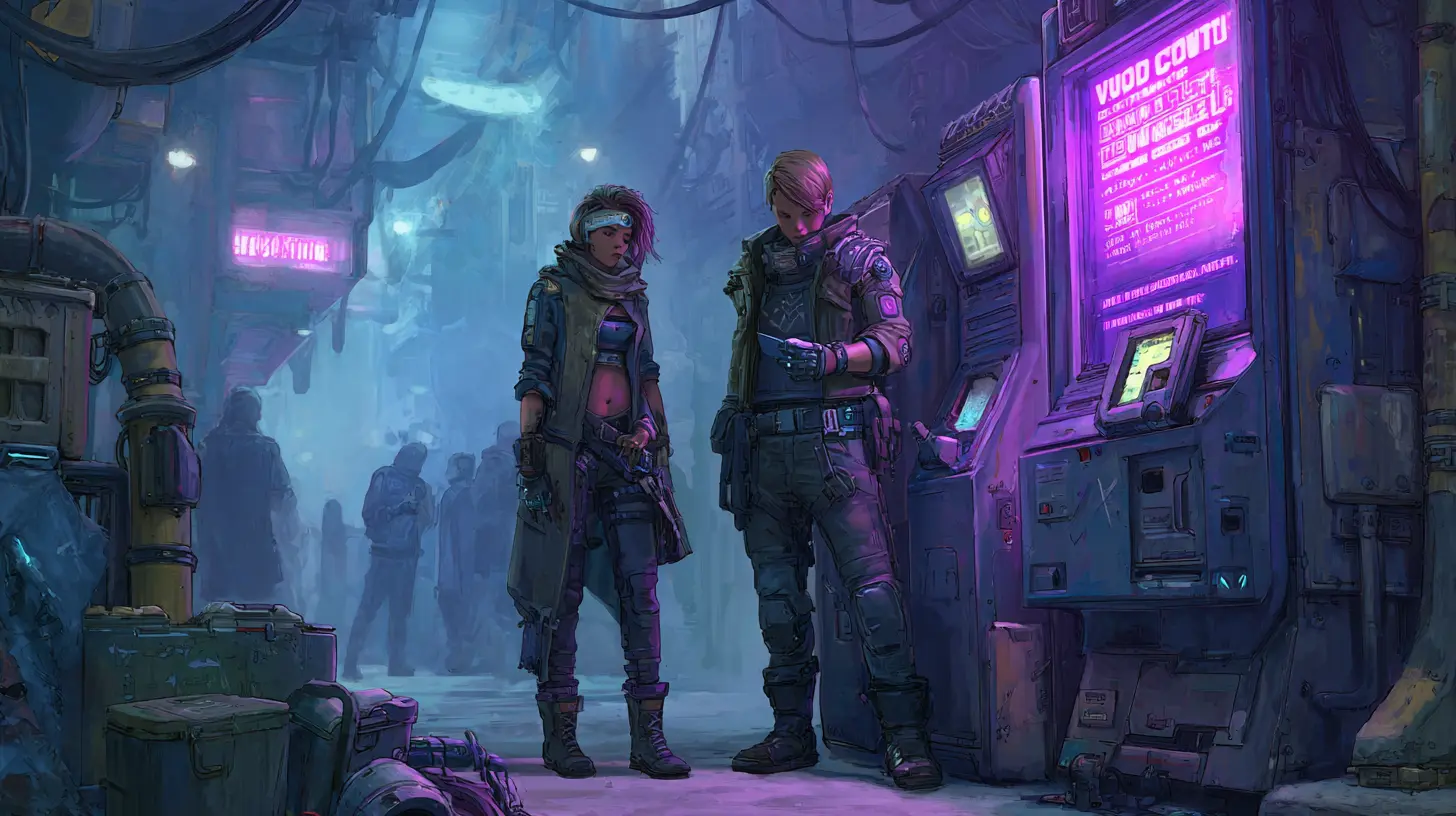
Mara Vex leaned into the glow of a busted vending machine like it was a campfire. The light carved her face into angles: a young woman with tired eyes and a grin that arrived late to every conversation, as if it had been roughed up on the way. She wore a coat cut from old courier armor, patched with duct-tape prayers and stitched pockets full of illegal tools—signal needles, micro-spoofs, a folding keyboard the size of a prayer book. She thought in patterns the way some people thought in songs: lattices of encryption, social networks like spiderwebs, the rhythm of patrol drones overhead. And she thought about Jax Rellan the way she tried not to think about hunger—constantly, fiercely, with a private shame at how much it mattered. Jax sat beside her on a crate of contraband oxygen canisters, long-limbed and restless, a boy with the kind of face that made security cameras “malfunction” because the algorithm couldn’t decide if he was trouble or just beautiful. His left wrist was wrapped in a haptic brace, a black band threaded with silver filaments, the kind of illegal augment that let you feel code like it was texture. When he flexed his fingers, Mara watched the tendons move and felt an ache in her chest that had nothing to do with fear.
Their handler didn’t use names. Names got people killed. The handler used locations, pulses, and dead drops—little graves of information. Tonight’s instruction arrived inside a children’s cartoon broadcast: a smiling comet character repeating a lullaby that, if you listened to the spacing of syllables, spelled coordinates. Mara and Jax stood under the station’s leaking ducts and pretended to be ordinary, which was the hardest kind of performance in a collapsing world. They followed the coordinates through service corridors, past homeless families camped around warm vents, past a priest selling counterfeit absolution chips, past a line of workers waiting for water that tasted like copper. At the target door—an access hatch marked MAINTENANCE: VOID COOLANT—Jax slid two fingers against the seam and let his haptic brace hum. The lock spoke to him in tiny vibrations, a language of resistance and surrender. “She’s old,” he murmured, meaning the door, but the tenderness in his voice made Mara think of the empire itself: old, proud, and ready to die cruelly. With a gentle twist, he convinced the hatch it had always wanted to open. Inside, a small room contained a chair, a projector, and a single hard-drive sealed in a polymer case like a preserved organ.
The message on the drive was blunt: STEAL THE ORCHARD. BURN THE ROOT. DO NOT GET CAUGHT. “The Orchard” was the Heliarchate’s central archive—where citizenship, debts, medical records, and identity proofs were stored. Whoever owned the Orchard owned reality. The resistance wanted to liberate it, or poison it, or both. Mara swallowed hard, tasting adrenaline like metal. “This isn’t a smash-and-grab,” she said. “This is a surgery performed during an earthquake.” Jax smiled, but it didn’t reach his eyes. He leaned close enough that she smelled ozone on his skin—residual from cheap power cells and late-night hacks. “Then we’ll be steady hands,” he whispered. His thumb brushed her knuckles, a small touch in a big ugly world, and Mara felt something bright flare inside her—an ember of defiance that hurt because it was alive. They didn’t have luxury. They didn’t have a future. But they had each other, and they had a mission that could shatter the regime’s spine. Outside, somewhere above, the Heliarchate’s anthem played again—sweet voices praising order. Mara stared into the projector’s cold light and imagined a different song: the sound of locked doors opening all at once.
Chapter 2: Orchard of Ghosts, Garden of Knives
The Orchard wasn’t a place you visited. It was a place you entered, the way you entered a storm: by mistake, by necessity, and with the sure knowledge something inside it wanted to tear you apart. Mara and Jax reached the access spine through a corridor that had once been an art promenade—polished steel, tasteful grav-sculptures, a fountain that now drooled recycled gray water into a cracked basin. The Heliarchate had sealed most routes between decks, but Klythera Station was ancient, and ancient things always had bones the architects forgot. They crawled through a maintenance lung, breathing air filtered by moss and rust, and emerged into a service alcove behind the Orchard’s outer wall. There, the regime’s security thrummed like a heartbeat: drones whispering in their sleep-chambers, motion sensors tasting the air, a lattice of laser tripwires invisible to the naked eye but loud as thunder to Mara’s scanner lens. She held her breath as she mapped it all, seeing the grid in her mind like a music score. Everything was rhythm. Everything was timing. The trick wasn’t being invisible—it was being so predictable you became part of the machine.
Jax worked first, because the door spoke his language. He touched the access panel and tilted his head like he was listening to a shy confession. His brace responded with a faint silver shimmer that crawled over his skin in circuitry patterns, a living tattoo. “They patched since last cycle,” he said softly. “New handshake protocol.” Mara’s pulse skittered. Patches meant someone else had tried this. Either another cell had failed, or the regime was expecting trouble and sharpening its teeth. She slid beside him and unfolded her keyboard—thin as a prayer, heavy as a promise—and began writing a counterfeit identity into the panel’s nerves: a maintenance tech that didn’t exist, with a schedule approved by a supervisor who’d died three months ago in a riot the regime had called an “accidental oxygen fluctuation.” Her fingers moved like she was braiding wire, quick and intimate. This was what she loved and hated about hacking: you didn’t break doors down, you seduced them. You convinced systems to betray their owners. You made truth pliable.
The panel accepted their lie with a click that sounded too much like a gun cocking. The inner door slid open on a sigh of cold air scented with antiseptic and electricity. The Orchard’s core chamber was a cathedral built for data: black glass floors, ceiling-high server trees wrapped in light, and a central column where the archive’s master index pulsed like a star caught in a cage. The beauty of it made Mara’s throat tighten. Empires always decorated their cruelty. Around the chamber’s edges, technicians moved in sterile suits, their faces behind mirrored visors—priests tending the regime’s sacred narrative. Mara and Jax stayed low in the shadows, cloaked by a frequency-haze Jax had tuned from stolen stealth fabric, and crossed the room like thieves crossing a sleeping dragon’s tongue. Mara felt the weight of the place pressing on her. Every record here was a life pinned to a wall: births, deaths, debts, criminal marks, “genetic suitability scores,” the polite paperwork of oppression. If they pulled the wrong thread, the whole web would snap and strangle millions. If they pulled the right one, the web would fall—and for the first time, people could move without a leash.
At the master index, Mara plugged in the polymer-cased drive from the dead drop. A ripple of code bloomed in her vision: an injection worm shaped like a seed, waiting for permission to sprout. The resistance’s instruction—steal the Orchard, burn the root—was suddenly less metaphor and more execution plan. Mara’s mouth went dry. “Burning the root means bricking the index,” she whispered. “It means the regime loses its hold, yes—but it also means hospitals lose patient records. Water systems lose distribution maps. Relief schedules collapse. People die.” Jax didn’t answer immediately. His gaze flicked over the server trees, the tech-priests, the quiet perfection of the room. Then he leaned close, his voice a rough thread. “People are already dying,” he said. “Slowly. Politely. On paperwork.” Mara hated that he was right, and she hated more how much she wanted to believe there was a clean way through this. Her mind raced, constructing alternate routes: copy the data, distribute it, corrupt only the regime’s control layers, leave the vital infrastructure intact. But the Orchard was built like a fortress precisely because it was the empire’s spine. You couldn’t punch the spine without shaking the body.
They started the theft anyway—because the resistance didn’t pay for hesitation, and the regime didn’t forgive mercy. Mara siphoned encrypted slices of the archive into a compressed stream, routing it through dead satellites, through broken comm relays, through a maze of hijacked civilian routers like water through a shattered aqueduct. Jax kept watch and maintained the cloak, his hands trembling in tiny, controlled spasms as he held the stealth field’s frequency steady. Sweat gathered at his hairline, glinting in the server light. Mara saw it and felt that old, dangerous tenderness. She wanted to reach out, wipe it away, tell him to stop pushing himself past the point of pain. Instead, she kept typing, because love in their world had learned to wear a knife.
Then the Orchard noticed them—not because a sensor beeped, but because the system hesitated. The central column’s pulse stuttered. A warning glyph blossomed on Mara’s screen like a bruise. “Trace vector forming,” she hissed. “They’re triangulating the siphon.” Jax swore under his breath, a low animal sound. He reached into his pocket and drew out a small device—a cracked pearl of metal with a single blinking eye. “Cicada bomb,” he said. “It’ll flood their security net with false alarms. But it’ll also wake everything.” Mara looked at him, and in that instant she saw the boy he’d been before the collapse: someone who might’ve laughed without checking for cameras first. “Do it,” she said, because there was no time for grief. Jax tossed the cicada bomb into the shadows. It clinked once against the floor, and then the entire chamber filled with phantom footsteps and invented heat signatures. Drones stirred. Lights flared. The tech-priests spun in confusion like startled birds.
A security drone snapped toward their hiding place anyway—its lens a cold pupil dilating. The cloak fizzled for a heartbeat, overwhelmed by interference. Mara and Jax were suddenly there, two uninvited truths in the regime’s holy room. The drone’s speaker barked an order in a sweet, automated voice: “CITIZENS. REMAIN CALM. SUBMIT TO VERIFICATION.” Jax moved first. He grabbed Mara’s wrist and yanked her behind the master column as the drone’s stun beam scorched the air where her head had been. The smell of burnt ozone filled Mara’s nose. Her heart slammed against her ribs like it wanted out. “We’re compromised,” she gasped. “We can still finish the copy—” Another stun beam cracked, chewing a line in the glass floor. Technicians screamed. Alarms began to sing. Jax’s eyes were wide, fierce, alive with that brutal clarity of the hunted. “We finish nothing if we’re dead,” he snapped, and it wasn’t cruelty—it was love refusing to become a martyr without a fight.
Mara’s fingers hovered over the keyboard. The seed-worm waited in the drive like a prayer or a curse. She could trigger the burn now—wipe the index, blind the regime, and leave chaos as a weapon. Or she could abort, run, and carry only what they’d stolen so far—enough to hurt the Heliarchate, not enough to decapitate it. Behind them, drones multiplied, their shadows crawling over the cathedral walls. In front of them, the Orchard glowed with stolen starlight, as if begging to be toppled. Mara looked at Jax, and Jax looked back, and in that shared glance a whole future tried to exist. She made her choice with a single keystroke—fast, final, and full of consequences.

Chapter 3: Blood in the Circuit, Stars in the Teeth
Mara’s keystroke didn’t feel like heroism. It felt like pushing a wounded animal off a cliff so it wouldn’t be dragged back into a cage. The seed-worm took root with a soft, obscene elegance—no fireworks, no cinematic countdown, just a silent spreading through the Orchard’s master index like mold through bread. On her screen, the archive’s perfect lattice began to blur, identities smearing into each other, permissions dissolving, command hierarchies turning to soup. It wasn’t a full burn—Mara couldn’t bring herself to torch the hospitals and water maps—but it was enough to make the Heliarchate’s grip slip. She targeted the regime’s “truth layers”: citizenship locks, debt chains, biometric blacklists, predictive-policing profiles. The parts of the Orchard that existed purely to own people. Those she salted. Those she broke. And the Orchard, in its cold machine innocence, screamed—an inaudible spike on the network that every security daemon interpreted as holy panic. The chamber’s lights snapped from white to emergency crimson. Drones woke fully, their rotors biting the air, their lenses narrowing with murderous intent. Somewhere far above, the station’s propaganda anthem died mid-verse, cut off like a singer’s throat.
Jax hauled Mara up by the elbow and they ran—not like graceful rebels in a holovid, but like two terrified kids sprinting through a collapsing cathedral while angels loaded their guns. The stealth haze was gone; they were visible, loud, real. A stun bolt grazed Jax’s shoulder and he staggered, teeth clenched so hard Mara heard the grind. He didn’t fall. He never fell when she was watching. They slid between server trees that hummed with stolen starlight, then vaulted a low maintenance rail and dove behind a cluster of cooling conduits. Mara’s lungs burned. Her hands shook on the keyboard she’d folded away too quickly, like she’d closed a book on a curse. “Left!” she shouted, scanning the floor’s reflection for the next drone sweep. Jax nodded and led them toward a side exit marked RESTRICTED: PRIESTHOOD ONLY. The words were meant to scare people back into obedience. Tonight, they were a map. He slapped his palm to the lock panel, felt the code through his brace, and forced it open with a violent shiver. The door spat them into a narrow corridor lined with reliquary cases—old data cores sealed in glass, labeled with saintly names and dates of “purification.” Proof, Mara thought wildly, that the regime even mythologized its deletions.
They didn’t get far before the corridor ahead filled with a new kind of threat: not drones, but humans in armor—Heliarch Wardens, faces masked in pale ceramic, rifles held with the bored precision of men who’d never gone hungry. Their leader raised a hand, and the squad fanned out with quiet confidence. “Target confirmed,” the leader said, voice filtered into something gentle and inhuman. “Surrender for processing. Resistance activity will be forgiven under the Mercy Statute.” Mara nearly laughed. Mercy. Like a leash called a hug. Jax squeezed her hand once—hard enough to bruise—then let go and stepped forward as if he were about to comply. His body language shifted, all loose shoulders and lowered gaze, a street kid playing submissive to survive. Mara understood at once: he was buying her seconds. Seconds were currency. Seconds were oxygen.
Jax lifted his hands. “Okay,” he said, calm as a liar. The Wardens took a step closer. In that step, Mara saw the little gaps in their armor seams, the cable bundles at their hips, the power packs under their ribs. She also saw Jax’s haptic brace glowing brighter, silver filaments tightening like muscle. He wasn’t surrendering—he was tuning. He was building a resonance between his brace and the corridor’s security grid, making the walls themselves listen. Mara’s throat tightened with fear and admiration and something like rage. He could get himself killed doing this. But he’d rather bleed than let her be taken. The Wardens’ leader barked, “Hands behind—” and Jax snapped his fingers.
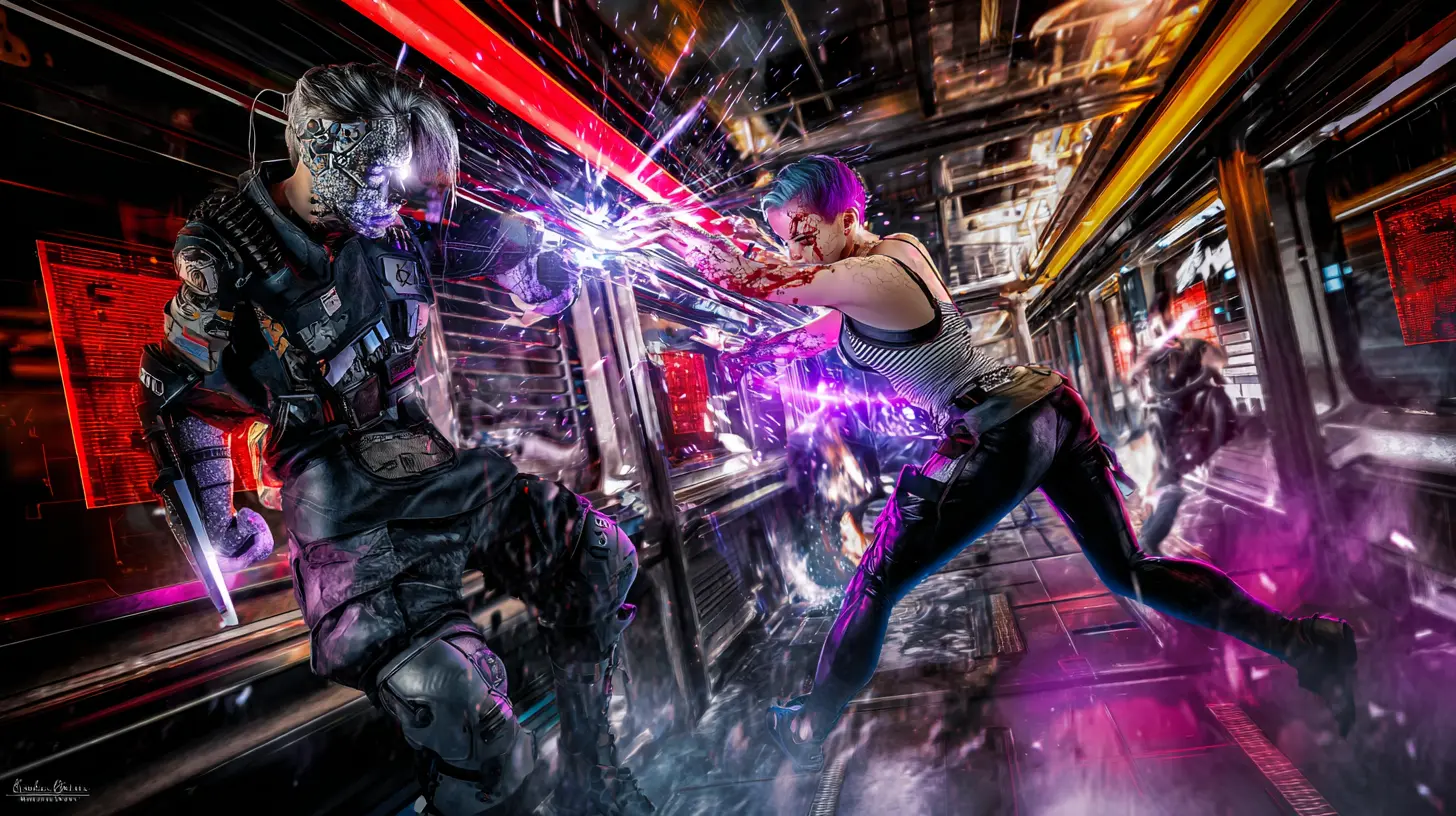
The corridor lights blew out in a pop of sparks. For half a second, everything was black—pure, honest darkness. Then emergency strips ignited in strobing pulses, turning movement into a series of violent still images. In those flashes, Mara saw Jax slam his shoulder into the nearest Warden, driving the man into a reliquary case that shattered in glittering data-glass. She saw Mara herself—because she was moving too, instinct and training taking over—snatch a broken shard of glass and jam it into the exposed cable at another Warden’s hip. Electricity spat like a cornered snake. The man convulsed, rifle clattering. Strobe. Jax’s elbow cracked into a mask. Strobe. Mara ducked under a swing and kicked a knee sideways, feeling cartilage tear beneath armor. The fight was ugly and close, the kind where you smell another person’s breath and regret. A Warden’s rifle butt caught Mara across the cheekbone, white-hot pain blooming behind her eyes. She tasted blood and metal and, absurdly, the sweet antiseptic air of the Orchard still clinging to her clothes.
They might’ve died right there—two teenagers with delusions of resistance—if the station itself hadn’t chosen that moment to remember it was collapsing. The Orchard’s partial burn rippled outward, chewing through permissions and protocols. Doors that should have stayed sealed popped open. Overhead, ventilation fans stuttered. A distant boom rolled through the corridor as some automated system tried to reboot and instead detonated. The Wardens hesitated for a fraction, instinctively glancing toward their helmet HUDs for orders that suddenly weren’t coming. Their hierarchy had been built on the assumption that the Orchard always answered. Now it answered with static. Jax seized the moment like a thief seizes an unlocked wallet. He grabbed Mara and dragged her through a side hatch that had opened on its own—an artery leading into the station’s maintenance guts. They plunged into heat and darkness, down a ladder slick with condensation, into a tunnel where coolant pipes ran like veins. Behind them, the Wardens’ shouted commands grew muddled, then lost, swallowed by alarms and failing systems.
In the maintenance tunnel, Mara pressed her palm to her bleeding cheek and forced herself to breathe slow. Her vision swam, but her mind—her mind was a storm that refused to stop. “I didn’t burn the whole Orchard,” she rasped. “I couldn’t.” Jax leaned against the pipe wall, chest heaving, his shoulder scorched where the stun bolt had kissed him. Even in pain, his eyes were bright, almost feverish. “You burned the cage,” he said. “Not the birds.” He tried to smile and winced, but the smile stayed, stubborn as rebellion. Mara’s heart lurched. She wanted to kiss him right there, taste the blood and sweat and victory, but the tunnel trembled with another distant explosion and reminded her they were still in the mouth of the beast. Somewhere above, the Heliarchate would be screaming, scrambling to restore control. The resistance would be listening for proof. And the Orchard—crippled, wounded—would be vomiting secrets into the wild network like a dying god.
They staggered onward, deeper into the station’s ribs, chasing a route only Mara’s map-minded brain could hold together. Ahead, a maintenance door blinked green—unlocked by the chaos. Beyond it waited the underlevels, the resistance safehouse, and whatever new hell their sabotage had unleashed. Mara wiped blood from her lip and looked at Jax, really looked: the boy who’d made himself into a weapon and still tried to be gentle with her. “When this is over,” she whispered, voice shaking with a hope she didn’t trust, “if there’s an after… I want a day without running.” Jax’s answer was almost a laugh, almost a prayer. “Then we steal that too,” he said, and they pushed into the green-lit doorway like two thieves breaking into the future.
Chapter 4: A Sky Made of Broken Permissions
The green-lit doorway spat them into the underlevels like a cough. Heat rolled over them—wet, industrial, alive with the stink of fungus farms and overheated converters. Here the station didn’t pretend to be eternal. It creaked. It leaked. It begged. Mara and Jax stumbled through a maze of pipes and low ceilings where families slept in shifts beneath quilts of foil, where children played with broken drone wings as if they were toy swords, where old men listened to static and called it prayer. Every screen they passed flickered with new madness: the Heliarchate’s announcements looping without a signature, ration accounts blank, debt ledgers suddenly reading FORGIVEN like a miracle stamped in bureaucratic ink. People stared at their own wrists—at their ID bands—watching the little authority lights go from red to uncertain amber. A regime built on permissions had just discovered what it meant to be denied. Mara felt the Orchard’s fracture rippling through everything, a tidal pull in the invisible sea of systems. It was exhilarating. It was terrifying. It was a knife thrown into a crowd and still spinning.
They reached the safehouse hidden behind a wall of scrap-copper saints and dead ventilation fans. The door recognized neither of them—because the safehouse didn’t trust the Orchard either—so Mara used an old resistance trick: a knock pattern tied to an audio frequency that only cheap microphones could hear. The panel clicked, and the door opened just enough for an eye to appear, then a face: Auntie Sable, not an aunt and not named Sable, a woman with silver braids and a revolver that looked like it had outlived three governments. Her gaze darted over Mara’s blood, over Jax’s burn, over their shaking hands. “You two smell like trouble and sermons,” she said. Then she yanked them inside.
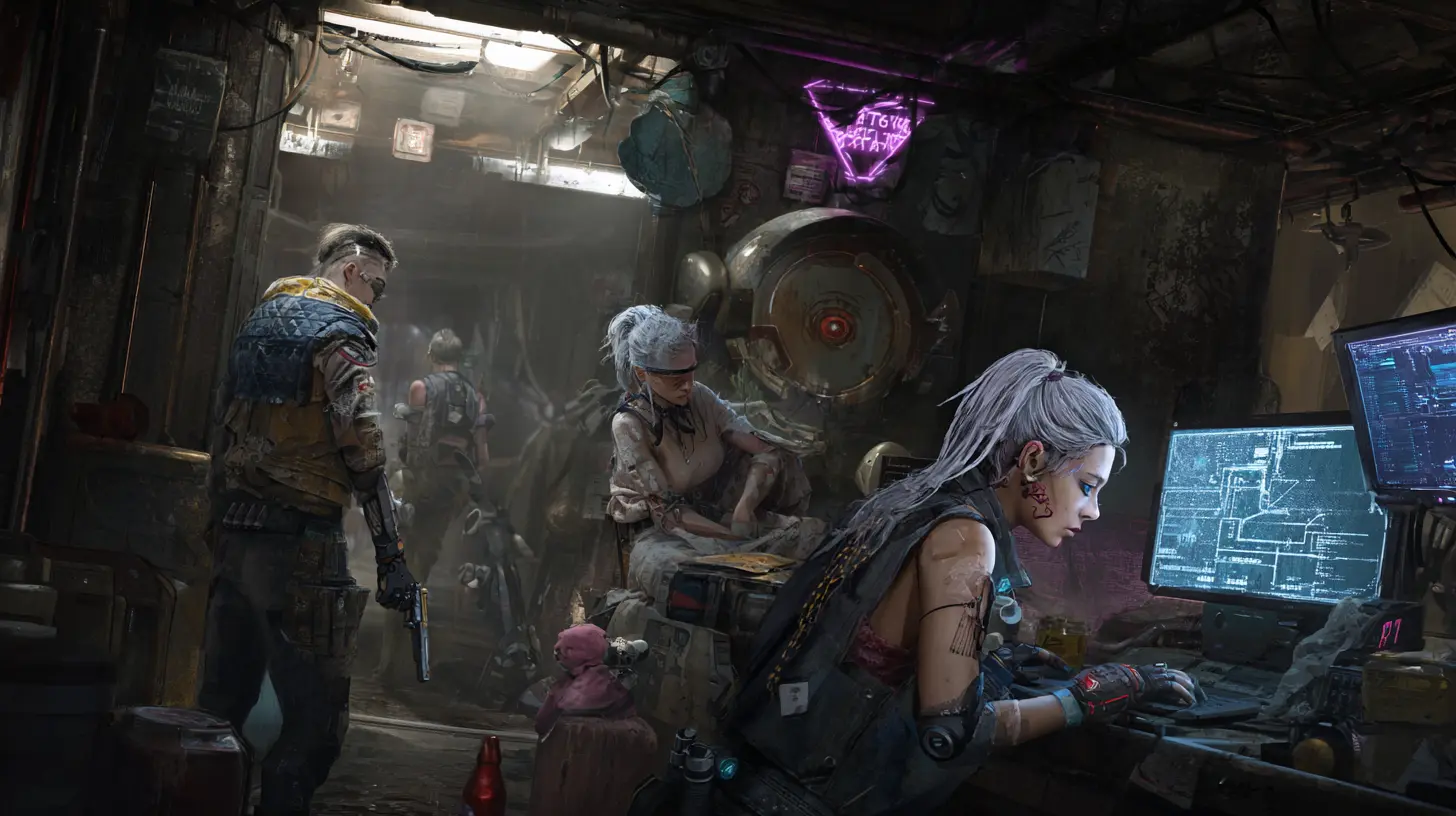
The safehouse was a cramped bunker of stolen power and stubborn hope—cots, water filters, old medical bots with their logos sanded off. Screens glowed with resistance chatter. People moved fast, speaking in clipped code and half-finished prayers. In the corner, a technician was already watching the Orchard’s spill: the regime’s secrets flooding into public mesh, cascading down into the hands of dockworkers and teachers and smugglers. Mara’s stolen stream had become a river. A river becomes a weapon when it learns where to cut. But rivers also drown. On a central display, red warnings blossomed like wounds: ORCHARD INSTABILITY—CASCADE FAILURE RISK. The partial burn had done what it was meant to do, and now it threatened to do what Mara had feared—systems tied to the same authority roots were starting to fail in sympathetic collapse. Water schedules flickered. Hospital access tokens timed out. Transit grids stuttered into deadlock. In the chaos, the Heliarchate’s Wardens were moving—hunting without certainty, but hunting harder because certainty had been stolen from them.
Auntie Sable shoved a battered comm headset into Mara’s hands. “You wanted to cut the empire?” she said. “Congratulations. Now it’s bleeding everywhere. Fix it or it bleeds on us.” Mara stared at the diagnostics and felt her stomach drop. The Orchard wasn’t simply a throne; it was a load-bearing lie. Tear it down and you didn’t just free prisoners—you also collapse roofs. Jax stepped beside her, breathing shallowly, and laid his hand over hers on the console. His fingers trembled, but his touch steadied. “We can graft,” he murmured. “Build a local trust tree. Keep the clinics and water on our own signatures. Let the regime’s layers rot, but give the people something to stand on.” Mara’s mind ignited with that familiar fierce clarity: it wasn’t enough to break chains. You had to build bridges before the fall. She began writing again—fast, ugly code, the kind that saved lives instead of proving brilliance. She created a resistance-issued authority patch: a temporary, decentralized credential system that could validate medical access, water distribution, and emergency transit without relying on the Orchard’s master index. It was duct tape for a galaxy’s arteries, and it might hold just long enough for the next breath.
Then the safehouse lights dimmed, surged, dimmed again—power instability rolling through the underlevels like thunder. The comm speakers crackled with panicked voices: WARDENS ON DECK NINE. RAIDING WATER LINE. SHOOTING ANYONE WITHOUT VERIFIED ID. Another voice, young and shaking: THEY’RE USING OLD PAPER LISTS. THEY’RE JUST… GUESSING. Mara’s jaw clenched until her teeth hurt. When regimes lose precision, they make up for it with cruelty. Auntie Sable cocked her revolver and looked at the room like a storm deciding where to land. “We move,” she said. “We protect the line.” But Mara’s hands were still on the console, still holding the fragile scaffolding of a new system. If she left, the patch might fail. If she stayed, people might die in the corridor while she typed. She felt split in two—hacker and human, lover and leader, child of collapse and architect of what came after.
Jax made the choice before she could drown in it. He leaned in close, forehead nearly touching hers, and his voice was rough velvet. “I go,” he said. “I’ll buy you the time.” Mara’s throat closed. “No,” she snapped, too sharp, too scared. “We don’t do that. We don’t—” He smiled, small and bright and unbearably young. “Mara,” he whispered, “you already taught me love is a knife. Let me hold the handle this time.” He pressed something into her palm: his brace’s override key, a tiny metal sliver warm from his skin. “If they take me,” he said, “burn my signature. Don’t let them use me to trace you.” The request was an intimacy more brutal than any kiss. Mara’s eyes stung. She wanted to scream at him for being noble in a world that ate nobility. She wanted to lock him in the safehouse and weld the door shut. Instead, she grabbed his collar and kissed him—hard, desperate, tasting blood and ozone and all the words they didn’t have time to say. When she pulled back, her voice came out cracked. “Come back,” she said, as if it were an order.
Jax left with Auntie Sable and a handful of resistance fighters, vanishing into the station’s veins. Mara stayed and became a machine for an hour that felt like a lifetime. She coded until her wrists ached and her vision tunneled. She pushed the patch across the mesh, node by node, convincing battered routers and scavenged satellites to trust a new authority: not divine, not imperial, but communal. The first confirmation ping came from a clinic on Deck Twelve—MED ACCESS RESTORED—and Mara exhaled like she’d been holding her breath since childhood. Another ping: WATER DISTRIBUTION RESUMED—LOCAL SIGNATURE. Then transit: EMERGENCY CORRIDOR GREEN-LIT. The patch was ugly, temporary, miraculous. It didn’t topple the empire by itself, but it gave people something the Heliarchate had never offered: the ability to keep living without permission.
When Jax returned, he didn’t come alone. He came with smoke clinging to his clothes and a limp that wasn’t there before. He came with a child in his arms—maybe ten, eyes huge, clutching a paper ration slip like it was a holy relic. Auntie Sable followed, her revolver’s barrel blackened, her braids loosened. “They were lining folks up,” she spat. “Shooting on guesses.” Jax set the child down gently and looked at Mara with a kind of exhausted wonder. “Your patch hit the line,” he said. “Their rifles paused. Their HUDs stopped lying to them. People got through.” Mara felt something in her chest twist and burn and bloom. Not triumph. Not relief. Something stranger: the first fragile shape of a future. Around them, the safehouse filled with new sounds—laughter that didn’t immediately die, sobs that weren’t only despair. The screens showed the Heliarchate’s official channels flickering, contradicting themselves, trying to reclaim narrative. But outside, in the mesh’s wild streets, other voices rose—citizens sharing data, exposing crimes, organizing supply runs without asking permission from any throne.
Later, when the station quieted to a wary hum, Mara and Jax sat on the floor beside the water filters. Their injuries throbbed in the calm like reminders. Mara turned the tiny override key over in her fingers and stared at it like it might bite. “We did it,” she said, but it sounded like a question. Jax rested his head against the wall and closed his eyes. “We started it,” he corrected. “That’s different.” He opened his eyes and looked at her—really looked, like he was mapping her face into memory in case the universe tried to steal it. “The Orchard will never be whole again,” he said. “Neither will the empire.” Mara’s laugh was soft and raw. “Neither will us,” she admitted. Jax’s hand found hers. His grip was warm, stubborn, alive. “Good,” he murmured. “Let’s be something new.”
Above them, Klythera Station drifted through the dark like a wounded animal refusing to die. In the far galaxy beyond, other worlds would hear what happened here—not as a clean revolution, not as a legend polished for children, but as a messy truth: two young hackers loved each other in a collapsing society and still chose to crack the sky open so others could breathe. The Heliarchate would strike back, of course. Empires always did. But the spell had been broken. The lie had been punctured. And somewhere in the underlevels, under neon ash and failing lights, a new kind of authority began to grow—not rooted in fear, but in the furious, hopeful idea that nobody needed permission to be human.
More from other interesting stories
Cyber Revolution
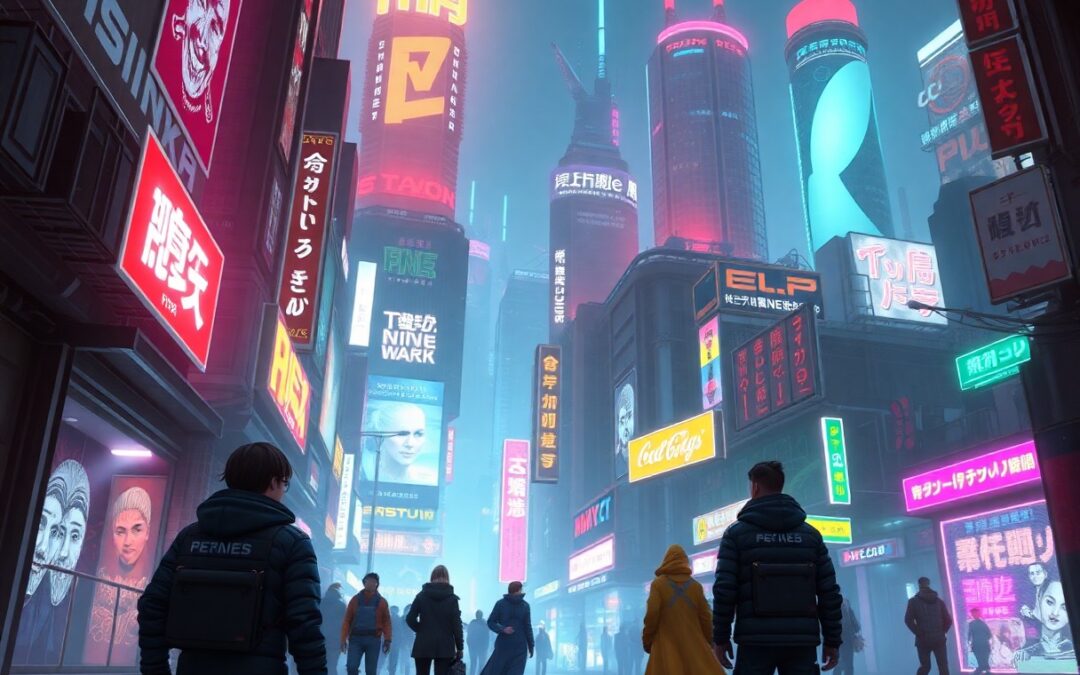
While the sun sets dimly upon this techno-dystopian city, I find solace in thine own thoughts, pondering the evolution that hath cast shadows over the very essence of humanity. In the bustling streets, superhumans reign supreme—cybernetic beings whose existence is intertwined with the very devices that give them life.