
The Treaty Before the Great Winter. Viking Saga Chapter 5
20 min read
Fantasy stories
share this story
Blood in the seal – Chapter 5
Night fell quickly, as if someone had thrown a black cloak over the land and weighted its hem with stones. Two fires remained at the ford, but the flames no longer looked friendly; they looked like witnesses who would one day tell who had stood by them and who had backed away. Salt, that precious whiteness of winter survival, lay mixed with snow and dirt, and people circled around it like hungry thoughts around their only hope. Eirik knelt by the cut rope, ran his fingers along the fiber, and felt a clean cut—no fraying, no accident. Whoever did this had a sharp knife and an even sharper reason. The same image rose in the eyes of the clans: “them” against “us,” the old game that is always played when people are afraid to admit that the enemy may be within. Haldor Staghorn sent two of his men to guard the edge of the clearing, and Jorund Ironbeard did the same; it looked like caution, but it was just a well-dressed threat. Brynja Runeblood was silent, as if gathering words that must not fall into the snow, and Sigrún stood beside her, straight and quiet, with that strange expression of someone who knows more than they would like to. Eirik felt the rope tightening around his wrist again and understood that now he had to negotiate not between clans, but between instincts: between the desire to find the culprit quickly and the need to find the truth correctly.
He stood up, walked around the circle, and looked people in the face until it became uncomfortable. In moments like these, the truth lies in the details: who looks directly at you, who looks away, who talks too much, and who remains silent too cleverly. Styr Wolf-Stomach got angry loudly, as if shouting were proof of innocence, while constantly touching his belt, where he kept his knife. Eirik noticed another detail: crystals of salt glistened on Styr’s sleeve, not accidentally spilled, but stuck in sweat, as if someone had handled the bag just before it spilled. Eirik did not accuse him immediately—accusations without evidence are just another axe to grind. Instead, he turned to Brynja. “We saw a traitor in our dream,” he said. “So tell me: is the traitor a person, or is it what walks in the mist?” Brynja stared at him so long that he felt as if she were peeling the skin from his eyes. “Both,” she replied. “What walks in the mist is the hunger for decay. And man opens the door to it. Not every betrayal is for gold. Some are for the feeling that you control at least something.” Sigrún lifted her chin, her voice thin as a blade: “I believe the saboteur did not just want to destroy the salt. He wanted the blame to fall on the other clan. He wanted to divide the fire.” That sentence said it all: the motive and the method, exactly the kind of dark simplicity that is born of panic.
Ketill Laugh-in-Coal (Hrafnvík)
a shaman who laughs even at the grave. His humor is a lock on the door of fear. He worships the fictional god of fire, Vargeldr, who is said to eat promises like dry wood. Ketill knows how to “oversalt” rituals in order to push people toward the truth – even if it is a truth they do not want to hear.
And just then, the fog on the river stirred, as if someone had breathed on the ashes and the ashes remembered the heat. A chill rose from the water, not a meteorological one; it was personal. A whisper rolled over Skjaldru, not words, but the feeling that someone was trying to suck the courage out of your bones. A figure appeared on the opposite bank—the same one Eirik had seen before—tall, slender, unnaturally calm, as if carved from shadow. It did not walk; it glided. Where its face should have been, three pale points glistened, like three moons in cold water. Haldor’s man raised his spear and shouted a challenge, but his voice broke in the middle, because a challenge is useless when you don’t know who you’re throwing it at. Brynja took a step forward and raised her hands as if caressing the air. “Nóttfadir’s messenger,” she breathed. “Or something pretending to be him.” A chill ran down Eirik’s spine so sharp that his fingers stiffened. The figure paused on the shore, and in that pause was a warning: I will come closer if you allow me. Everyone understood that this was not just a ghost. This was pressure. And pressure always seeks a crack.
The rift came immediately, because fear is faster than honor. Styr Wolf-belly stepped forward, pointed at the Deer Spears, and shouted, “See? You brought this here! This is their magic, their runes, their springs!” People moved, weapons clanged against metal, someone tripped over a piece of antler, someone slipped in the blood of defeat, and the chaos was exactly what the figure wanted. Eirik lunged forward, grabbed Styr by the collar, and jerked him so hard that the man’s teeth clattered together. “Shut up!” he growled. “If you break the agreement now, you’ll sign our death warrant.” Styr broke free, but Eirik quickly grabbed the knife from his belt—and grains of salt stuck in the crack near the handle glistened in the fire. It was proof, not a dream, not a prophecy, but cold fact. There was a murmur in the circle, someone from the Raven Shields shouted Styr’s name as if that could pull him out of the mire of guilt. Styr turned pale and his eyes narrowed to slits; for a second, he looked like a cornered animal. “I just wanted…” he began, and then his voice broke with hatred. “Just for our people to have more! So we wouldn’t be beggars at their fire!” And there was something terrifying about that confession: it wasn’t a great betrayal for power, it was a small betrayal for a sense of security. Such betrayals are easily born. And that is why they kill entire worlds.
The figure by the river moved closer, as if nourished by the confession. Darkness stretched out of the mist, thin strands like wet hair, and touched the shore. At that moment, Sigrún stepped forward until she stood on the very edge between the fire and the water. Her runic spear glowed with a gentle pulse, like a heart, and Brynja began to sing behind her, this time not in gratitude, but in defiance. Eirik understood: now the price of the contract was being decided. Not meat. Not salt. The price would be the courage to do something together, publicly, before everyone’s eyes. “A guarantee,” said Haldor, and there was no harshness in his voice, only the need for an anchor. “Now.” Jorund nodded, and the nod looked as if someone had cut off a piece of his pride. Eirik took a step toward Sigrún. Not to stop her, but to walk beside her. Together they placed the tips of their weapons in the snow and pressed their fingers, bare, without gloves, against the steel and wood—so that the blood would flow, so that it would be real. The cold bit them, but the blood was warm and stubborn. “Skjaldro,” Brynja whispered to the river, “remember this. Two clans. One seal.” Eirik felt the blood running down his fingers into the snow, and in that moment he realized that what the gods and men wanted was happening: shared pain as proof of shared will.
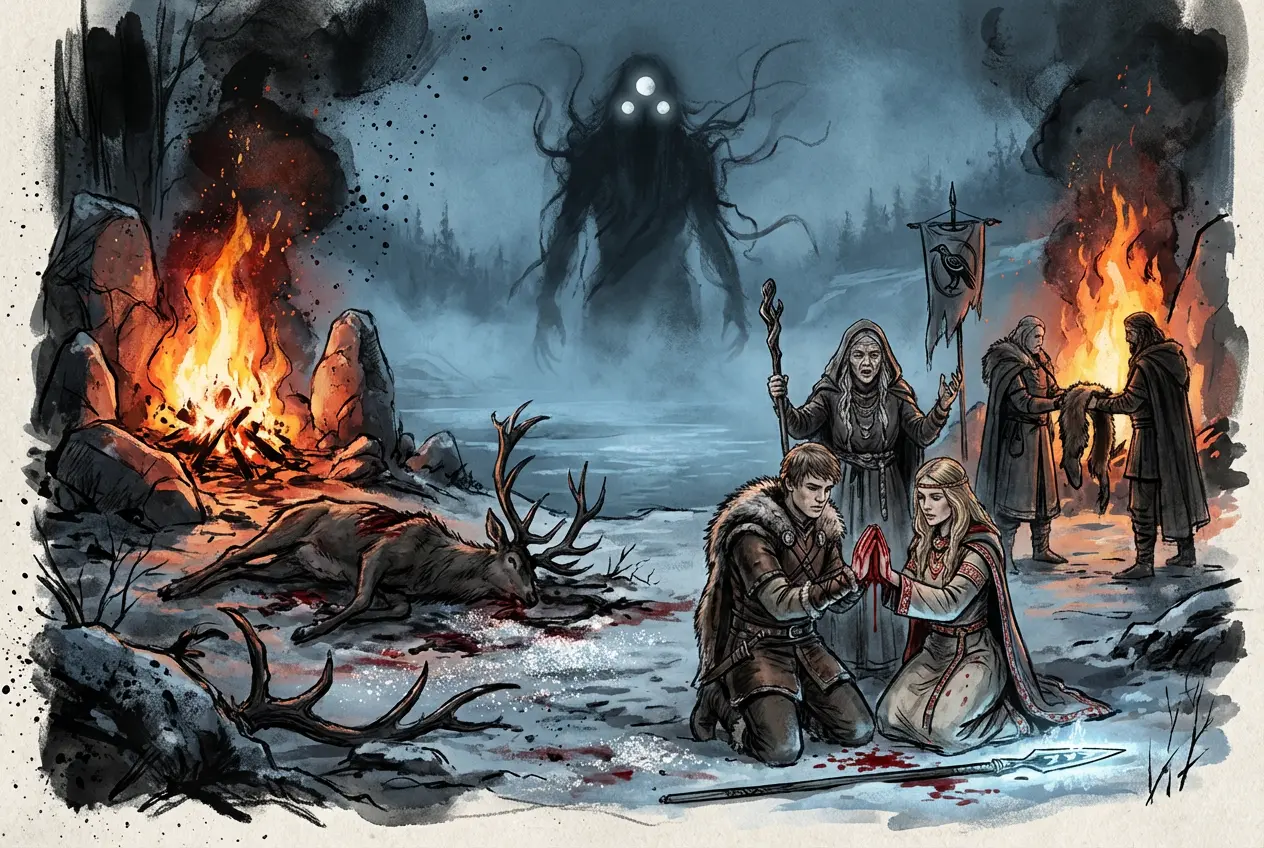
The messenger of three months hissed silently. His darkness tried to draw closer to their blood, like frost creeping along the edge of a window, but the runes on Sigrún’s spear glowed with a bright, cold light. Eirik saw the darkness pause, recede, like a dog encountering fire. The figure did not stop watching—the three pale points pulsed, as if assessing whether the seal was strong enough. Then the mist began to break, slowly, reluctantly, and a sound came from the river that could only be water… or laughter. It was not Ketill’s. It was not human. It was the sound of something retreating because it had encountered an obstacle it did not expect: unity. Styr Wolf-belly was dragged away, not to death, but to work—to the most humiliating work of winter: cleaning, drying, carrying, serving. A punishment that does not kill the body, but forces it to remember. Haldor and Jorund exchanged their fur belts in front of everyone — a simple sign that the agreement was valid. And Sigrún, the safeguard between the shores, walked with Eirik towards Hrafnvík, not as a prisoner, but as a bridge of flesh and will.
As they parted, the sky brightened for a moment with a strange light, as if the three moons had hidden deeper into the night. The great cold was not defeated; it was only postponed, like a wound that had decided to strike later. But something had changed in the people: they knew that they could withstand the pressure if they held on to each other, even if it hurt. Eirik walked beside Sigrún and felt the blood on his fingers dry into dark patches, yet he felt a strange calm in his chest, not happiness, but direction. In the distance above Frostfjall, the wind howled, and that cry sounded like a promise: winter is coming. It would be harsh, long, and merciless. But this time, two packs would stand against it as one. And somewhere in the fog, in a place beyond human eyes, the messenger of three months retreated—not defeated forever, but warned that its prey could bite back.
<<< Previous chapter
More from other interesting stories
The Treaty Before the Great Winter. Viking Saga Chapter 2
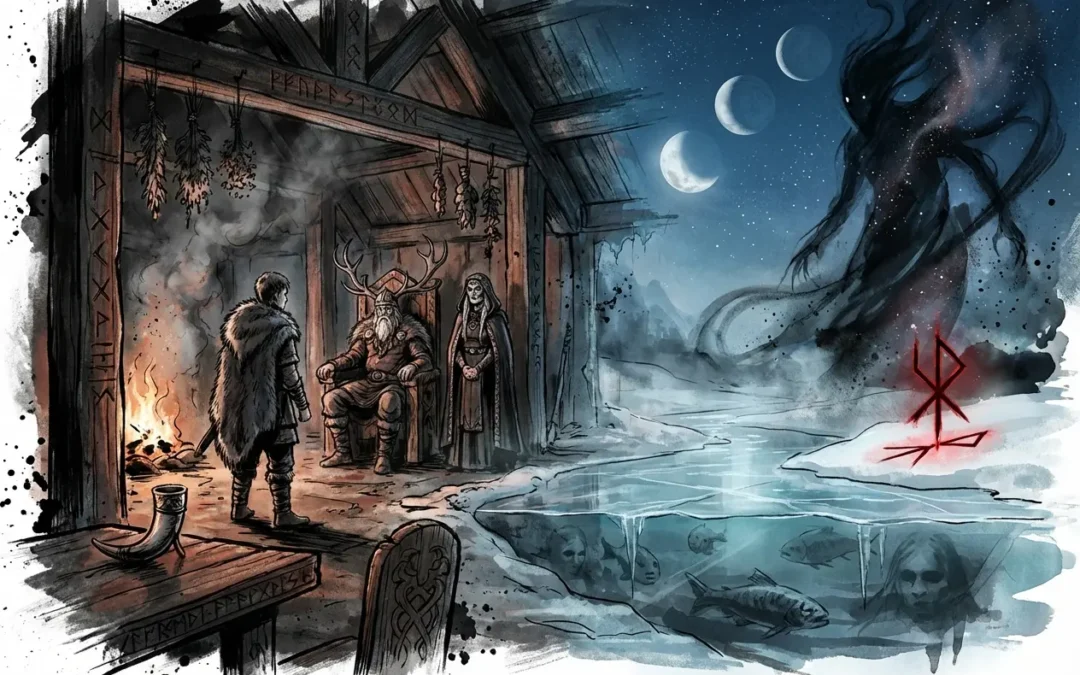
Chapter 2 of a fantasy saga inspired by the world of the Vikings. Two clans live in the neighborhood, separated by the Skjaldra River and the gray ridges of the Frostfjall Mountains. Skjaldra is not just water: it is a living strip of memory, a stream that “remembers” blood and oaths.