Everything Must Go – Chapter 10: The Town That Wasn’t There, Part One
Mystery stories
share this story
On Monday the fourteenth of December I drive to Kingston with Hal's check in the glove box and my own checkbook in my coat, and I don't decide which one I'm going to use until I'm standing in line.
The Ulster County Treasurer's office is on the second floor of a brick building on Fair Street, behind a counter with a bulletproof window and a take-a-number machine. There are four people ahead of me. A man arguing about a dog license. A young couple with a baby and a folder of paperwork they keep reorganizing. An old woman in a church coat paying something in cash, counting it out twice.
I've been afraid of the fifteenth for three months. I've done the arithmetic at two in the morning more times than I've read my father's ledgers. Final date for payment before enforcement proceedings. I read that sentence the way a claimant reads a denial letter: as the end of something.
When my number comes up, the clerk is a heavy, tired man with reading glasses on a cord like mine. He pulls up the parcel, reads for a second, and then looks at me over the glasses with an expression I recognize, because I wore it for nineteen years. It's the look of somebody about to explain a policy to a frightened person.
"Ms. Sutter. Enforcement proceedings means we start a process," he says. "It doesn't mean anybody shows up at your barn on Wednesday with a padlock. In this county an in-rem foreclosure takes years, and there are notices at every step. People pay on a plan all the time." He taps the screen. "You can pay what you can today and sign an installment agreement for the balance. Most folks in your situation do."
I stand there for a second longer than I need to.
"Who told you it was the fifteenth or else?" he asks, not unkindly.
"The yellow paper," I say. And then, because it's true: "And somebody who knew exactly how it would sound to me."
I write a check from the business account for six thousand nine hundred dollars, which leaves a hundred and twelve dollars and change for the van insurance and Theo's wages. I sign an agreement for the rest at four hundred and twenty a month. The clerk stamps everything twice and gives me a receipt on paper so thin I can see the counter through it.
In the parking lot I sit in the van with the receipt on my knee and Hal's check still in the glove box, and I laugh, out loud, alone, for the first time since February. It isn't a good laugh. It's the laugh of somebody who has just found out the wall she's been holding up with both hands for three months was never going to fall on her.
He knew. He's been dealing with estates in this county for forty years. He knew exactly what that sentence meant, and exactly what it would sound like to Walt Sutter's daughter, alone, behind on her taxes, in the first winter without him.
I take the check back to him that afternoon.
Brewer & Lowe is closed on Mondays in December, but the side door to the old vestry is unlocked and the light is on behind the frosted glass panel that still says PASTOR in gold leaf. I knock once and go in without waiting, which is something I've never done in his building in my life.
Hal's office is warm and smells of furniture wax and coffee. Bookshelves of auction catalogs going back to the seventies. A Federal desk he's never let anyone bid on. A window onto the snowy parking lot. He's at the desk in his shirtsleeves with a magnifier over a silver teapot, and when he looks up the smile is already there.
"Mae. What a nice surprise."
I put the envelope on the desk in front of him. He doesn't touch it. He knows what's in it by the way it lies flat.
"I paid the county," I say. "This morning. Most of it, and a plan for the rest. The man at the window says nobody loses a barn on the sixteenth of December. He seemed surprised anybody thought they would."
Hal leans back. The smile stays where it is. Something behind it does a quiet piece of arithmetic.
"I'm glad," he says. "Truly. I only wanted to take the worry off you. Walt would have..."
"Please don't tell me what Walt would have wanted."
That lands. I see it land. For a second his face is just an old man's face, tired, surprised. Then it's Hal again.
"All right," he says gently. "Then I'll tell you what I want, since we're being plain with each other. I want what your father and I agreed on, over forty years, in a business we built together. Things he held for me. Things that were to come to me when he was gone." He folds his hands on the blotter. "It's all in his books. He wrote everything down. You know he did. When you've finished reading them, you'll see it. And then you'll bring them to me, because you're his daughter, and he always settled his accounts."
"I'm reading them," I say. "One a week. Every line."
"Then you'll find me in every one." He picks up the magnifier again, and turns the teapot so the light runs along the curve of it. "Take your time, Mae. I've got all the time in the world. That's the one advantage of being old. You stop being in a hurry."
I leave the envelope on his desk. On my way out, through the frosted glass, I see him sitting exactly as I left him, magnifier raised, not looking at the teapot at all.
My sister Jess makes pot roast on Monday nights because our mother did, and because, she says, somebody in this family has to keep doing something on purpose.
Her house is a split-level on the edge of Rosendale with Danny's tractor parts in the garage and a kitchen that's always too warm. Danny says grace in about four words and then talks about a hay baler for twenty minutes. Theo has seconds, then thirds. I tell them about the county office, and Jess puts her fork down and looks at me the way she did when we were girls and I'd climbed something I shouldn't have.
"You thought you were going to lose the barn," she says. "Tomorrow. And you didn't tell me."
"I was handling it."
"You were handling it by yourself in the dark with Dad's coat on, which is exactly what he used to do." She picks the fork up again and points it at me. "He did that. You know he did that. Something would go wrong and he'd go quiet for a month and fix it on his own, and Mom would find out at Christmas."
Danny clears his throat and becomes very interested in the gravy.
After dinner Jess walks me out to the van. It's snowing again, small and dry, the kind that squeaks underfoot. She stands with her arms wrapped around herself in the driveway light and doesn't go back in.
"He called me," she says. "In January. A couple of weeks before."
I stop with my hand on the van door.
"He said, if anything happens, tell Mae to read the books. I said what books, Dad, and he laughed and said she'll know. And then he said a strange thing. He said: tell her to read them from the beginning. Not the end. The end's where they'll be looking." She shakes her head. "I thought he meant his will. I thought he was being Dad. I forgot about it until Theo told me about the ledgers at Thanksgiving." Her voice catches and she lets it. "I'm sorry. I should have said."
"You said it now."
"From the beginning," Jess says. "Not the end. Does that mean anything to you?"
I think of the shelf in the barn. Eleven green spines. I've been reading them like an adjuster, from the claim backward, starting with the year that hurt.
"It might," I say.
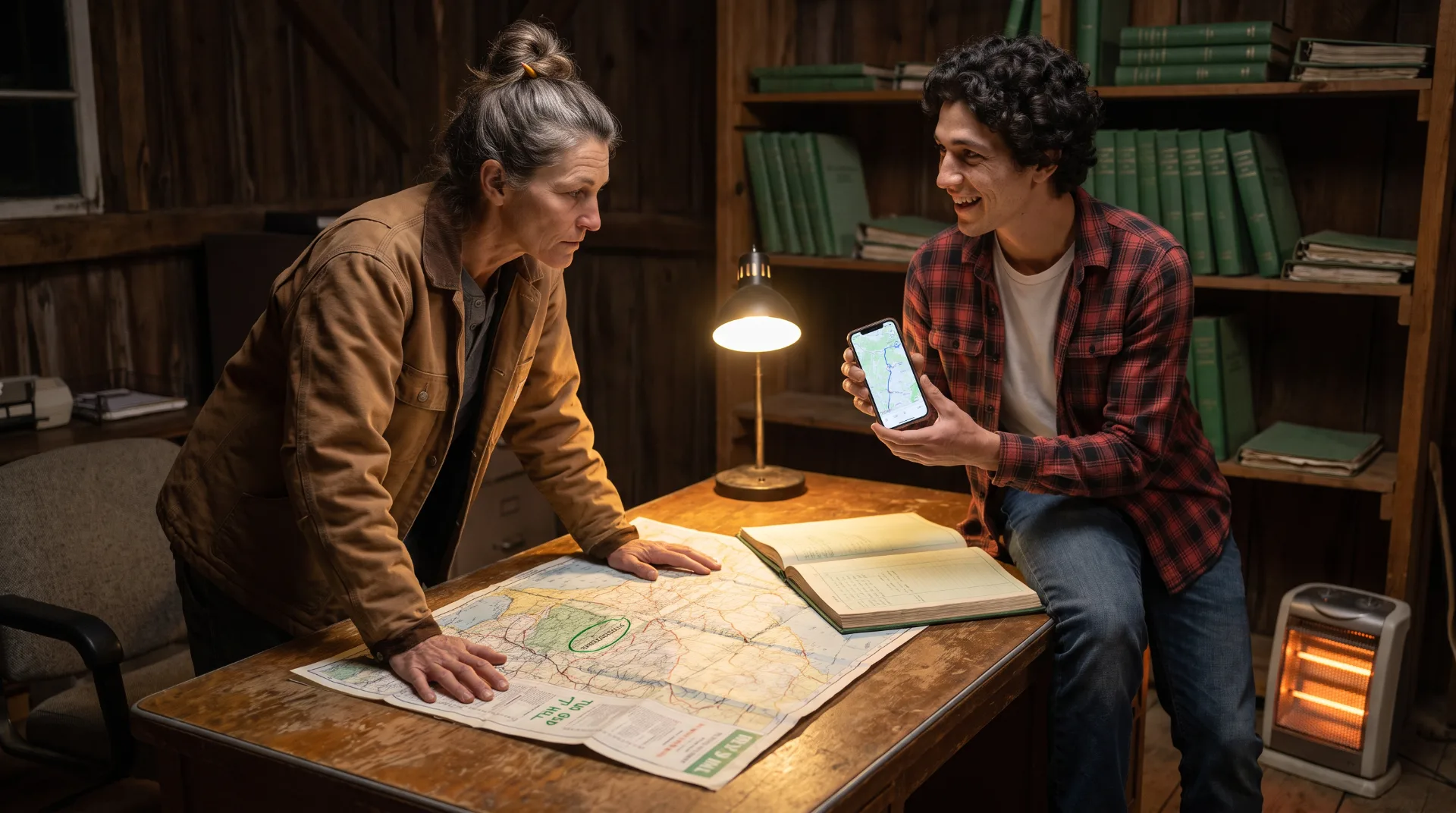
That night I mean to start at the beginning, the way Jess said. I take down 2016 and set it on the desk. Then I take down 2025 as well, because it's the last full year, and if Hal is in every book I want to see him first in the one my father was writing while he was still alive and afraid.
Theo comes over with a pizza and stays, sitting on the floor of the office with his back against the filing cabinet and the box between his knees, reading the lines out loud as I turn pages, because he's decided that's his job now. He reads my father's capitals slowly and carefully, the way Ruth read the Courier.
January: a clearance in Saugerties. February: a run of Shaker boxes. Hal's name in the buyer column three times by March, the way it is every year, ordinary, consignments and splits. Theo's voice goes flat over the dull ones and quick over anything odd. Around the end of October, he stops.
"Huh."
"What?"
"Read this." He holds the book up to me open, a finger under a line near the bottom of the page.
ALPERS-LINDBERG, O. & E. Agloe, Delaware Co. Gold hunter-case watch, movement reversed (opens wrong way). Lot 25-311. HELD.
I read it twice. Then a third time, because something in it is snagging on a memory I can't reach.
"There's no lot 25-311," Theo says. "I checked the numbers on the page. It goes 309, 310, then 312. This one's squeezed in. And it's written smaller. Look at the spacing."
He's right. It sits between two ordinary entries like a passenger who got on without a ticket.
"Where's Agloe?"
Theo looks at me with a face I've learned this month. It's the face he makes when he knows something I don't, and is trying very hard not to enjoy it.
"Aunt Mae. Agloe isn't anywhere. It's not a real place."
"It says Delaware County."
"Right. That's the point." He's already got his phone out. "Okay. So, in the 1930s there was a mapmaking company in New York, General Drafting. The guy who ran it was Otto Lindberg and his assistant was Ernest Alpers. And they wanted to catch people stealing their maps, so they made up a fake town and put it on their map of New York, on a dirt road in the Catskills up north of Roscoe, where nobody would ever check. They named it with their initials scrambled. O.G.L., E.A. Agloe."
"A trap."
"A copyright trap. If Agloe ever showed up on somebody else's map, it meant that somebody had copied theirs." He scrolls. "And it did. Years later it showed up on a Rand McNally map, and General Drafting went gotcha. Except Rand McNally said, no, it's a real place, there's a store there. Because some people had built a general store at that exact intersection, and they'd seen it on the Esso map, so they called it the Agloe General Store. The fake town became real because people believed the map." He grins. "There's a whole novel about it. Paper Towns. I had to read it in tenth grade."
I'm not listening to the last part. I'm opening the top drawer of my father's desk, the one I know by heart, and then the second drawer, the one I don't, because it's full of old maps he used before he had a phone and I've never had a reason to go through them.
They're road maps, dozens of them, folded and refolded until the creases have gone soft as cloth. Mobil, Sunoco, Texaco. An Esso map of New York State from some year in the fifties, the cover a cartoon family in a convertible. When I unfold it on the desk a little dust comes up into the lamplight.
Up in the Catskills, north of Roscoe, in the middle of a lot of nothing, somebody has drawn a neat circle in green ink around a dot and a name in tiny type.
Agloe.
Beside it, in the margin, in my father's capitals:
O.G.L. + E.A. = AGLOE. A TOWN THAT ISN'T THERE, TO CATCH A THIEF. W.
I sit down very slowly in my father's chair.
"Theo," I say. "Hand me my notebook. The black one. Front pocket of my coat."
He brings it. I go back through it to November, to the Koenig house, the day Hal came down the basement stairs ducking under the beam. I wrote it in the van afterward because I didn't want him to see me write it in front of him. I find the page.
Hal: "Arthur and his toys. He made Walt a pocket watch once that opened the wrong way. Walt used it for years to annoy people." No such watch. Never was. Checked desk drawer, nothing. Why say it?
I turn the notebook around and put it on the desk next to the ledger, so the two lines sit side by side under the lamp. A gold watch whose movement is reversed. A pocket watch that opened the wrong way.
Theo reads them both. I watch him get there. His face does what mine must have done a minute ago.
"There's no watch," he says slowly.
"There's no watch. There's no Mr. and Mrs. Alpers-Lindberg. There's no Agloe." I put my finger on the line in the ledger. "Grandpa made this up. In October of 2025. He put a fake entry in his own book, a thing that never existed, belonging to people who never existed, in a town that was invented to catch people copying. And he squeezed it in between two real lines so it would look like it had always been there."
"So if anybody ever talked about that watch..."
"Then they'd read this page. Because it isn't anywhere else in the world. Not in a catalog, not in a house, not in anyone's memory. Just here." I tap the book. "And Hal stood in a dead man's basement in November and told me about it like he was remembering a friend."
Theo is quiet for a long time.
"When could he have read it?"
I already know. I knew when I was sitting in the van in the treasurer's lot this morning, laughing at nothing.
"March," I say. "Three Saturdays. He came with coffee and two of his yard men and helped me sort my father's things because I couldn't face it on my own. I sat in the stalls going through crates and crying, and he sat in here, at this desk, helping. The ledgers were on that shelf. He had all day."
My father knew Hal was reading his books. That's the only reason to build a town that isn't there. He'd caught him at it, or suspected it, sometime in 2025, and instead of saying anything he did what Otto Lindberg did in the 1930s. He put a fake town on the map and waited to see who copied it.
And Hal had. He'd taken the trap home in his head and handed it back to me as a memory.
I pick up the phone and call Lena. It's ten past eleven at night. She answers on the second ring, which tells me something about the kind of week she's having too.
"It's me," I say. "I've got something that isn't string. I think my father left it for us."
"Read it to me," she says.
I read her the line. I read her the note on the map. I read her my notebook from the Koenig basement. When I'm done there's a long silence on the line, and then a sound I've never heard her make before: Lena Ortiz, laughing quietly, alone in her kitchen at eleven at night.
"A trap street," she says. "Your father put a trap street in his ledger."
"A trap town."
"It's not enough. You know that. A man repeated a story about a watch."
"I know."
"But now we know what to look for." I hear her pull out a chair and sit down. "If Hal Brewer ever puts anything on paper that came out of those books, Mae, it'll have that watch in it. Or something like it. Your father wouldn't have built just one." A pause. "How many ledgers haven't you read yet?"
I look up at the shelf. 2020. 2021. 2022. 2023. And 2016, 2017 and 2018, which I skipped because I thought they were too old to matter.
"Seven," I say.
"Then read faster," Lena says. "Every one of those towns is a door he doesn't know is there."
After she hangs up I sit for a while with the heater ticking. Then I do what Jess told me, what my father told Jess to tell me, eleven months late.
I pull 2016 across the desk, where it has been sitting all evening. The oldest one. The first year he stopped trusting the computer. The cloth is faded almost grey, and the spine has been opened so many times it falls open by itself.
The first page has the year in his capitals, and under it the line he wrote at the start of every ledger he ever kept. WRITE WHAT YOU SEE.
Under that, in pencil, very faint, added later in a hand that was already starting to shake, there's one more line I've never seen in any of the others.
FOR M. START HERE.