Everything Must Go – Chapter 9: The Hair Wreath, Part Three
Mystery stories
share this story
The letter comes back by mail on Thursday.
Peter calls me from River Road at nine in the morning with his voice pitched high and careful, the voice of a man holding something he's afraid to drop. A padded envelope in the mailbox, addressed in typescript to The Executor, Estate of Miss H. A. Vosburgh. Brewer & Lowe Auctioneers in the corner, with the little engraved church.
Inside is a square of brown kraft paper folded in thirds, worn soft at the creases. And a note on Hal's cream letterhead, two lines in his long confident hand.
Found among papers Harriet asked me to look after during our visit in October. I believe it belongs with the wreath. Warmly, H.
"He's giving it back," Peter says. "Just like that."
"He's giving it back," I say.
I drive over. Lena drives over. Theo is already there, because Theo now drives to River Road every morning on his own to help Peter pack the almanacs, and because, I suspect, he likes being useful to somebody who isn't me. We stand around the kitchen table looking at the folded paper without touching it, the four of us, like people at an accident.
"He read it," Lena says. "Before he sent it. You know that."
"I know that."
"He read it, and decided whatever's in it can't hurt him, or would hurt him more if it turned up later in somebody else's hands. So he's the gentleman who found it and returned it." She looks at the note. "Lost causes, he cuts. That's his gift. He'll be telling people at church on Sunday how he helped."
Nora comes in at ten, still in her scrubs, with her coat over them and her eyes red from twelve hours awake. Peter hands her the paper without a word. It's addressed to her, after all, or to people like her.
She reads it standing up, by the window, in the cold white light off the river. When she's finished she hands it to me, and sits down, and puts her face in her hands, and Peter puts his hand on her back.
I read it out loud, because she asks me to.
For June's children, if they come.
My name is Harriet Vosburgh. I am writing this in September of 2024 at the kitchen table on River Road, because Mr. Walter Sutter has been here this afternoon and told me where June went, and I find I cannot say it out loud to anyone and must put it somewhere.
Your grandmother was born on the third of March 1946 in our Aunt Ida's back bedroom on Lark Street in Albany. Her mother was my sister Agnes. Her father was Thomas Brandt of Rosendale, who was killed on Okinawa the May before and never knew. Agnes was nineteen. I was seventeen. Our father sent us both to Albany in November to wait it out where nobody knew us, and told the town Agnes was delicate.
The birth went wrong. I will not write how. The doctor did what he could. Agnes held her for about an hour, and said she wanted to call her June, because June was when Tommy was supposed to come home, and then she said she was tired, and by morning she was gone.
Our father came on the first train. He did not cry where I could see. He spoke to the doctor in the hall, and when the papers were written, the doctor had put my name down as the mother, not Agnes's. Father said it was kinder. He said Agnes would be buried clean, of pneumonia, and I was a minor, so my name would go into a sealed file and nobody would ever think to look for a child belonging to a girl who had never been with child. He was right. Nobody ever did.
They took June to the Children's Aid on the twenty-fourth of March. The night before, I cut a little curl from the back of her head with Aunt Ida's sewing scissors while she slept, and I kept it in my glove all the way home on the train.
When Mother died I put her in the wreath beside Grandmother, where she belonged. When Edwin died I put him at the end beside Father. I never moved June out of the middle. I know that is not how it is done. But she never got to be anywhere else, so I gave her the center and kept it for her.
Mr. Sutter says June died in 2019 in Poughkeepsie, and that she was loved, and had a daughter, and the daughter had a daughter who is a nurse. He went to find her for me. He came back and said she might not be ready, and that I should not take it personally, because people come when they come. I am ninety-five and I do not have much time for people to come in. But I am also a coward, and always have been, and I find I cannot go and knock on her door.
So: if you are reading this, you came. The wreath is yours. It was always hers. And you should know that your great-grandmother Agnes was brave and was loved and did not die of pneumonia, and that her sister was not brave, and kept quiet for seventy-eight years, and is sorry.
Harriet A. Vosburgh.
P.S. Mr. Sutter would not take any money. Please thank him if you see him. I never know how.
I stop. The kitchen is very quiet. Outside, a car goes over the bridge, and the tall clock in the hall, which has said ten past four for longer than any of us has been alive, goes on saying it.
Nora takes her hands away from her face.
"She signed it with her right hand," she says. "In 2024. Before the stroke." She looks at me. "That's what a real signature of hers looks like."
I take out my phone and find the photograph of Hal's bill of sale, the eleventh of October, and lay the phone down on the table next to the letter.
Lena looks at the two signatures side by side for a long time. Then she photographs them, together, with a pencil beside them for scale. She's started doing that. I didn't teach her. She just started.
It's Theo who notices. Of course it is.
He's been sitting very quietly at the end of the table through the whole letter, the way he does when something is happening that he knows isn't about him. When I put the paper down, he asks if he can read one line again, and I hand it to him, and he reads it under his breath, and then he reads it a second time out loud.
"Thomas Brandt of Rosendale."
"Ruth said there was a Brandt boy," I say. "Tommy."
Theo puts the letter down very carefully on the table, as if it's gotten heavier.
"Aunt Mae," he says. "What's my last name?"
I look at him. Twenty years old, curly hair, chipped front tooth, my sister's son. Theo Brandt. Jess married Danny Brandt when she was twenty-three, a big quiet man who fixed tractors, whose family farmed apple orchards outside Rosendale for four generations before the developers came. I've been to Thanksgivings at the old Brandt place. There's a photograph in the front hall there that I've walked past fifty times without looking at: a boy in a Navy uniform, very young, with the Brandt jaw and a grin like Theo's.
"Danny's grandfather had a brother," Theo says slowly. "Who died in the war. Grandma Brandt used to say he was the handsome one. There's a picture of him in Grandpa's hall." He swallows. "His name was Tommy."
Nora is staring at him.
"So that makes us," she says. "What does that make us?"
Peter, who teaches teenagers and therefore knows how to do arithmetic about families in his head, works it out on his fingers. "Tommy was your great-grandfather. Tommy's brother was Theo's great-grandfather." He looks up. "Third cousins? Second cousins once removed? Something like that."
"Cousins," Theo says. "We're cousins." He sounds astonished and delighted and about eleven years old, and I have to look out the window at the river for a while.
In this valley everything is somebody's great-granddaughter. I said that a week ago as a joke.
"Grandma Brandt is going to lose her mind," Theo says. "She's going to want you for Christmas. She's going to want to show you every photograph in the house. Nora. She has so many photographs."
Nora laughs, the first time I've heard her laugh, a sudden surprised sound that she covers with her hand. Then she stops laughing and doesn't uncover her face for a while, and Theo, without being asked, gets up and makes her a cup of coffee on the old stove, which nobody else can work.
Lena takes it to the district attorney's office in Kingston the following Monday: the bill of sale, the hospice log, Beverly Ahn's statement, the video of the empty pocket behind the wreath, the two signatures side by side. She calls me from the parking lot afterward.
"They won't charge it," she says. "Not on this. An elderly woman with a stroke, a family friend who says he guided her hand, a sale he voided himself the minute anybody questioned it, and a letter he returned of his own free will. The ADA called it a misunderstanding with unfortunate optics." I can hear traffic. "She also said, off the record, that she'd like to see the file if anything else ever turns up with his name on it."
"So that's three."
"That's three times he's walked through a house where somebody was dying or dead and come out with paper," Lena says. "And three times there's no crime anybody can charge. I've got a whole drawer now. It's the most interesting drawer I've ever had." A pause. "Mae. He's careful. People like that aren't careful forever. They get old and they get impatient. When he slips, I want to be standing there."
The wreath goes home with Nora on the Saturday.
Peter and Theo carry it out to her car between them, wrapped in two moving blankets, the walnut case resting on Nora's back seat with a pillow wedged on either side. Peter has decided, as executor, that his aunt's letter is clear enough about what she wanted, and that if anybody in the family wants to argue about it they can argue with him. Nobody in the family is left to argue.
Before she goes, Nora walks up the hill to the cemetery by herself, with a pair of pruning shears from Harriet's garden shed. I watch from the bottom of the hill. She kneels by the small white stone at the end of the row, unties the twine on the burlap around the rosebush, checks the canes underneath the way you'd check a sleeping child's forehead, and ties the twine again, tighter. Then she stands there for a while with her hand on the top of the stone.
When she comes down she gives me a hug I'm not expecting, in the cold, in her nurse's parka.
"Thank your father," she says into my coat. "She asked me to. In the P.S."
"I can't."
"I know. Thank him anyway." She lets go. "I'm going to hang it in my living room. Right in the middle of the wall. And when people ask, I'm going to tell them all of it. Every single name."
After she's gone, Peter and I walk through the house one last time. Most of it's packed. The almanacs are boxed for the historical society, the Canton china for the January sale, which Peter has moved from Brewer & Lowe to an auction house in Hudson without telling me why, and without needing to.
In the front hall he stops in front of the tall clock that has said ten past four since before either of us was born.
"Aunt Harriet stopped it," he says. "Did I tell you? When I was little I asked her why it never ran, and she said it had stopped on its own one day and she'd rather leave it." He opens the narrow glass door of the case and finds the key on a hook inside, where it has always been. "I don't think it stopped on its own."
"Ten past four," I say. "In the afternoon. In March?"
"I don't know. Maybe." He winds it, slowly, counting the turns under his breath. Then he takes out his phone, checks the time, and moves the long hand around with one finger, very carefully, until it's right.
The pendulum swings. The clock begins to tick. It's a loud tick, in an empty house, and both of us stand there listening to it for longer than either of us would admit.
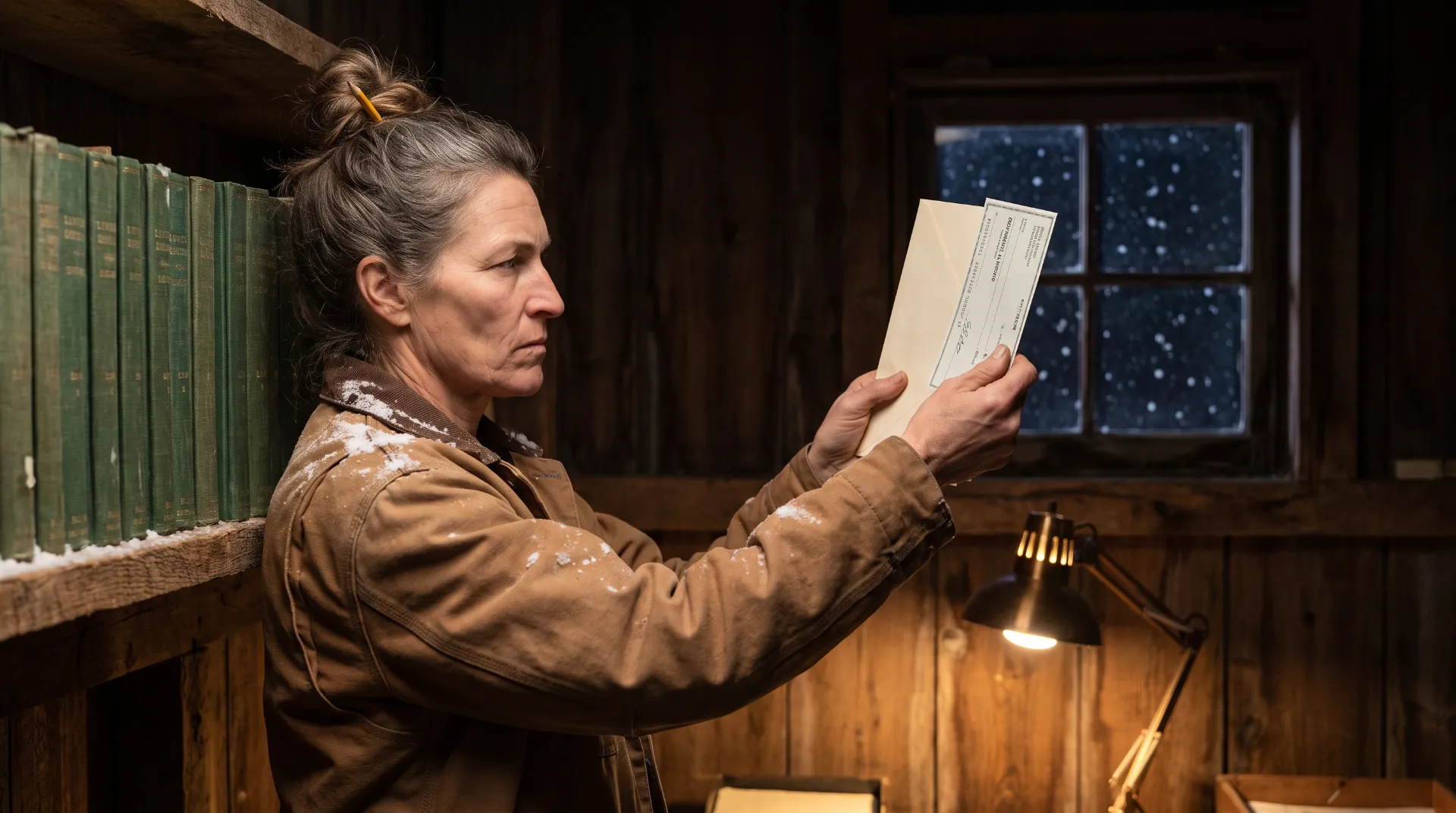
The county deadline is Tuesday the fifteenth. On Saturday the twelfth, when I get back to the barn from River Road, there's an envelope in the mail slot of the office door.
Cream, heavy, Brewer & Lowe in the corner. No stamp. Hand delivered.
Inside is a cashier's check drawn on a bank in Kingston, made out to Sutter Estate Services, for eleven thousand three hundred dollars and no cents. The exact amount on the yellow paper under my 2019 ledger. Folded around it is a single sheet of his letterhead.
Mae,
For the county, before the fifteenth. I know what the barn means to you. It meant as much to me, for forty years.
In return I'd ask only for Walt's ledgers. All eleven. He and I kept a great many things in those books that were never meant for anybody else to read, and I'd like to be the one who puts them away properly. You'd be free of all of it. You could sell the business, or keep it, and never think about any of this again.
By Christmas, if you would. You know where to find me.
With real affection, as always,
Hal.
I read it standing in the office doorway in my coat with the snow coming in behind me. Then I go in and close the door and sit down at my father's desk and read it again.
It's the honest offer, that's the worst thing about it. The money's real. The deadline's real. The barn is real, the roof and the stalls and the milk cooler with the mice in it and the pegboard with the empty hook, and in three days the county starts the process of taking it. And everything he says about the books is true. There are a great many things in them that were never meant for anybody else to read. I've read four of them now. There are seven more, sitting on the shelf above my head, in order, green spines, my father's capitals.
Theo comes in at six with two coffees, sees my face, sees the check on the desk, and puts the coffees down very slowly.
"No," he says.
"I haven't said anything."
"No," Theo says again. "Aunt Mae. Not for H.B. Ever. He wrote it on four tags. He wrote it on the storage unit. He wrote it in the ledger." His voice cracks on the last word and he doesn't care. "Grandpa spent two years hiding things from that man. You can't just hand him the books."
"I know."
"Then why haven't you torn it up?"
I don't have an answer for him. I look up at the shelf. Eleven ledgers. Four read. Seven to go, and three days, and eleven thousand three hundred dollars on the desk between us in a cream envelope with a little engraved church on the corner.
I take the check and stand it up on the shelf, in front of the ledgers, leaning against the spine of 2020. Where I'll see it every time I reach for the next one.
"Because I want to know what he thinks is in them," I say. "Before I decide."
The real story behind the Hair Wreath
Victorian hair wreaths were real, and they were common. Through the middle of the nineteenth century, families in Britain and North America kept the hair of their dead and worked it into jewelry, framed pictures and wreaths. The practice grew sharply after Prince Albert died in 1861 and Queen Victoria began four decades of public mourning, and in the United States after the enormous death toll of the Civil War.
A family wreath worked much like a family tree. Hair was wrapped around fine wire and shaped into flowers and leaves, often one flower per person, and new flowers were added as relatives died. Wreaths were usually built in a horseshoe shape left open at the top, which was read as the soul rising toward heaven. Some museum examples record that the flower in the center belonged to the most recently deceased, and was moved aside when someone new died. Not every lock came from the dead: living relatives sometimes added hair too. The custom faded in the early twentieth century, after the First World War and the 1918 flu.
The DNA detail in the story is real as well. Hair cut from the head has no root, and routine forensic testing of hair shafts relies on mitochondrial DNA, which passes from mother to child and cannot tell apart relatives on the same maternal line. Newer sequencing methods can sometimes recover more.
Harriet and Agnes Vosburgh, June, and the house on River Road are fiction.
Sources: Black Creek Pioneer Village · Kent-Delord House Museum · Rancho Los Cerritos · Genes (2022), mitochondrial DNA from rootless hair