Everything Must Go – Chapter 11: The Town That Wasn’t There, Part Two
I read 2016 in one sitting. It takes until four in the morning.
It's a smaller book than the later ones, the business still small, my father still doing most of the hauling himself. Barn clearances in Accord and Stone Ridge. A run of estate sales in Kingston. Hal's name in the buyer column on every second page, the way it is in all of them. I read it with the ruler, line by line, waiting for whatever start here means.
In April there's a house on Spring Lake Road. KITTLE, R. (dec'd). Clearance for son, D. Kittle, Phoenix. Highboy, Queen Anne, cherry, c. 1760. To B&L. Est. $200 per H.B.
Two hundred dollars. I've cleared a hundred houses. A Queen Anne cherry highboy from the 1760s, in decent condition, is not two hundred dollars. It's not two thousand. It's a number you say slowly.
Three pages later, in June, a single line in the margin, in different ink, the green faded but still clear:
Kittle highboy sold at B&L Oct. to private buyer, $14,000. H. told son $200 was the "auction estimate" and paid him $180 after fees. I was there. I said nothing.
And under that, in a third ink, darker and newer, the capitals pressed hard enough to dent the page:
THIS IS WHERE IT STARTED. I SHOULD HAVE SAID NO. I DIDN'T. W.
I sit back in the chair.
I've spent three months building a man out of these books. The careful one. The one who wrote wise in a dentist's diary and not for H.B. ever on four cardboard tags and drove to Albany to find a dead woman's niece for free. I built him line by line, and I liked him better than I liked the father I remembered, who went quiet for a month when something went wrong and let my mother find out at Christmas.
And here, at the beginning, in his own hand, is a man standing in a dead woman's house in Spring Lake watching his oldest friend take a grieving son for fourteen thousand dollars, and saying nothing.
I don't know what to do with that. So I do what I always do, and write it down. In my own notebook, in pencil, so I can't confuse it with his. 2016. Kittle. He knew. He let it go.
Then I turn the page, because he told me to start here, not stop here.
The letter comes on the eighteenth of December, by certified mail, and the mail carrier makes me sign for it on her little screen with my finger in the snow.
Gerald T. Pratt, Attorney at Law. Wall Street, Kingston. Two pages on heavy paper, and a stapled bundle behind them as thick as a church bulletin.
I read it standing at the office door. Pratt writes the way lawyers write when they've been told to sound reasonable: my client, Mr. Harold Brewer, and the late Mr. Walter Sutter, and a longstanding business relationship of more than forty years. My client purchased and paid for certain items, which Mr. Sutter agreed to hold on my client's behalf. My client now requests that these items be delivered to Brewer & Lowe Auctioneers no later than the fifth of January, in advance of the January sale, at which some of them will be offered. Failing which, my client will have no alternative but to seek their return through the courts. Copies of Mr. Sutter's own business records are enclosed.
The bundle is photocopies. Ledger pages, in my father's capitals. Not one page with four lines crammed at the bottom like the film from Arthur Koenig's nickel. Real-looking pages, a dozen of them, from different years, each with one line highlighted in yellow. Each with a lot number. Each with a price.
HART, E. Kedzie folio. SOLD H.B. $11,000.
KOENIG, A. Coin cabinet, dr. 7. SOLD H.B. $3,400.
PRUITT, L. Box, sealed. SOLD H.B. $900.
ABERNATHY. DEWITT. Every object from storage unit fourteen, and more besides. A shelf clock from a house I've never heard of. A set of Shaker boxes.
He learned. Arthur told him what was wrong with the first page, and he learned. These have lot numbers. They have dates in the margin. If I hadn't spent three months reading the real books with a ruler, I'd believe them.
And on the last page, from 2025, highlighted in yellow like the rest:
ALPERS-LINDBERG, O. & E. Agloe, Delaware Co. Gold hunter-case watch, movement reversed. SOLD H.B. $1,800.
I make a sound out loud in the empty office.
It's there. He copied the trap. He copied a watch that doesn't exist from a town that isn't there into a legal demand with his lawyer's name on it, and sent it to me by certified mail.
Then I turn to the last sheet, which isn't a photocopy of a ledger. It's a color photograph, glossy, printed on photo paper, with a typed paragraph under it.
The photograph is a gold pocket watch, the hunter case open, lying on a square of green baize. The dial is ordinary. The crown is on the wrong side, at eight o'clock instead of twelve, so the whole watch opens backward, the way a left-handed thing opens. Inside the lid, engraved in a neat script: W.S. to H.B. 2025.
Mr. Brewer remains in possession of the watch described in the 2025 entry, a novelty piece exchanged between the two men as a private joke and paid for by Mr. Brewer as recorded. It will not be offered for sale. A photograph is enclosed for your records.
I sit down on the office step in the cold with the photograph in my hands.
He didn't walk into the trap. He walked up to it, looked at it, and built the town.
On Saturday Theo and I drive to Agloe.
I don't have a good reason. I tell myself it's research, the way I used to tell myself it was research when I drove past a claimant's house on a Sunday to see whether the roof they said had collapsed was still on. Really I want to stand somewhere my father drew a circle around.
It's an hour and a half west through the Catskills on Route 17, then north out of Roscoe on Route 206 into country that gets emptier with every mile. Snow on the hills, black trees, a creek running fast and dark beside the road under a skin of ice at the edges. Theo navigates with his phone and reads me things as we go: that the mapmakers put Agloe at a dirt-road intersection where nothing was, that sometime in the fifties somebody built a general store right there and called it after the name on the Esso map, that the store closed and the town hung on in atlases for decades afterward, and that people still come out here to stand at the crossing because of the novel.
"There's nothing here," he says when we pull onto the shoulder. "Like, that's the point. But there's really nothing here."
He's right. A two-lane road. A narrower one crossing it, Morton Hill Road, climbing away into the trees. A mailbox on a post. A field under snow. No store, no foundation I can see, no sign of anyone ever having called this a town except, nailed to a fence post at the corner, a small hand-painted wooden sign that someone has put up and someone else has kept repainting.
AGLOE.
I get out of the van and stand in front of it in the cold.
A man made this place up in the 1930s so he'd know if someone stole from him. And then somebody believed the map, and built a store, and for a while it was real. My father understood that. He understood that a lie written carefully enough becomes a place people can stand.
That's what Hal has been doing for forty years. Not stealing. Writing things down until they became true. Est. $200 per H.B. An auction estimate, a grieving son in Phoenix, a check for a hundred and eighty dollars. A bill of sale with a dying woman's name on it. A page in a dead man's handwriting that says sold. Every one of them a little town on a map, and everybody in Callow Falls driving through it every day without ever slowing down.
"Aunt Mae?" Theo has come up beside me, hands jammed in his flannel. "You okay?"
"He knew," I say. "Your grandfather. He knew what Hal was in 2016, and he didn't say anything, and then he spent ten years trying to make up for it in the only way he knew. Writing it down."
"Is that bad?"
I think about it for a long time, standing at a crossroads in a town that doesn't exist.
"It's not enough," I say. "It's also not nothing."
Theo takes a photo of the sign with his phone. Then he takes one of me in front of it, without asking, and shows it to me. A tall woman in an old man's coat, squinting in the cold, in the middle of nowhere.
"For the account," he says. "No address. I promise."
"You can't post a sign that says the address."
"It's a fake town," Theo says. "Nobody's going to find it."
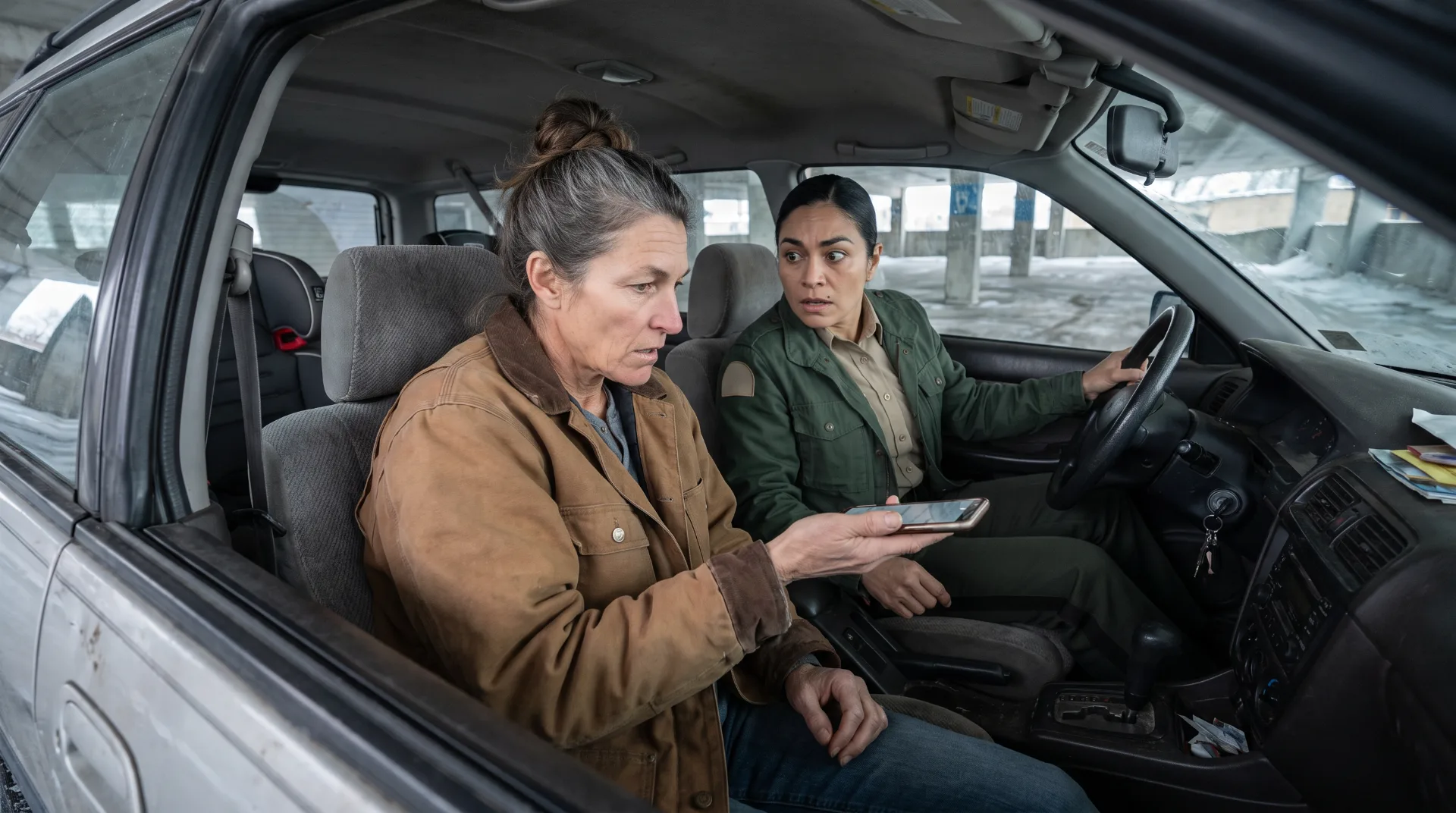
On Monday morning Lena drives me to Kingston to meet an assistant district attorney named Dana Ruiz, who has a corner office with a view of a parking structure and a framed photograph of a German shepherd in a police vest.
She reads Pratt's letter. She reads the bundle. She reads my notes from three months of ledgers, the four HELD tags, the hospice log, Arthur Koenig's diaries, the film, the trap, the Esso map with my father's green circle. It takes her an hour and ten minutes. Lena drinks two coffees and doesn't say a word.
"Here's where you are," Ruiz says finally. She takes her glasses off. "A demand letter isn't a crime. It's a letter. If Mr. Brewer files these pages with a court, as exhibits in a suit to recover property, and they're forged, that's offering a false instrument for filing. In New York that's a felony. But I'd have to prove they're forged, and right now what I have is a handwriting question and a dead man who can't testify."
"The trap," I say. "The watch. There's no such watch."
"There's a photograph of a watch right here," Ruiz says gently. "Engraved. W.S. to H.B. 2025. His lawyer will put it on a table in front of a jury, and some retired jeweler will tell them it's a perfectly ordinary left-handed movement, and Mr. Brewer will tell them about his old friend's sense of humor, and they'll smile at him." She puts her glasses back on. "Your father's trap has a real watch in it now. That's a problem."
In the car, Lena doesn't start the engine for a while.
"He's good," she says. "I keep telling you."
"I know he's good."
"He saw you hear him say it. In the basement in November. He went home and thought about it. And when it came time to put the books on paper, he made sure the one thing you'd heard about was real." She shakes her head. "He doesn't make the same mistake twice. He makes a new watch."
My phone buzzes. Theo. He's been at the barn since six with the photograph of the watch and his laptop, because I asked him to see what he could find, and because asking Theo to see what he can find is like asking a terrier to see what's in a hole.
Call me. Now. Found it.
I put him on speaker.
"Reverse image search doesn't find the engraved one," Theo says, very fast. "But I took the engraving out. Cropped it so it's just the case and the dial and the crown. And it's on an auction site. A dealer in Albany. Antique 14k hunter-case pocket watch, rare left-hand movement, crown at eight, excellent condition. Same scratch on the bow, same little dent at four o'clock on the case, I checked them side by side, Aunt Mae, it's the same watch."
"When?" Lena says.
"Listed September thirtieth. Sold October ninth." Theo takes a breath. "Twenty-twenty-six. This October. And in the dealer's photos there's no engraving inside the lid. The lid's blank."
Lena turns her head and looks at me. Neither of us says anything for a second.
My father died in February. A watch engraved W.S. to H.B. 2025 was sitting in a dealer's case in Albany with nothing written inside it eight months after the man who supposedly gave it was dead.
"Screenshot everything," Lena says to the phone. "Every page. Every photo. Email it to me and to Ms. Ruiz before you do anything else. Don't click buy, don't message the dealer, don't do anything clever."
"I wasn't going to do anything clever."
"You were absolutely going to do something clever," Lena says, and starts the car.
Ruiz calls Lena that afternoon. Lena calls me. The message, relayed, is short.
It's good. It's very good. It's still a civil dispute until he files.
"She means we wait," Lena says. "Pratt gave you till the fifth of January. If you don't deliver, Hal sues for the property, and his lawyer attaches those pages to the complaint. The minute that complaint hits the clerk's desk in Kingston with forged pages in it, it's a crime, and Dana can charge it." She pauses. "He has to be the one to file. We can't make him."
"And if he doesn't?"
"Then he doesn't, and you keep your father's things, and he sits in his church for the rest of his life knowing you know." Another pause. "He'll file, Mae. He's been waiting forty years for those books. He's not going to stop because of one watch."
I spend the next three nights on 2017 and 2018, because that's the order, because my father told Jess to tell me to start at the beginning, and because I've learned by now that when he says something three times it means something.
2017 is ordinary. I read it twice to make sure.
2018, in the second week of November, between a dry sink from Marbletown and a box of quilts, there's a line written slightly smaller than the lines around it, squeezed in, a passenger without a ticket.
LINDBERG, O. G. Morton Hill Rd., Agloe. Shelf clock, Seth Thomas, ogee case, c. 1860. Lot 18-266. HELD.
I check the lot numbers. The line above it is 18-266 too: a pair of brass andirons from the same house in Marbletown. Two lines, one number.
There are two of them. He built Agloe twice. Once in 2018, the year after he started really watching. Once in 2025, seven years later, when he was sure.
I reach for Pratt's bundle. My hands aren't steady, so I count the pages instead of flipping them. Page one. Two. Three. Four. On the fifth page there's a photocopy of a ledger page from November 2018, every line in my father's capitals, lot numbers in order, and one line highlighted in yellow.
LINDBERG, O. G. Morton Hill Rd., Agloe. Shelf clock, Seth Thomas, ogee case, c. 1860. Lot 18-266. SOLD H.B. $2,600.
I'd read it on Friday. I'd read it and seen shelf clock and Seth Thomas and a house I've never heard of and turned the page to look for the watch. I'd done exactly what Hal did. I'd looked for the town I already knew about.
Theo is asleep on the office floor with his coat over him. I don't wake him. I lay the real 2018 ledger and the forged page side by side on the desk under the lamp, and photograph them together with a pencil beside them for scale, and send the picture to Lena at one in the morning with no message.
She calls back in under a minute. She doesn't say hello.
"Morton Hill Road," she says. "That's the road. The real one. Where the fake town was on the map."
"Yes."
"And he bought a watch to cover the one you'd heard about. And never noticed the clock."
"He didn't know there was a clock. He doesn't know there are two." I look up at the shelf. 2019, 2020, 2021, 2022, 2023. "He might not know if there are more."
Lena is quiet on the line for a long moment.
"He'll file on the fifth," she says. "With that page in it."
"Yes."
"Then on the fifth," Lena says, "I'll be standing there."