Everything Must Go – Chapter 3: The Green Book, Part Three
15 min read
Mystery stories
share this story
Eleanor Hart kept her papers the way she kept her pantry. On Thursday morning I find them in a four-drawer oak cabinet in the room she called the office and Dennis called the junk room: hanging folders, typed tabs, an index card taped inside the top drawer listing what lives in every drawer, revised in pencil as recently as September.
Theo is downstairs packing the kitchen. I can hear him narrating to nobody as he wraps the mason jars. Beans, August. Rice, August. Flour, August. He stopped finding it funny around the third shelf.
I start with H, because that's where I would have filed it.
HART HOUSE, GENERAL. HART HOUSE, ROOF 2019. HART HOUSE, PAPER.
The last folder is thin. The first thing in it is a carbon copy, an actual carbon, of a typed letter dated September 20 and addressed to Hudson Valley Environmental Testing on Broadway in Kingston.
Dear Sirs. I enclose four samples for analysis. Three are specimens I have removed from my own copy of Dr. R. C. Kedzie's book of arsenical wall papers (1874), numbers 72, 73 and 74. The fourth is a strip of the original paper from the back parlor of my house, which was steamed from the wall in August by a visitor and has troubled me since. I should like to know whether any of them contain arsenic, and how much. I have had headaches, nausea and tingling in my hands since the end of August, and my physician believes I am old. I am old. I should still like to know. Payment enclosed.
It's signed in the same small upright hand as the tags on the keys.
I read it twice. Then I sit down on the floor of the junk room with my back against the cabinet, because my knees have decided that for me.
She cut the pages herself. Not a thief, not a collector. A ninety-one-year-old woman with dressmaker's shears and a ruler, taking three leaves out of a book she knew was irreplaceable, because nobody would believe her about her own walls and she wanted proof. That's why the edges were white. That's why the twine was new. She wrapped the book up again herself, tied it, and put it under the quilts.
Stapled behind the letter is a receipt from the lab, paid by check, and a note in pencil: Results 3 to 4 weeks. Called 10/2, not yet.
She died on the seventh.
Under the receipt is something older: two typed pages, folded in thirds, from 2019. Agreement. I read it standing up.
In consideration of eleven thousand dollars, Eleanor M. Hart grants to Harold Brewer the right of first refusal on her copy of Shadows from the Walls of Death, should she or her estate ever offer it for sale, at a price to be set by independent appraisal. Signed by Eleanor. Signed by Hal, the long confident signature I've seen on a hundred auction checks.
Witnessed by Walter Sutter.
My father's signature is the last thing on the page. Green ink. I'd know it from across a room.
So Hal didn't lie to Dennis about a check. He paid her eleven thousand dollars in 2019 for a promise: the right to buy the book first, if it was ever sold. And he let a grieving nephew believe he'd bought it outright, because a man who thinks the book is gone doesn't go looking for it.
The roof was replaced that summer. There's a folder for that too.
"Aunt Mae?" Theo calls up the stairs. "You okay? You went quiet."
"I'm reading," I say. "Come up here and bring your phone. I need a witness who isn't dead."
The woman who answers at Hudson Valley Environmental Testing tells me she can't discuss a client's results with a third party, and then, when I explain that the client is dead and I'm clearing her house, tells me she's very sorry and still can't.
"Were they sent?" I ask. "That's all I need to know. Not what they said."
A keyboard. "Mailed October ninth. To the client's address on Orchard Hill Road."
Two days after she died. I walk downstairs to the brass tray in the front hall. The mail in it stops on the sixth.
I call Dennis.
He picks up on the second ring, which tells me something about the week he's having. When I ask about his aunt's mail he's quiet for a moment, and then I hear him moving through a house, a door, a drawer.
"The post office forwards everything to me," he says. "There's a pile. I haven't opened most of it. It's catalogs and the church and people telling me they're sorry." Paper. "Hudson Valley Environmental."
"Open it. Read me the part that isn't letterhead."
He reads it badly, the way people read chemistry out loud, stumbling on the units. I don't need the units. I need the sentences, and the lab put them in plain English at the bottom, the way labs do when they expect the client to be a homeowner and not a chemist.
All four samples contain arsenic. The three book specimens contain it at levels consistent with nineteenth-century arsenical pigments. The strip from the parlor wall contains it too, and the analyst has added a note: the surface of the strip shows the paper was heated and lifted while damp, which loosens the pigment layer, and the client should avoid disturbing the remaining paper and have the room assessed before using it.
Dennis stops reading. I can hear him breathing.
"She wasn't confused," he says.
"No."
"I told her she was confused. I told her doctor." His voice does something I've heard a lot of voices do on the phone, in a lot of kitchens. "She was right, and she found out alone, and she died two days before the letter came."
I don't say anything. There isn't anything that helps, and anything I say will be about me.
"Who steamed the wall?" he asks finally.
"That's my next stop."
The Callow Falls Historical Society lives in two rooms in the basement of the public library, behind a door with a hand-lettered sign and a bell you have to ring. The woman who answers is Ruth Kessler, who has chaired the society for twenty-two years and taught my sister algebra before that. She has reading glasses on her head and another pair around her neck.
"Mae Sutter," she says. "I was so sorry about Walt."
"Thank you. Ruth, did the society send anyone to photograph Eleanor Hart's back parlor in August? For the house tour?"
She frowns. "The spring tour is set in January. We don't photograph anything until March. And the Hart house was never on it. Eleanor wouldn't have people tramping through." She takes the reading glasses off her head and puts them on, as if that will help her understand the question. "Why?"
"Because someone told her the society sent him, and he steamed a strip of wallpaper off her wall and took it away in an envelope."
Ruth sits down at her desk. She's quiet long enough that I start to wonder if she's unwell.
"She called me," she says. "In September. I thought she was rambling. She said the society man had been very polite and she hoped we'd got what we needed." She covers her mouth. "I said of course, Eleanor. I thought she meant someone from years ago. I didn't want to embarrass her."
"Did she say anything else?"
"She said the book was promised." Ruth looks up. "To us. She said she'd put it in writing, and the bill from the paperhanger as well, the framed one. She wanted them to stay in the valley and never be sold. She was very firm about never be sold."
"Did you ever receive anything in writing?"
"No." She opens a drawer, closes it. "Nothing came."
I think about the folder labeled HART HOUSE, PAPER, and how thin it was, and about the cabinet with an index card revised in pencil in September. I think about a woman who typed carbons of everything she sent.
"It might still be in the house," I say.
Ruth gets up and goes to a filing cabinet that is older than both of us. She comes back with a society newsletter from the spring of 1998, folded open to a page with a black-and-white photograph. The back parlor, the fern paper dark in the print, a younger Eleanor standing beside the long wall with one hand raised toward a frame about two feet by three. Inside the frame, a sheet of handwriting and, pinned under the glass beside it, a small square of the same ferns.
Mrs. Eleanor Hart with the original 1872 account of the paperhanger, Mr. J. Vosburgh, for papering the parlor complete, $41.00.
"May I photograph this?"
"Take it," Ruth says. "Bring it back."
I photograph it on her desk with a pencil beside it for scale, and then once more without the pencil, because Ruth is watching me and I can tell she thinks the pencil is strange.
It's in the book.
I find it at two in the afternoon, after I've been through every drawer in the oak cabinet and Theo has been through every pocket in every coat in the hall closet. I go back up to the bedroom, unlock the chest, fold back the oilcloth, and open the front board, and turn the essay pages I skipped on Monday because I was in a hurry to get to the poison.
Between the fourth and fifth pages of Dr. Kedzie's preface there's a long cream envelope, unsealed. On the front, typed: To the Callow Falls Historical Society, on my death.
Inside is one page dated September 30. In plain language, Eleanor Hart gives her copy of Shadows from the Walls of Death and the framed paperhanger's bill of 1872 to the society, to be kept in Callow Falls, displayed when the society wishes, and never sold. It's signed. It's witnessed by D. Kraus.
"Dee signed it," Theo says, reading over my shoulder.
"Dee signs whatever Eleanor puts in front of her. She probably never read it." I slide it back into the envelope without touching more of the page than I have to. "Eleanor didn't mail it. She put it where the only people who'd ever find it were whoever came for the book."
"So it's not for sale."
"It was never going to be for sale. It's a gift." I think about the agreement in the folder downstairs, the eleven thousand dollars, Hal's right to buy the book first if it was ever sold. You can't exercise a right of first refusal on something that's given away. "She found the one door he hadn't paid for."
Lena Ortiz takes my statement at four-thirty that afternoon, at the desk in the substation, with the recorder running and the door locked.
Dennis is there. He drove down from Albany with the lab letter in a manila envelope on the passenger seat, and he sits in the second plastic chair with his hands between his knees and answers every question she asks without once looking at his watch. Ruth Kessler gave hers by phone. On the desk between us, in a clear sleeve, are the carbon of the letter to the lab, the 2019 agreement, the gift letter, and three photographs of white stubs with a pencil beside them for scale.
Lena reads everything twice. She calls Eleanor's physician while we wait and listens for a long time.
"He says he'd have written the same cause of death," she tells us when she hangs up. "Ninety-one, a weak heart, two hospital stays last year. He also says that if he'd known she'd been breathing that dust since August, he'd have got her out of the house." She looks at Dennis. "He says it wouldn't have helped her heart. He won't say more than that, and he can't. She was cremated on the eleventh."
Dennis nods. He'd known that, and he nods anyway.
"So there's no case about her death," I say.
"There's no case about her death." Lena turns a page in her notebook. "There is a man who lied his way into a ninety-one-year-old woman's house in August, told her he was from a historical society, and took property off her wall in a way that made her sick. That's fraud at minimum, and I'll call it more when I know more. And there's somebody who let themselves into a locked house the night after her cremation and took a framed document off the wall. That's burglary." She looks at me. "Who had keys?"
I tell her. Eleanor. Dee. Dennis. My father, years ago, for an appraisal. A hook on a pegboard in my barn with the name HART under it in green ink and nothing on it.
"Who's been in your barn since February?"
I have the list. I counted it on Tuesday night in front of the empty hook. I could say the name right now, in this room, with the recorder running.
"Half the valley came by in March," I say. "People bringing casseroles. People helping me sort. I'll write you a list."
Lena looks at me for a long moment. She's a good deputy. She knows what a witness sounds like when she's holding something back, and she knows I know she knows.
"Write me a list," she says, and turns the recorder off.
Outside, in the parking lot, Dennis shakes my hand. He has decided the book and the bill go to the society, if the bill is ever found. He says it plainly. It is the most expensive sentence I have heard anyone say all year.
"She said promised," he says. "I'm her executor. I'll keep it."
My phone rings while I'm unlocking the van. It's Hal.
"I hear Eleanor left the green book to Ruth's little society," he says. His voice is warm and unhurried. Callow Falls has thirty-eight hundred people, and every one of them talks. "That's lovely. That's exactly like her. Walt would have been so pleased." A pause, the length of a sip of coffee. "You did a good job up there, Mae. Your father always said you finish what you start."
"He said that about you too," I say, and he laughs, and says goodnight, and hangs up first.
Theo and I eat at the Kill Diner at seven because neither of us can face the barn yet.
He orders a patty melt and doesn't touch it, which for Theo is the equivalent of a fever. He waits until the waitress has topped up my coffee and gone, and then he says it.
"You didn't tell her."
"I told her a lot."
"You didn't tell her it was Hal. You know it was Hal. The society man was tall with a nice coat. The footprint's a leather dress shoe. He was in the barn in March, standing right by the key board, and the HART key is gone. He told Dennis he owned the book and told you he appraised it." He counts on his fingers like I do, and I wonder when he started doing that. "That's five things."
"That's five things that point at a man," I say. "None of them is a thing Lena can put in front of a judge. Tall, nice coat. Half the men at the Rotary breakfast. A smooth heel print in dust, which is now in a sealed room nobody's allowed into because of arsenic. A key that might be in a junk drawer in my father's truck. And a man who said two different things to two different people about a book, which is what auctioneers do for a living."
"So you're protecting him."
"I'm not protecting him." I hear my voice go up and bring it down. "If I give Lena his name tonight, she calls him tomorrow morning. She's good, she'll do it right. And Hal will be shocked and sorry and helpful, and by Saturday every door that's open now will be closed. He's been closing doors in this valley for forty years. I watched him do it at my father's funeral."
Theo looks at the patty melt. "That's not the only reason."
He's twenty. He's not supposed to be able to do that yet.
"No," I say. "It's not."
I don't explain the rest, and he doesn't make me. The rest is that my father witnessed that agreement in 2019. My father had a key to the house, and the key is gone. My father kept a ledger I haven't had the nerve to open. If I hand Lena the name Hal Brewer, whatever she finds when she pulls on it, she'll find my father on the other end of the same string.
I want to see it first. I'm not proud of that. I was an adjuster for nineteen years, and I can tell you exactly what that kind of wanting is called in a claims file. It's called a conflict of interest.
"Okay," Theo says finally. He picks up the patty melt. "But when you know, you tell her."
"When I know, I tell her."
"And you tell me before you tell her."
"Eat your sandwich," I say, and he does, and I pay, and we drive back to the barn in the dark without the radio on.
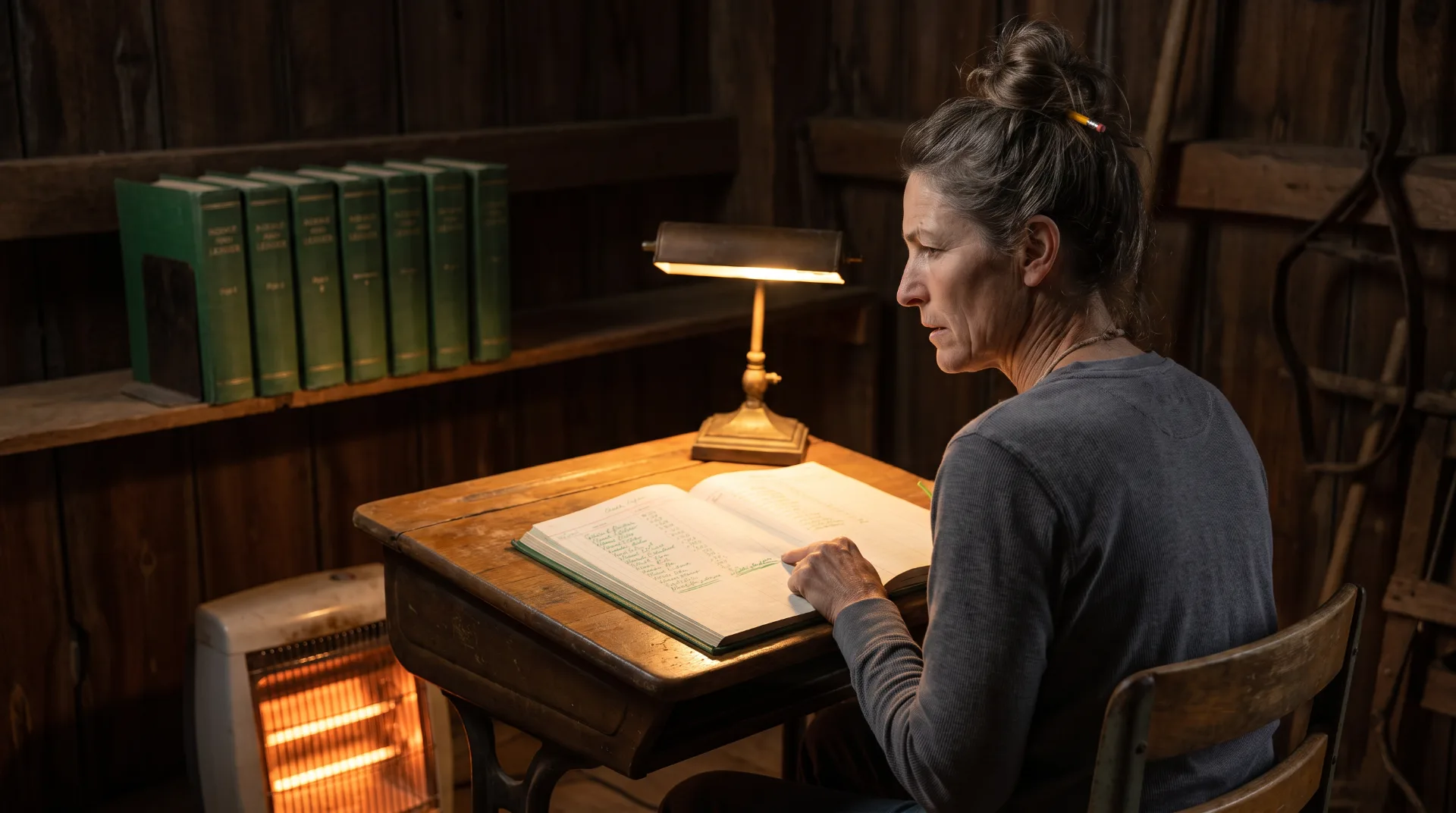
At eleven I take down the ledger for 2024.
I've been not doing this since February. I've been not doing it all week, standing in front of the shelf, looking at eleven green spines and leaving them where they are. Theo has gone home, the heater is ticking, and the only sound in the barn is a mouse somewhere in the stalls doing inventory of its own.
The cover is soft from handling. The first page has the year in his capitals and, under it, a line he wrote at the start of every ledger I've ever seen him keep: WRITE WHAT YOU SEE.
I turn the pages. Clearances. Hauls. A barn in Accord. A farmhouse in Stone Ridge, every lot numbered, every buyer named, every fee in a column that adds up. I check one page of addition with my phone, out of a professional habit I'm not proud of. It adds up.
March 2024.
HART, E. Orchard Hill Rd. Kedzie folio, Shadows f/t Walls of Death, 1874. Large. Oilcloth. Lot 24-117.
In the right-hand column, where every other line has a buyer's name or a price, there is one word, in the same green ink, underlined twice.
HELD.
Under it, smaller, squeezed in as if he'd come back to it later:
Ret'd to E.H. Jan '26. H.B. not to know.
January 2026. A month before he died. My father took the most valuable book in Ulster County out of Eleanor Hart's house two years before she died, kept it somewhere I have never seen, and gave it back a month before his heart stopped in this barn. And he wrote down, in a ledger he knew someone would read someday, that the man who delivered his eulogy was not to know.
I don't know if that's a man protecting a friend's book from another friend. Or a man moving a valuable object out of a house, out of sight, with a partner he'd started to stop trusting. I've read a lot of files that looked like the first thing and turned out to be the second.
I turn the page. I turn the next one.
There are other lines in the 2024 ledger with HELD in the right-hand column. I count them because counting is how I keep my hands steady.
Four.
None of the others say returned.
The real story behind the Green Book
Shadows from the Walls of Death is a real book. In 1874 Robert C. Kedzie, a chemistry professor at Michigan State Agricultural College who served on Michigan's State Board of Health, bound 86 samples of arsenic-colored wallpaper into one large volume, roughly 22 by 30 inches, and opened it with an essay on how dust from such paper could slowly sicken a household.
He had 100 copies made and sent them to public libraries across Michigan. Most were later destroyed, largely because librarians did not want poison in their patrons' hands. Only a handful survive. Michigan State University, the University of Michigan, Harvard Medical School and the US National Library of Medicine each hold one, and some sources count a fifth. The National Library of Medicine has digitized its copy, so anyone can turn the pages online without gloves.
The vivid greens of the era, such as Scheele's green and Paris green, got their color from arsenic compounds. Near the end of the century the American Medical Association estimated that up to 65 percent of wallpaper in the United States contained arsenic.
Eleanor Hart, her copy of the book and the fern parlor on Orchard Hill Road are fiction.
Sources: Atlas Obscura · Wikipedia · WVPE / Michigan History Center · 99% Invisible