Everything Must Go – Chapter 4: The Hollow Nickel, Part One
Mystery stories
share this story
For a week I carry the four lines around with me.
I copied them out of the 2024 ledger onto an index card the night I found them, in pencil, in my own handwriting, because I couldn't stand to keep opening his. The card lives in the breast pocket of his coat. I take it out at red lights. I take it out at the Kill Diner while Theo talks about a man in Rosendale who wants us to clear a garage full of outboard motors. I take it out at two in the morning, which is when I do most of my reading now.
ABERNATHY, J. Stone Ridge. Ship model, cased. HELD.
DEWITT, M. & P. Accord. Sampler, silk, 1790s. HELD.
KOENIG, A. Spring St. Coin cabinet, 1 drawer. HELD.
PRUITT, L. Orchard Hill Rd. Box, sealed, contents unk. HELD.
No buyer, no price, no returned. Four houses, four things my father carried out the door and wrote down and didn't give back, as far as the ledger can tell me. I looked the names up the way I used to look up claimants. Joseph Abernathy died in 2023. The DeWitts sold their farmhouse to a couple from Brooklyn and moved to Florida. Lorraine Pruitt is the neighbor on Orchard Hill Road who called the sheriff about a flashlight in the Hart house on the twelfth of October, which is a sentence I have not yet figured out what to do with.
Dr. Arthur Koenig, DDS, retired, of Spring Street, Callow Falls, died in his sleep on the seventh of November at the age of eighty-eight.
I read his obituary in the county paper on Tuesday. Forty years of dentistry on Main Street. Past president of the Mid-Hudson Numismatic Society. A lifelong amateur magician who performed at every Callow Falls Elementary field day from 1971 to 2009 as The Remarkable Dr. K. Survived by a daughter, Carol, of Scottsdale, Arizona.
On Wednesday morning Lena Ortiz comes to the barn for her list.
She arrives in the county Explorer at ten past eight in the morning, which I suspect is a choice, and stands in the office doorway with her hands in her jacket pockets while I find the sheet of paper I've been not finishing for six days. She looks at the pegboard. She looks at the empty hook with HART under it in green ink for longer than she looks at anything else.
I hand her the list. Fourteen names. Me, Theo, my sister Jess. The assessor. The man from the propane company. Two of Hal's yard men by first name, because I never learned their last ones. Ruth Kessler, who brought a pie in April. Hal Brewer, eleventh, between the propane man and the woman from the church who came about the folding chairs.
Lena reads it from top to bottom without expression.
"Alphabetical would have been easier," she says.
"I did it in the order I remembered."
"Sure you did." She folds the paper in thirds and puts it in her jacket. "The eleventh one. He came more than once?"
"Three Saturdays in March. He helped me sort the inventory. He was my father's oldest friend."
"I know who he is." She doesn't push. She looks at the hook again. "Lorraine Pruitt," she says. "The neighbor who called in the flashlight on the twelfth. I went up to take a proper statement on Monday."
"And?"
"And she's eighty-four and her eyes are better than mine. She said the flashlight went into the back of the Hart house, stayed about twenty minutes, and came out the same way. One person, tall, walking slow like it was his own house. She didn't see a car." Lena checks her watch. "She also asked me to tell Walt Sutter's girl that she'd like her box back."
I keep my face where it is. The index card is in my breast pocket. Fourth line. PRUITT, L. Orchard Hill Rd. Box, sealed, contents unk. HELD.
"Her box," I say.
"That's all she said. Her box, and Walt knew which one." Lena looks at me with that patient, level skepticism that I'm starting to think is just her face at rest. "You want to tell me what that means, Ms. Sutter?"
"When I know what it means," I say, "you'll be the first."
"I won't be," she says. "But I'll be second." She leaves the door open on her way out, and the cold comes in after her.
On Friday morning the barn phone rings, the old landline my father never let me cancel, and a woman with a flat, tired desert voice asks if this is still Walt Sutter's business.
"It's still the business," I say. "Walt died in February. I'm his daughter."
"Oh. I'm sorry." She means it for about a second. "My father always said if anything happened, call Walt Sutter. He wrote it on a card by the phone. I'm Carol Platt, Arthur Koenig's daughter. I fly back Thursday. I need the house empty and on the market before Thanksgiving."
"That's eleven days."
"Is that a problem?"
I take the index card out of my pocket and look at the third line.
"No," I say. "That's not a problem."
The Koenig house is a brick ranch from 1956 at the bottom of Spring Street, with a carport, a picture window and a lawn somebody has kept mowing out of habit since the funeral. Carol Platt meets me on the stoop at nine on Saturday. She's in her fifties, tanned the color of a saddle, in a down vest she clearly bought at the airport. She has the keys on a ring with a plastic tag from a dental supply company.
"Everything goes," she says. "I don't want any of it. Hal Brewer said he'd take the coins for his January sale, and you can do whatever you do with the rest."
Hal again. I write it down. Coins: Brewer & Lowe. His name is turning up in my notebook more often than I like.
"Did your father ever mention my father?"
"He mentioned everyone. He was a dentist, he talked for a living while your mouth was full." She almost smiles. "He said Walt Sutter was the only honest man in the antiques business, and that was why he never sold him anything."
I don't know what to do with that either, so I put it with the rest.
Theo arrives in the van with the boxes and the tape guns, and we walk it. Clockwise.
Dr. Koenig lived like a man who had spent forty years putting small things exactly where they went. The living room has a recliner facing a television the size of a microwave, and on the wall behind it, framed, three posters for magic acts from the 1950s with names nobody remembers, all of them in that red and gold lettering that promised the impossible for thirty-five cents. A bookcase holds nothing but books about coins and books about sleight of hand, shelved alternately, as if he wanted them to keep an eye on each other.
"He did the field day for forty years," Carol says from the doorway. She doesn't come in. "Pulled quarters out of every kid's ear in this town. Including mine. I was eight before I realized he wasn't actually finding them."
The dining room is the coin room. He took the table out at some point and put in a cabinet against each wall: tall mahogany numismatist's cabinets with shallow drawers, each drawer lined with green baize and cut with round wells for coins. I've seen a dozen of them. A good one costs more than my van.
I pull drawers. They slide like they were made last week. Indian head pennies, each in its well. Mercury dimes. Walking Liberty halves, a run of silver dollars with a gap in the middle that will make some collector in Ohio very unhappy. Every drawer has a typed label inside the front edge: the series, the years, the count.
The cabinet on the north wall has eight drawers.
The seventh one isn't there.
The runners are, two smooth wooden rails with nothing on them, and a dark rectangle on the back panel where light hasn't reached in a long time. The label slot on the cabinet face is empty too, two small brass brackets holding nothing.
"Was this always missing?"
Carol leans in. "I have no idea. I haven't been in this house in six years."
I take out my phone and photograph the gap with a pencil laid across the runners for scale. Behind me Theo is reading the index card over my shoulder, because I left it on the cabinet top and because he's Theo.
"Coin cabinet, one drawer," he says quietly. "Held."
I put the card back in my pocket.
"What's that?" Carol asks.
"Inventory," I say. "We'll start in the basement."
The basement is where Dr. Koenig was honest with himself.
Upstairs everything is labeled. Downstairs is a workbench that runs the length of the house under a row of fluorescent tubes, and on it is forty years of a dentist's spare time. A bench lathe the size of a breadbox. A dental drill on an articulated arm, the old belt-driven kind, still plugged in. Trays of burrs and files sorted by size. A jeweler's loupe on a cord. Half-finished things: a brass box with a false bottom, a deck of cards with one corner milled thin, a set of steel cups that fit inside each other so neatly I can't see the seams until I hold them to the light.
"He made his own tricks," Theo says, delighted. "Aunt Mae, look at this, it's a magic workshop."
"It's a dental lab," I say. "Same tools. Smaller hands."
On the end of the bench, under a shelf of paint cans, there's a gallon pickle jar full of change. Pennies mostly, nickels and dimes, a few quarters, the jar three-quarters full and heavy enough that I have to brace it against my hip to lift it. Every house has one. Usually it's the last thing anybody thinks about and the first thing the heir asks about.
"Theo. Count that before Carol leaves. She'll want to know."
He groans, then finds an old postal scale on the shelf and decides it's a game. He weighs the pennies in batches against a roll. He sorts the nickels into stacks of twenty on a sheet of newspaper and narrates the dates to me as I work my way along the bench writing lots.
"1964. 1971. 1999, that's a baby. 1948. Huh." A pause. "Aunt Mae, does a nickel weigh five grams?"
"A nickel weighs five grams," I say without looking up. You learn that clearing coin collectors' houses.
"This one doesn't."
I look up. He's holding a nickel between finger and thumb at eye level, frowning at it. He puts it on the postal scale. The needle wavers and settles a hair past four.
"Is it worn?"
"It's not worn. Look at it, it's sharp." He hands it to me.
It's a Jefferson nickel, 1948, ordinary in every way, with the faint gray dullness of a coin that has been in a jar for a long time. The weight is wrong in my palm before I even think about it. It feels like a token for a parking meter.
I hold it under the loupe. The rim is clean. The edge is smooth. I turn it over twice, three times, and on the reverse, at the rim just above the M in MONTICELLO, I see a line so fine it could be a scratch, except that it runs exactly around the inside of the rim the whole way.
"Theo," I say. "That spy podcast you made me listen to in the van in September."
He goes white. He remembers it better than I do; he played the episode twice. A fourteen-year-old paperboy in 1953. A nickel that felt too light. He dropped it on the floor and it came apart in two pieces, and inside was a tiny roll of microfilm full of numbers, and it took the FBI four years to find out what it meant.
"No," Theo says. "No way."
"He was a magician," I say. "Magicians use hollow coins. Magic shops sell them. I've cleared two other magicians' houses and found a hollow half-dollar in each." I'm talking because my hands want to do something stupid. "It's a trick coin. That's all it is. It's a dentist's trick coin."
"So open it."
I don't drop it on the floor. I put it on the bench on a clean sheet of newspaper, take the thinnest burr from the dentist's tray, and set the point into the hairline at the rim, very gently, the way you'd lever the back off a watch.
The reverse comes away. It's a cup, a perfectly turned shell no thicker than a fingernail, and it sits in my palm with the obverse still in the other half, and in the hollow between them, curled into a tight coil the size of a lentil, is a strip of film.
I've got the two halves of the nickel and the coil of film folded into a square of tissue in my breast pocket, next to the index card, when I hear a car door in the carport and a voice I know saying Carol's name like he's known her all her life.
Theo looks at me. I shake my head once. He goes back to stacking nickels on the newspaper with exaggerated care.
Hal Brewer comes down the basement stairs a minute later, ducking under the beam at the bottom without having to look for it, a man who has been in this basement before. Tweed, brogues, a paper cup of coffee from the Kill Diner he doesn't offer to share.
"Mae. Theo." The smile. "Carol says you've already started. Good. I only need the coin room, I won't be in your way."
"You knew Dr. Koenig well," I say.
"Forty years. He did my crowns." He taps a front tooth. "And I sold half his collection to him, one coin at a time, and I'll sell all of it again in January. That's the trade." He looks along the workbench, at the lathe, the drill, the little brass box with the false bottom. Something in his face changes and changes back. "Arthur and his toys. He made Walt a pocket watch once that opened the wrong way. Walt used it for years to annoy people."
I don't remember a pocket watch. I remember everything my father owned. I write it down later, in the van.
"The cabinet on the north wall upstairs," I say. "There's a drawer missing. Number seven."
"Is there?" Hal frowns, a small, sympathetic frown, the one he uses when a bidder's paddle goes up a second too late. "Arthur kept a few of his better pieces in a safe deposit box at the bank in Kingston. I'd imagine that's where it went. Carol will find it when she does the paperwork." He sips his coffee. "I'll make a note."
He goes back upstairs. I listen to his steps cross the dining room above us and stop in front of the north wall, and stay there.
"He's lying," Theo whispers.
"He might not be." I take the tissue out of my pocket, then put it back. "That's the problem with him. He's right about almost everything."
Carol Platt is in the carport on the phone with a realtor when I find her. I hold the two halves of the nickel out on my palm with the strip of film between them, and tell her what it is and where it came from.
She looks at it the way people look at a receipt they've already decided to throw away.
"It's a nickel," she says.
"It's a hollow nickel with something inside it."
"Dad made a hundred of those. He made them for the kids at the field day. He'd put a little note inside, you are remarkable, and hand it to whoever looked saddest." She covers the phone with her hand. "Take it, if it's interesting. I'll sign whatever you need. I've got eleven days and a house to sell."
I write it on the lot sheet in front of her, Lot 41a, hollow 1948 nickel w/ film, retained by contractor for examination, released by heir, and she signs it on the hood of her rental car without reading it, and goes back to the realtor.
Theo drives the van back to the barn. I hold the coin on my knee in a plastic bag the whole way and don't say anything, and he doesn't turn the radio on, which is how I know he's thinking the same thing I am. A child's note doesn't need to be on film.
Before I turn on the light, I open the top drawer of his desk.
I emptied it in March and put everything back, because I couldn't decide what to throw away. A Timex with a cracked strap. Reading glasses from the drugstore, three pairs. A tin of lozenges, a pocketknife, a book of stamps from 2019, a church bulletin with my mother's name in the prayers. I know this drawer the way I know the inside of my own coat.
There's no pocket watch. There was never a pocket watch, not one that opened the wrong way or any other way. My father thought pocket watches were for men who wanted you to notice them checking the time.
Hal said it so easily. A small warm story to fill a small silence in a basement, the kind of detail that makes a lie sound like a memory. Or the kind of detail an old man gets wrong about a friend who's been dead nine months. I've taken a thousand statements. I know exactly how little that tells me.
I close the drawer.
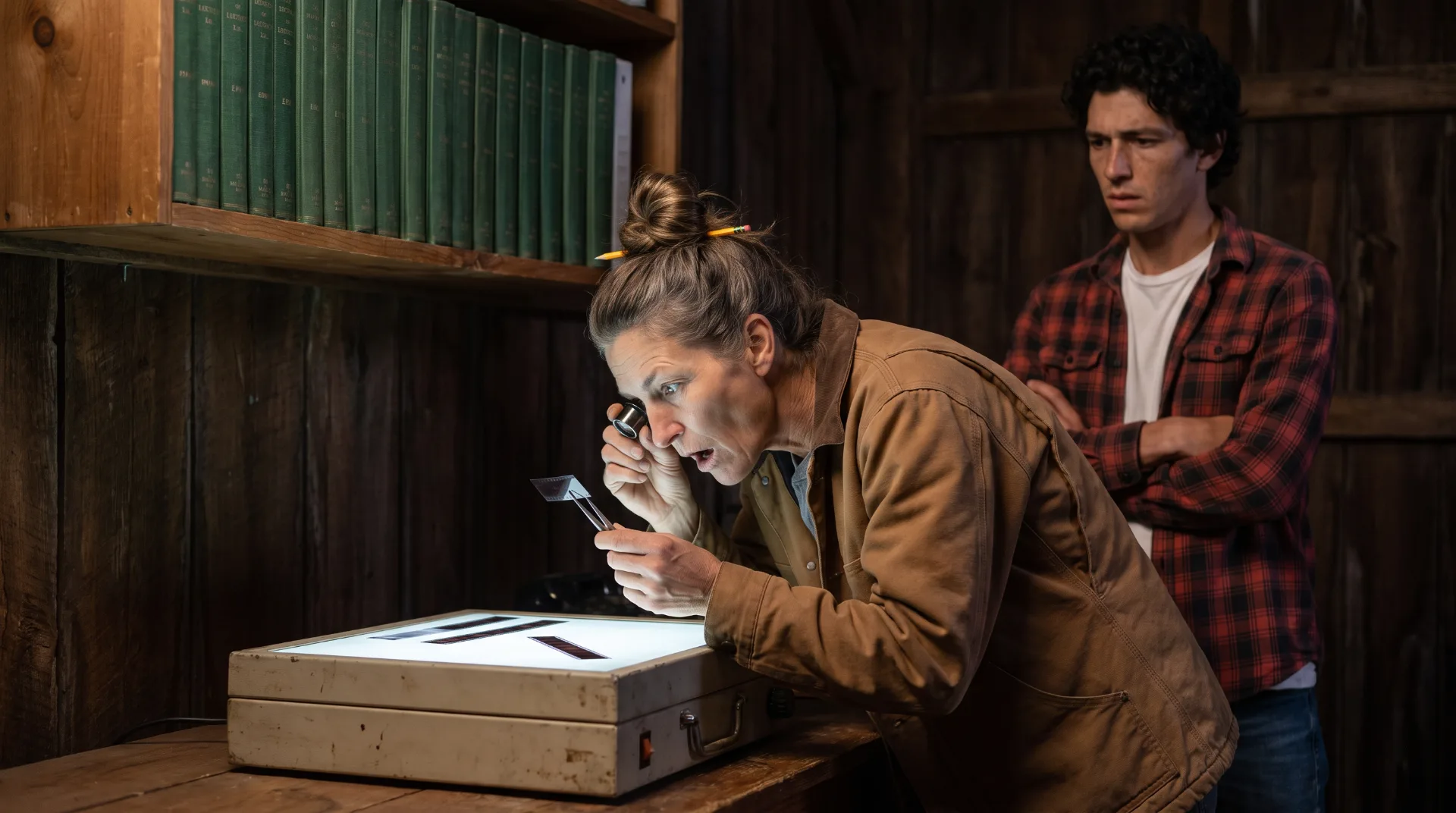
My father had a light box. He bought it in the eighties to look at slides of inventory for an insurance company that wanted photographs of everything, and it's lived on the bottom shelf of the office ever since, under the ledgers, next to a ten-power loupe in a leather case with his initials stamped on it. I set the light box on the desk and plug it in, and it hums and flickers and comes up a flat, cold white.
I uncurl the film with two pairs of tweezers. It fights me. It's been rolled tight for a long time. When it finally lies flat it's about two inches long and narrower than my little finger, and against the light I can see three tiny gray rectangles in a row, each one the size of a fingernail clipping.
"Pages," Theo says. He's standing behind my chair with his arms wrapped around himself as if he's cold. "They're pictures of pages."
I put my father's loupe to my eye and bend down until my nose almost touches the light.
The first frame is out of focus. Lines of writing in columns, too soft to read.
The second frame is sharp.
It's a ledger page. Ruled columns. A date at the top, MAR. 2024. Handwriting in block capitals, upright and even, every letter the same height, the kind of hand that learned to letter blueprints before it learned to sign a check.
I know that handwriting better than my own.
"Aunt Mae?"
I read the line in the middle of the frame twice, because the first time my eye refuses it.
HART, E. ORCHARD HILL RD. KEDZIE FOLIO, SHADOWS F/T WALLS OF DEATH, 1874. LARGE. OILCLOTH. LOT 24-117.
It's the same line. Word for word. The same lot number I've been carrying on an index card in my coat for a week.
Except that in the right-hand column, where my father's ledger, the real one, the green cloth one sitting eighteen inches from my left hand on the shelf, says HELD, this one says something else.
SOLD. H.B. $11,000.