Everything Must Go – Chapter 5: The Hollow Nickel, Part Two
Mystery stories
share this story
On Monday morning I find out that the public library keeps one microfilm reader, in the basement, across the hall from the historical society, under a dust cover that Ruth Kessler lifts off with both hands like a tablecloth after a holiday dinner.
"Nobody's used it since the newspaper project in 2011," she says. "The bulb might be gone."
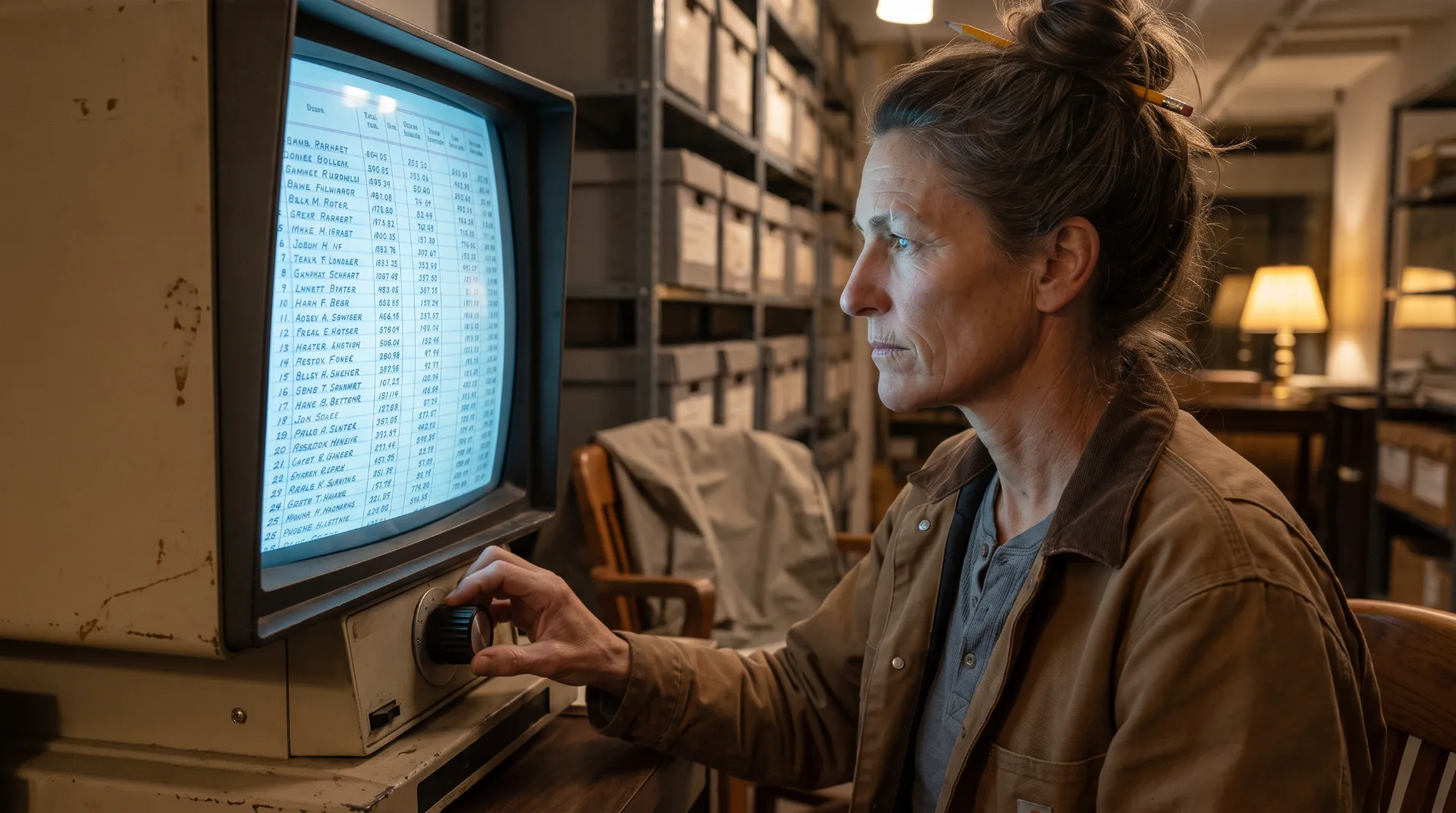
The bulb isn't gone. The machine is a beige box the size of a microwave with a screen on the front and a glass carrier underneath, and when Ruth flips the switch it hums the way my father's light box hums. I lay the strip of film on the glass with the tweezers, the way I've practiced at the barn twice since Saturday night. Ruth adjusts something. The screen fills with gray.
"Turn this," she says, and puts my hand on a knob.
I turn it. The gray sharpens into lines, and the lines into handwriting, three feet tall on the screen, every stroke as wide as my thumb.
The first frame, the one I couldn't read under the loupe, is the top half of a ledger page. Ruled columns. MAR. 2024 across the top in my father's capitals. Eight entries. A clearance in Accord. A haul from a storage unit in Stone Ridge. Two estate sales. Lot numbers in order, 24-101 through 24-108. In the right-hand column, buyers and prices. Ordinary work. I've read a hundred pages like it this week.
The second frame I already know. HART, E. The Kedzie folio. SOLD. H.B. $11,000.
I move the carrier to the third frame.
It's the bottom of the same page. The last four lines before the ruled margin, and they're written a little closer together than the rest, as if whoever wrote them was running out of room.
ABERNATHY, J. Stone Ridge. Ship model, cased. SOLD. H.B. $2,200.
DEWITT, M. & P. Accord. Sampler, silk, 1790s. SOLD. H.B. $4,800.
KOENIG, A. Spring St. Coin cabinet, 1 drawer. SOLD. H.B. $3,400.
PRUITT, L. Orchard Hill Rd. Box, sealed, contents unk. SOLD. H.B.
No price on the last one. Just the initials.
Ruth reads it over my shoulder. She taught algebra for thirty years and she reads a column of figures faster than I do.
"That's Walt's hand," she says.
"Yes."
"And H.B."
"Yes."
She doesn't say the name. Neither do I. In Callow Falls you don't need to.
I photograph the screen three times, frame by frame, with my phone, and once more with Ruth's permission and her old digital camera, because a photograph on a device that isn't mine is a photograph someone else can swear to. Then I roll the film back into its tissue and put it in my breast pocket next to the index card, which now looks like the other half of a conversation.
Four things my father carried out of four houses. In the ledger on my shelf, all four say HELD. On a strip of film hidden in a dead man's change jar, all four say sold, to the same buyer, for money.
One of those pages is a lie. Both of them are in his handwriting.
By Monday night I've decided my father kept two sets of books.
It's the simplest explanation, and in nineteen years of claims the simplest explanation was right more often than I liked. A business that runs on cash and trust. A partner with deep pockets and a sale room. One ledger for the shelf, honest and green, where anybody might open it: HELD. Another one somewhere else, for the partner, where the same objects turn into money. I've watched honest men keep two sets of books. Most of them didn't think of themselves as anything but honest. They thought of the second set as a kindness to someone.
"Grandpa wouldn't," Theo says.
"You don't know that. I don't know that." I'm on my knees in the hayloft with a flashlight, running my hand along the gap between the floorboards and the eaves, where he used to hide Christmas presents when Jess and I were small. "Neither of us knew him at work. We knew him at dinner."
"You worked for him every summer till you were twenty."
"I carried boxes for him every summer till I was twenty. That's not the same thing."
Theo doesn't argue. He takes the stalls. I hear him in the dark below me, opening drawers in the old feed cabinets, moving crates of Fiestaware I can't bring myself to sell. We do the loft, the stalls, the office, the space behind the office where the old milk cooler still sits with its lid open and a family of mice living in the insulation. We do the truck.
My father's truck is a 2006 Silverado that I have driven exactly once since February, to the dump, and it still smells like him: coffee, two-stroke oil, the pine tree air freshener he replaced every month for twenty years whether it needed it or not. The glove box has the registration, a tire gauge, a flashlight with dead batteries, and nine napkins from the Kill Diner. The door pockets have maps. Actual paper maps.
Under the driver's seat, Theo finds an envelope.
It's a long white business envelope, soft from being sat on, with the Brewer & Lowe logo in the corner, a little engraved church with a gavel instead of a steeple. On the front, in a long, confident hand that I've seen on a hundred auction checks: W.S. With thanks. H. And a date. 3/22/24.
It's empty.
"March 2024," Theo says quietly.
"Yes."
"Same month as the page."
"Yes."
He holds it the way he held the light nickel, between finger and thumb at eye level, as if weight will tell him something.
"It's an envelope," he says finally. "It doesn't say what was in it."
"It says Hal paid him something in March 2024, in cash, in an envelope, and said thank you." I take it from him. I hear my own voice, flat and quick, the voice I used to use on the phone to claimants whose stories were coming apart. "And a dead dentist photographed a ledger page from March 2024 that says Hal bought five things from him. That's not nothing, Theo."
"It's not proof."
"I didn't say proof. I said it's not nothing."
I put the envelope in an evidence bag, because I'm apparently a woman who keeps evidence bags in her coat now, and I sit on the running board of my father's truck in the cold with the bag on my knees. Theo sits beside me. He doesn't say anything for a long time, which is a thing I didn't know he could do until this month.
"If he did it," Theo says eventually, "does it change anything? About him?"
"Yes," I say. "It changes everything about him. That's why I need to know."
On Tuesday morning I call the substation from the Koenig carport and tell Deputy Ortiz that a drawer of coins appears to be missing from a dead man's cabinet, and that the heir would like to know where it went before she sells the house.
This is true. Carol Platt said exactly that, twenty minutes earlier, after I showed her the empty runners and the label slot with nothing in it. She said it mostly because she'd just found out what a drawer of her father's Morgan dollars might be worth, but she said it.
Lena arrives at ten. She looks at the cabinet, at the dark rectangle on the back panel, at the brass brackets with no label. She looks at me.
"You called me about a drawer."
"The heir called you about a drawer. I dialed."
"Uh-huh." She takes out her notebook. "Who's had access?"
Carol counts on her fingers from the doorway. "Me, since Thursday. The cleaning lady, every other Monday, for years. Mae and her nephew since Saturday. Hal Brewer, Saturday afternoon, to look at the coins." She frowns. "Hal said Dad kept his best coins in a safe deposit box. In Kingston."
"Did he?" Lena asks.
"I don't know. Let's find out." Carol already has her phone out. She is a woman who has spent her life in real estate and she does not like not knowing what's in a house. She calls the bank, puts it on speaker, and gives her father's name, his date of death, and the case number for the estate, all from memory, in the voice of somebody who has sat across a lot of desks from a lot of loan officers.
The woman at the bank is kind and slow. There is a pause while she looks.
"Dr. Koenig did have a safe deposit box with us," she says. "Box four-eleven. He closed it in June of 2018."
Carol thanks her and hangs up. Nobody says anything.
"Maybe Hal didn't know he closed it," Carol says finally.
"Maybe," Lena says, and writes something down.
Theo has been in the basement the whole time, packing the workshop because somebody has to. He comes up the stairs now two at a time, ducking at the bottom, and he has something in his hand.
"Aunt Mae. Deputy." He holds it out. "Bottom drawer of the workbench. Behind the sandpaper."
It's a small leather case, worn shiny at the corners. Inside, nested in a fitted velvet bed, is a camera about the length of my finger, flat and silver, with a sliding body and a lens no bigger than a pencil eraser. Beside it are three film cassettes the size of a stick of gum and a black plastic developing tank that would fit in my coat pocket.
"Minox," Carol says, surprised. "That was his spy camera. He used it in his act. He'd take your picture without you noticing and then pull the photo out of your ear."
"Did he develop his own film?"
"He did everything himself. He didn't trust drugstores." She almost smiles. "Or anyone."
Lena looks at the camera, and then she looks at me, and she sees whatever my face is doing, which I'm told is not as much as I think.
"Ms. Sutter," she says, very pleasantly, "is there anything about this drawer that you'd like to tell me in front of a witness?"
"Not yet."
"You keep saying that."
"I keep meaning it." I hold her eyes. "Friday. I'll bring you something by Friday that isn't string."
She looks at me for a long moment. Then she closes her notebook and nods once at Carol, at Theo, at the camera in its velvet bed.
"Bag that," she tells Theo. "It's evidence now, whatever it turns out to be evidence of." And to me, on her way out: "Friday, Mae. Not Saturday."
She's started calling me Mae. I haven't decided yet what that means.
Lorraine Pruitt lives directly across Orchard Hill Road from the Hart house, in a white farmhouse with green shutters and a front window that looks, I notice as I walk up the path on Tuesday afternoon, straight into Eleanor's back parlor.
She opens the door before I knock. She's small and very straight, in a cardigan buttoned to the neck, with a pair of binoculars on a strap around it.
"Birds," she says, when she sees me looking. "Mostly. You're Walt's girl. Come in, it's cold."
Her kitchen smells of coffee and woodsmoke. She sits me at a table with an oilcloth cover printed with cherries and pours coffee without asking how I take it, and it's exactly how I take it, which I decide not to think about.
"The deputy said you wanted your box back," I say.
"I do." She sits across from me with her hands folded. "Walter took it in August of last year. Not this one. Two Augusts ago. 2024. He said he'd bring it back when it was safe to, and then he died."
"Safe from what?"
"From the man who kept wanting to buy it." She says it plainly, the way she probably reports a hawk on the feeder. "It was my husband's. Frank's. A tin box about so big," her hands make a shape the size of a shoebox, "soldered shut. He brought it home from his mother's house in 1971 and said it was family business and never to open it, and I never did, and he died in 2009 and I still haven't. That's a long time not to open a box. You get used to it."
"Who wanted to buy it?"
"He came three times. The spring of 2024. Very polite. Said he'd heard from a friend there might be something of interest in the house, and he'd give me a good price for anything old, sight unseen. Then he asked about the box by name." She looks at me. "Nobody knew about that box but Frank and me and Walter. Walter was the one who appraised Frank's things after he died. So I called Walter, and Walter came that afternoon with a blanket and took it to the barn, and told me if the polite man came back to send him to Walter."
"Did he come back?"
"No." She drinks her coffee. "He never came back after that."
I don't ask her the polite man's name. I want to, and I can see from her face that she'd tell me, and that she has told herself the name every day for two years. But I can also hear Lena in my head saying a woman with a notebook who doesn't like the way a room feels, and I know what a defense lawyer would do to a statement I'd led.
"Mrs. Pruitt. If you saw him again, would you know him?"
"I see him every Sunday," she says. "At church. He reads the lesson." She puts her cup down. "Is my box all right, Mae?"
I think about the barn, the loft, the stalls, the feed cabinets, the milk cooler, the truck. I've searched all of it in the last two days, looking for a second set of books. I didn't find a tin box the size of a shoebox, soldered shut.
"I'll find it," I say. I hope it's true.
She walks me to the door. On the step she stops and lifts the binoculars an inch on their strap, and looks across the road at the Hart house, at the back parlor window where Eleanor's bedsheet used to hang. The county took it down last week when they sealed the room. The fern paper shows through the glass, dark and green, even from here.
"I told the deputy the man on the twelfth was tall," she says. "I didn't tell her the rest, because she didn't ask, and because I'm eighty-four and people stop listening after tall."
"What's the rest?"
"There's a hanging basket on Eleanor's back porch. It's been there since 1990. Everybody who's ever gone in that door has hit their head on it once." She lowers the binoculars. "He didn't. He ducked before he got to it. In the dark. Like he knew it was there."
On Wednesday night I do what I should have done on Saturday. I stop reading the film and start reading the ledger.
Not the four lines on my index card. The whole of March 2024, every entry, the way I used to read a claimant's bank statements: top to bottom, with a ruler under each line and a pencil in my other hand. I lay the green ledger open on the desk under the lamp. Beside it I prop my phone with Ruth's photographs of the three frames, enlarged until my father's capitals are as tall as my thumbnail.
The real March 2024 runs to three pages. Thirty-one entries, lots 24-101 to 24-131, each in order, each with a date in the left margin. Lot 24-117 is HART, E., on the second page, the fourteenth of March, between a pine dry sink from New Paltz and a box of Depression glass from a storage unit in Rosendale.
On the film, lot 24-117 sits on the first page, directly under 24-108.
Eight lots are missing between them. Not crossed out. Missing. The film page jumps from the eighth entry to the seventeenth as if the middle of the month never happened.
I go back to the bottom of the film page. The four lines written close together. ABERNATHY. DEWITT. KOENIG. PRUITT. I find them in the real ledger, one at a time, and write the dates on my index card in pencil.
Abernathy, the ship model: April 2024, lot 24-142.
DeWitt, the sampler: May, lot 24-170.
Koenig, the coin drawer: June, lot 24-203.
Pruitt, the box: August, lot 24-251.
Four different months. Four different pages. On the film they're all crammed together at the bottom of one page in March, and not one of them has a lot number.
My father never wrote a line without a lot number in his life. He'd sooner have written without a pen.
I sit back.
It isn't a page from a second set of books. A second set of books runs in time like the first. It has its own dates, its own order, its own mistakes. This is something else: a page somebody built. Somebody took a real March heading and the first eight real lines, copied them out in my father's hand, skipped to the one line they cared about, and then added four more lines from four other months at the bottom, because those were the four objects they needed to own on paper. Sold. H.B. A receipt for things my father never sold.
And they made it look exactly like him. The capitals, the spacing, the way he squared off the bottom of every S. Whoever wrote it had spent a long time looking at his pages.
I pick up the evidence bag with the Brewer & Lowe envelope in it. W.S. With thanks. H. 3/22/24. I find the twenty-second of March in the real ledger. Lot 24-121: six Victorian side chairs, consigned to Brewer & Lowe, sold at the spring sale, paid cash, H.B., $1,450. An ordinary consignment, an ordinary envelope, an ordinary thank-you between two men who did business together for forty years.
My father didn't keep two sets of books. I sat on the running board of his truck on Monday night and believed he had, because an envelope and a bad feeling were enough for me. I'd have fired an adjuster for that.
I turn off the lamp and sit in the dark with the heater ticking.
Arthur Koenig spent forty years making things look like what they weren't. He built coins that were really boxes and cups that were really other cups. If anyone in this valley could look at a forged page and know it for a forgery, it was him. He photographed it with a spy camera, rolled it into a hollow nickel, and dropped it into a pickle jar full of change where nobody would ever look except a woman clearing his house who happened to weigh it.
So somebody showed him that page. Somebody stood in his dining room in front of the cabinet with the missing drawer, and showed him a ledger page in my father's handwriting, and told him that drawer seven had been sold.
And Arthur, who never trusted drugstores or anyone, smiled and nodded and took its picture when they weren't looking.