Debtbound – Chapter 10: The Enforcer
Progression fantasy & LitRPG
share this story
Kell was gone before the carts, but only just.
He went the way the porter had brought him, in reverse, with the bells of the bridge road ringing behind him and the river fog going grey with morning. Through the cinder lanes, past seven sheds where every Ashen turned its head to watch him go, up the river stairs below the Weighhouse Bridge where he had to lie flat in a culvert while three slate coats with lanterns went past above him at a run, toward the bend. He heard the gimbal-creak of their instrument. He heard one of them say, quite clearly, "It's still lit. The whole floor of the place is lit," in the voice of a man who has never seen his instrument do anything interesting before and does not enjoy it.
Then he was in the dye-yards, where the gutters ran blue and red and nobody looked at anybody.
Ada had told him where. Fennick's works, at the top of the yards, where she had stained her hands for nine years: a yard of great wooden vats as tall as a man, a drying loft, a counting office the size of a pantry. Old Fennick slept above the office and was deaf in one ear and owed Merren four hundred drams on the vats. "He won't ask," Ada had said, at the door of Hessa's kitchen, with her brother sitting behind her in a chair for the first time in nine years. "Nobody up there asks anything before the second bell."
The counting office had a ledger. Of course it did; every business in Vell kept its book against the day a House came to look. Kell let himself in with the key under the madder vat, sat down at Fennick's little desk in the half-dark, and opened the book before he did anything else. He told himself it was to check his line. It was partly that. It was also that he had spent two months learning that the safest place in any room was the page.
The page went deep. His line was where he had left it. One hundred and eighteen.
He sat with his palm on the book and let himself breathe for the first time since the seal came apart. Tobin Marsh was sitting in a chair. That was a fact now, written in the only ledger that mattered, and no House in Vell could unwrite it, because the instrument that had made him an Ashen had never lawfully existed. Kell had done that. He found he was shaking, and let himself shake, since there was nobody to see.
Then, because shaking was not a plan, he made one. He wrote it on the back of one of Fennick's alum bills, in pencil, small, the way he wrote everything now. Brann was assisting, which meant Brann was somewhere with a door that locked from the outside. Corvin had been gone from the floor two days, which meant either the Houses had him or he was doing something no one had told him to do, and Kell did not know which frightened him more. The saddler's daughter was under review. Sela's door was watched. And the instruments of the Office of Weights and Instruments were, at this moment, standing in a cinder lane in Ashen Town looking at a floor that glowed. They would not look at a dye-works for an hour. Perhaps two.
Two hours. A page. A pencil. A hundred and eighteen drams. He began, out of pure habit, to list the ledgered things in the dye-yards that might hold a debt if a man needed to put one down in a hurry.
He was still sitting like that when the page went blank.
It did not close. Closing he would have understood; he had felt pages resist, and stall, and go slow through old canvas. This one simply emptied. The grey-gold script under Fennick's columns of figures did not go dark. It went away, the way water goes away from a stone dropped into it, and left the ink lying on plain paper, and plain paper is only paper.
Kell lifted his palm and put it down again. Nothing. He turned the page. Nothing. Every account in Fennick's book was still written there in ink, the madder bills and the alum bills and the four hundred drams on the vats, and under the ink there was no light at all.
He had felt this once before, from a long way off, in the annex at Halcot. Weather in the script. Something walking up through the ledgered light of a building the way his own sight walked into a page, with the script bowing aside in front of it.
It was in the yard.
He went out through the back of the office into the vats because there was nowhere else to go, and stopped on the wet cobbles between the indigo and the madder, with steam coming off both into the cold, and the man was standing at the gate.
He was tall and neat and somewhere between forty and sixty, in a long slate-grey coat with no insignia on it and grey gloves. He had no instrument. He had no hat. He had a face Kell would spend the next eleven days trying to describe and fail, a face that was perfectly ordinary while you looked at it and gone the moment you stopped, like a figure carried in your head that drops out before you can write it down. He stood with his gloved hands folded in front of him and looked at Kell with polite interest.
Around him, in the air of the yard, the faint threads of script that hung over every ledgered thing in Vell, the vats and the gate and the cobbles, were leaning away from him. Not far. Just enough. The way a counting floor leans away from a master who has walked in angry.
"Mr. Arden," the man said. "My name is Hale. I keep the Chancellor's book. Please don't run; it's very tiring for both of us and it never ends differently."
Kell ran.
He did not get far, and he would think about why for a long time afterward, because the why was the lesson.
He went for the drying loft, where there were stairs and a hatch to the roofs. He knew the dye-yards a little now, enough to know the roofs ran all the way down to Tannery Row. He got four steps up the loft stairs and the stairs went soft under him. They did not break. The wood simply stopped being sure of itself, the way the script had stopped being sure of itself in Fennick's book, and the tread gave under his boot without a sound, and he fell.
He came down on the cobbles on his shoulder. Hale had not moved from the gate.
"Everything in this yard is on a ledger," Hale said, in the same pleasant voice. "Fennick's book, Merren's book, the city's register of works. Ledgered things are written. Written things know who they answer to." He tilted his head. "You've been reading them for two months like a man who's found a library unlocked. It never occurred to you to ask whose library."
Kell got up. He did the only thing left in his column. The madder vat stood beside him, eight feet of oak and iron and red dye, and it was on Fennick's book and Merren's book, assessed, he had read it ten minutes ago at forty drams. He put his palm flat against the wet oak, found the dark line behind his breastbone, and took hold of fifty drams of it to shove, the way he had shoved thirty into the annex door.
Nothing took hold of anything.
The dark line came up into his hand willing enough. His creditor had never once refused to lend him the cost of a working. But when he reached for the vat's worth to put it into, there was no worth there. The vat was oak and iron and dye. It was not written. Or it was written, and the writing had leaned away from him toward the man at the gate, and would not let itself be read.
He felt the draw go out of him anyway. Ash, spent on nothing, booked to him at once. The strap took in a hole, then another. Eight drams for a door that would not open.
"Yes," Hale said, almost kindly. "It still costs. Your creditor bills for the attempt. I'd stop."
Kell stopped.
He stood on the cobbles with his shoulder burning and dye soaking through his boots, and for the first time since the night he read his father's name, he had nothing. No page. No window. No vessel. The one gift in Vell that no one else had, gone out like a lamp because a man in grey gloves had walked through a gate.
So he did the other thing. He looked at Hale the way he had learned to look at a page, and he asked.
He had never tried it without a book. He did not think it would work. It half worked. With no window he could not read Hale's account; he could only feel the shape of where it was, the way you can feel a ledger in a dark room by the weight of the shelf. And what he felt there was not an account at all.
There were no figures. No debt, no worth, no increase, no history of draws. Where a soul's long running ledger should have been, there was one round heavy seal of grey light, the same kind Kell had unwound in Hessa's kitchen, and it said one thing. It had no whereas of figures. Its recital was a single clause.
WHEREAS THE HOUSE REQUIRES IT.
Hale watched him read it. Something in his ordinary face moved, very slightly: not alarm, more the look of a clerk who has heard a new junior sum a column faster than he expected.
"Now you know what I am," he said. "Most people never get that far. I was a man once, with a ledger like yours. I signed it over. Every line. The Chancellor keeps it, and the script keeps the Chancellor's book the way it keeps the Ledger, so the script makes way for me the way it would make way for a seal." He unfolded his gloved hands. "You unwound a seal last night, I'm told. A seal on a false recital. I'd invite you to try mine, but you'd have to prove the House doesn't require it. And it does."
He crossed the yard. He did it without hurry, around the indigo vat, his coat not even touching the wet stone, and he took Kell's right wrist in one grey glove, exactly where the Ashen held out their own.
It did not hurt. That was the worst of it. His grip was the polite grip of a man helping someone off a step.
"Your hand was recorded at Halcot for nine minutes," Hale said. "Last night it lit up the whole last bend. You're the easiest man in Vell to find, Mr. Arden. You only have to work."
The boy came through the gate first.
He came the way he went everywhere, quietly, with careful hands, and he stopped two paces inside the yard and stood like a post. Behind him came Senior Tallyman Corvin of House Merren, in his dark coat, with the grey at his temples gone a little greyer in two days and his still hands not quite still.
"Senior Tallyman," said Hale, without letting go of Kell's wrist. "You're a long way from your mezzanine."
"So is my clerk," said Corvin.
He reached into his coat and took out a folded document with a heavy red seal on it, the audit seal of House Merren, which Kell had seen perhaps four times in six years, always on the east mezzanine, always in the hand of a man about to ruin someone. Corvin unfolded it, and held it up.
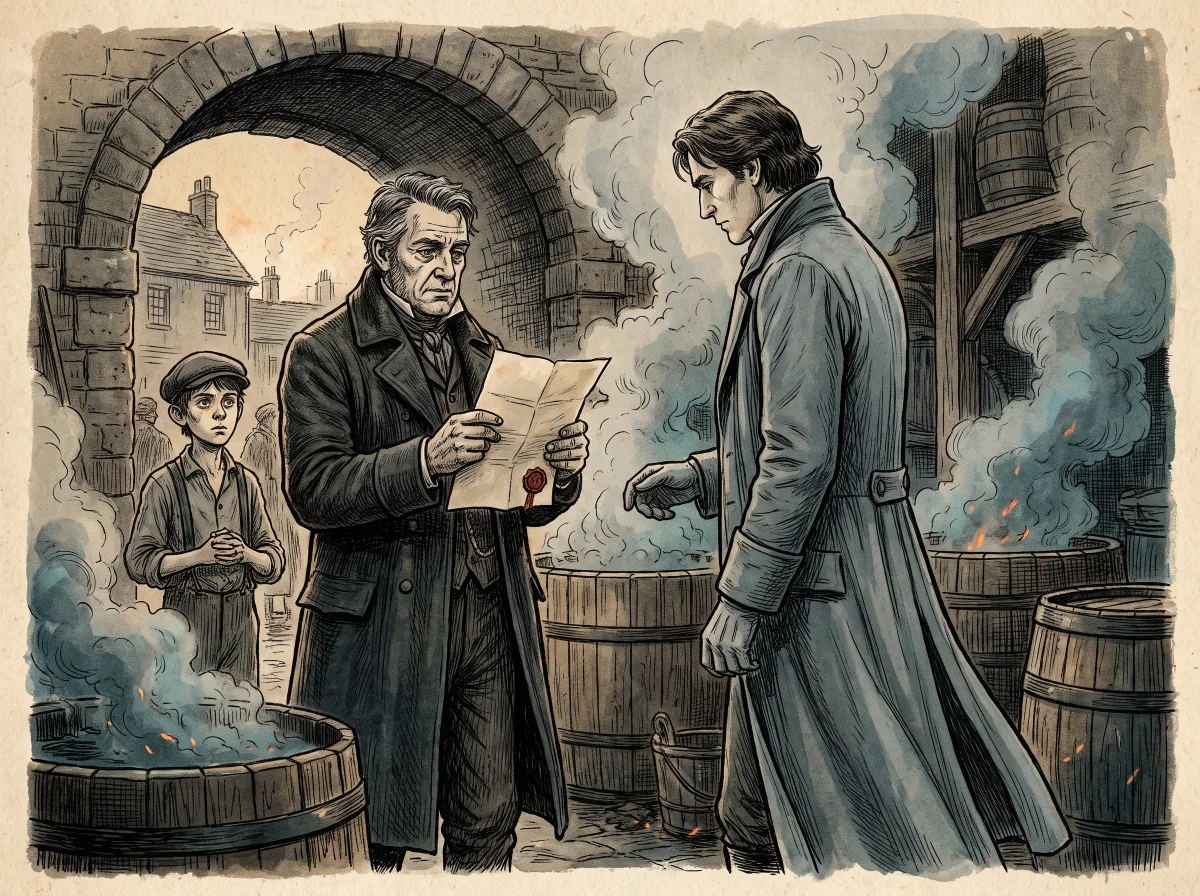
Hale read it without touching it. Kell, two feet away, read it too, because he could not help reading.
BY ORDER OF THE AUDIT OF HOUSE MERREN: THE CLERK KELL ARDEN, OF THIS HOUSE, IS HELD UNDER INTERNAL AUDIT IN THE MATTER OF THE V-ACCOUNTS, AND IS RESERVED TO THIS HOUSE'S JURISDICTION PENDING ITS FINDING. And under it, in Corvin's own square, careful hand, a signature, and the date, and the seal.
There was no such audit. Kell knew that the way he knew his own name. He had seen Corvin's face on the mezzanine when they talked about Wessic and the proper channel. This was not a proper channel. It was a sheet of genuine House paper with a genuine House seal on it and a lie in the middle, written by the most honest man Kell had ever met.
"This is a clean lie, Senior Tallyman," Hale said mildly. "I'd have said you didn't have one in you."
"I didn't," said Corvin. "I had two days in your under-vault looking at a junior clerk named Brann through a grille, trying to get him out by the proper channel. Your committees were very polite. They're still considering my request." He did not lower the paper. "Merren claims its clerk. Under charter, an inter-House claim stands until the committees rule on it. You know that better than I do. You are that."
Hale looked at the paper for a long moment. Kell, with his wrist still in the grey glove, felt the script in the yard hold still around the two of them, waiting, the way it had waited in Hessa's kitchen while the Ledger chose.
It was a House instrument. Real paper, real seal, a recital sworn by an officer of the House in his own hand. A forgery in its content and nothing else. And a seal that made way for House instruments had to make way for this one, until someone with standing proved it false.
"An accusation is an expense," Hale said at last, quietly, quoting someone. "The Chancellor won't want two Houses in committee over a clerk. Not this month." He let go of Kell's wrist. "Merren may have its clerk. I'll file your paper, Senior Tallyman. I'll file it very carefully. When the committees rule, your name will be on it, and you'll find out what it costs to be right about the wrong account in writing."
"I know what it costs," said Corvin. "I've watched other men pay it for thirty years."
Kell looked at him then, properly, and saw what Hale had seen: the still hands were not still. They were holding the edges of the coat where the paper had gone, very tightly, the way a man holds a rail on a boat. Corvin had written one line in his life that was not true, on the best paper his House owned, and signed it, and the signing had taken something out of him that two days in an under-vault had not.
"How," Kell said, and found he did not know how to finish the question.
"The boy," said Corvin. He did not look at Kell. "He came to my door last night with your letter. Not the one under your floorboard. The one you wrote out for him on the fifteenth and then took back. He'd made a copy." His mouth moved, briefly, toward something that was not quite a smile. "In a very good hand. He said you'd told him not to bring it, and he'd decided you were wrong. Then the bells started and he said he knew where you'd go."
The boy said nothing. He stood like a post and looked at Hale with his account-keeping eyes, the way he had looked at the ivory card in the dark of the stacks, and Kell understood that the child had been keeping a ledger of his own the whole time, and that in it, somewhere, Kell's name had a column.
Kell walked toward the gate. His legs did it without consulting him. The boy fell in at his side. Corvin folded the paper and put it back in his coat, the way you put away something you will be buried with.
Hale spoke once more, as Kell passed him. He did not raise his voice.
"One more thing, Mr. Arden. A courtesy. I keep a book that sees a great deal, and last night it saw something it doesn't often see." He looked at Kell with his forgettable face, and for the first time there was something under the politeness, something that in another man Kell would have called caution. "You released a sworn claim. Your creditor had an interest in that claim. Every dram that farm ever grew went up the chain to the same dark you owe. You cut into its income. It has noticed."
Kell stopped.
"I've no idea what your creditor is," said Hale. "Nobody does. Nobody asks; asking is a draw. But I can read its notices, and it has sent one. Your line is being called." He folded his grey gloves together again. "On the first of the month. All of it, at once. One hundred and twenty-six drams, due in full, from a man the Houses won't lend a grain to."
Kell did the sum because he could not stop himself. The first of the month was eleven days away. A called line paid nothing on account, kept no margin, asked no worth. A called line was paid, or it foreclosed.
"Eleven days," Hale said, reading his face. "I'd hurry."
He turned and walked out of the gate into the morning, and the script of the dye-yards leaned out of his way as he went, and then leaned back.
Next chapter: Calling In. Eleven days, a hundred and twenty-six drams, and a blank ivory card that costs nothing to touch. Posted next week.