
The Treaty Before the Great Winter. Viking Saga Chapter 2
20 min read
Fantasy stories
share this story
Hall of Deer Spears - Chapter 2
Hjorthegn lay on the other side of Skjaldra like a dream that seems welcoming until you step inside it.
Eirik waded across where the current breaks against black boulders, the water biting at his calves. The cold didn't just want to hurt him — it wanted to convince him that the world was hostile and warmth was something he'd invented. When he climbed ashore, the wind threw snow in his face and the pines creaked around him, talking to each other in a language he wasn't meant to understand.
The path to the village led through a narrow pass where warm steam rose from holes in the ground — the breath of underground springs, which the people here called the exhalation of Hlinnara, Guardian of the Thresholds. Above Hjorthegn, Frostfjall's ridges cut the sky like the teeth of something old and patient. In the village below: long houses with carved deer heads above the doors, smoke hanging low as if afraid to rise.
People here didn't walk quickly. They walked as if each step confirmed they belonged to the land — not the other way around.
The Hall of Deer Spears was warmer than outside, but it was the kind of warmth that didn't soften a man. It reminded him of what he stood to lose.
Dried herbs hung from the beams — bitter, medicinal, faintly threatening. The fire in the stone hearth threw long shadows across the faces of people who had not yet decided what to do with their hands.
Chieftain Haldor Staghorn sat on a raised platform, a white reindeer cloak around his shoulders, watching Eirik the way a man watches ice — looking for the place where it's thinnest. At his sides, warriors held spears that were not just weapons. They were arguments, ready to end the conversation.
By the fire sat Brynja Runeblood, a wise woman who looked like time had tried to wear her down and given up. She didn't look at Eirik when he entered. She was listening to the wood crack.
Beside her stood Sigrún, Brynja's daughter and the clan's dream-reader. Her hair was braided with small bones and runic beads. She held herself the way a bow holds itself just before release — not tense, not relaxed. Ready.
Eirik felt her glance touch his thoughts and move on, as if she'd already found what she was looking for.
He presented the agreement as Jorund had taught him: first praise, then need, then offer, and only at the end a request dressed as a proposal.
He spoke of shared patrols on the mountain passes. Of joint hunts for the giant reindeer herds that retreat to the valley before the Great Winter. Of salt and fat distributed by the number of children in each house. He spoke of how Skjaldra remembers blood — and that if blood is spilled again, the river may lock the fish under the ice until spring comes too late.
Then he touched the oldest thing without naming it: the bond between clans, the kind that holds when words break.
A silence settled in the hall thick enough to taste.
Haldor smiled — not with joy, but with the knowledge that now it was his turn. "Shared supplies. Shared patrols. Shared risk." He let each word sit. "It sounds like the words of a man who fears his own people won't survive the cold."
There was no insult in it. Only description. That was why it landed harder.
Brynja leaned forward as if hearing something in the fire's crackle that no one else could. "Nóttfadir has opened the sky," she said. Her voice was quiet, but it struck the hall like a flat stone on ice. "Three months are not an ornament. They are a debt. And the black sun is the ink." She looked at Eirik then, for the first time. "You may carry a contract in your head, Wolf-knot. We want one in blood. Not yours. Not ours. Ours together."
Sigrún's eyes settled on him. "Mother means a ritual," she said. "If we are to hunt together, we must first see what we do when we go alone."
The drink was dark and thick, smelling of burnt honey and bitter mushrooms. Brynja called it Hrimsvölr — the Ice Chalice. Eirik understood that his negotiations had ended. Something else was beginning — something that couldn't be counted in bags of barley.
He drank.
The world narrowed to a single point of firelight. Then that point burst.
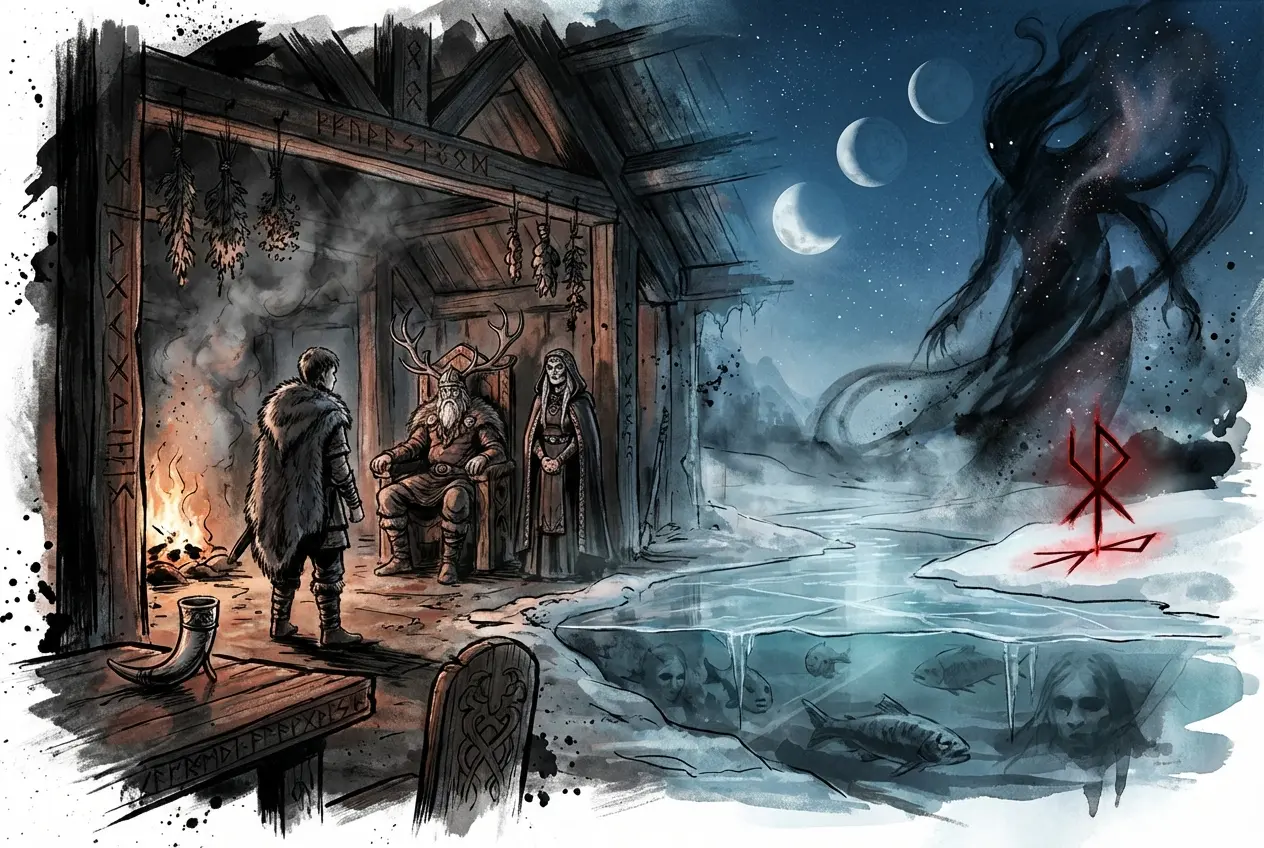
He stood on frozen Skjaldra, but the ice was transparent as an eye. Beneath him, fish with human faces swam slowly and whispered the names of the dead. A wind came from Frostfjall that carried no sound — only meaning. Three moons hung above like three wounds that hadn't decided whether to close.
Sigrún walked beside him, barefoot. The frost didn't touch her. It moved around her, the way water moves around something it has learned to respect.
A figure rose before them — tall, shifting, made of darkness and fine stardust. Nóttfadir, Father of Three Moons. His face was there and then not there, like something seen at the edge of sleep. When he spoke, it wasn't sound. It was the sensation of someone reaching into your past and rearranging it.
He showed them a single image: two clans moving together across a white plain, hunting side by side. And blood on the snow beneath them. Not from the beasts they hunted. From each other.
Eirik woke feeling like he was drowning, spitting out water that tasted like truth.
The fire was the same. The people were not. Some faces had gone pale. Others had hardened, as if they'd swallowed something they couldn't put back. Brynja leaned on her staff looking tired in the way of someone who carries responsibility, not age. Sigrún's pupils were wide, a vein moving at her neck like a signal.
Haldor Staghorn rose slowly. There was no panic in it — only the movement of a man who has made a decision and is now living inside it.
"We saw it," he said. "Blood on the snow. Betrayal." He looked at Eirik the way a butcher looks at a hanging carcass — measuring, not cruel. "And yet without a treaty, we all die. So there will be a treaty." He paused. "But it will have teeth. Break it, and we won't take your supplies. We'll take your names."
Eirik felt the cord on his wrist pressing into his skin.
For the first time he admitted to himself that he wasn't negotiating against another clan. He was negotiating against hunger, against whatever the gods had decided, and against the parts of his own people that a bad winter could wake up.
Sigrún leaned close enough that he could smell herbs and smoke on her breath. "In the dream," she said quietly, "you stood by the blood and didn't look away." A pause. "Just remember — betrayal doesn't start with a knife. It starts with an excuse."
Eirik said nothing. The cord on his wrist was tight.
Outside, the wind moved through Frostfjall like it was looking for something it had lost.
<<< Previous chapter
Next chapter >>>
More from other interesting stories
The Treaty Before the Great Winter. Viking Saga Chapter 1
Chapter 1 of a fantasy saga inspired by the world of the Vikings. Two clans live in the neighborhood, separated by the Skjaldra River and the gray ridges of the Frostfjall Mountains. Skjaldra is not just water: it is a living strip of memory, a stream that “remembers” blood and oaths.