The Treaty Before the Great Winter. Viking Saga Chapter 4
20 min read
Fantasy stories
share this story
Prey that divides the fire - Chapter 4
The way back was heavy. Wet leather on the shoulders, straps biting, the snow breaking underfoot in thin plates. And under the weight, that old drunk feeling every hunter knows — the animal dead, the hunger beaten back one more time, life carried home in the shape of fat and bone. Men and women traded the loads at every rise. Nobody hurried. When the ground finally fell away and showed the two settlements facing each other across the Skjaldra, Eirik understood that the relief was only tension wearing a different coat. They were coming home as allies. But every man carried his own sum behind his eyes: how many shares, who owed whom, who would have to meet whose gaze once the meat — and the honor — got cut up.
Fog lay low on the river. Frostfjall stood behind it, black and saying nothing, the way a judge says nothing when the verdict is already written.
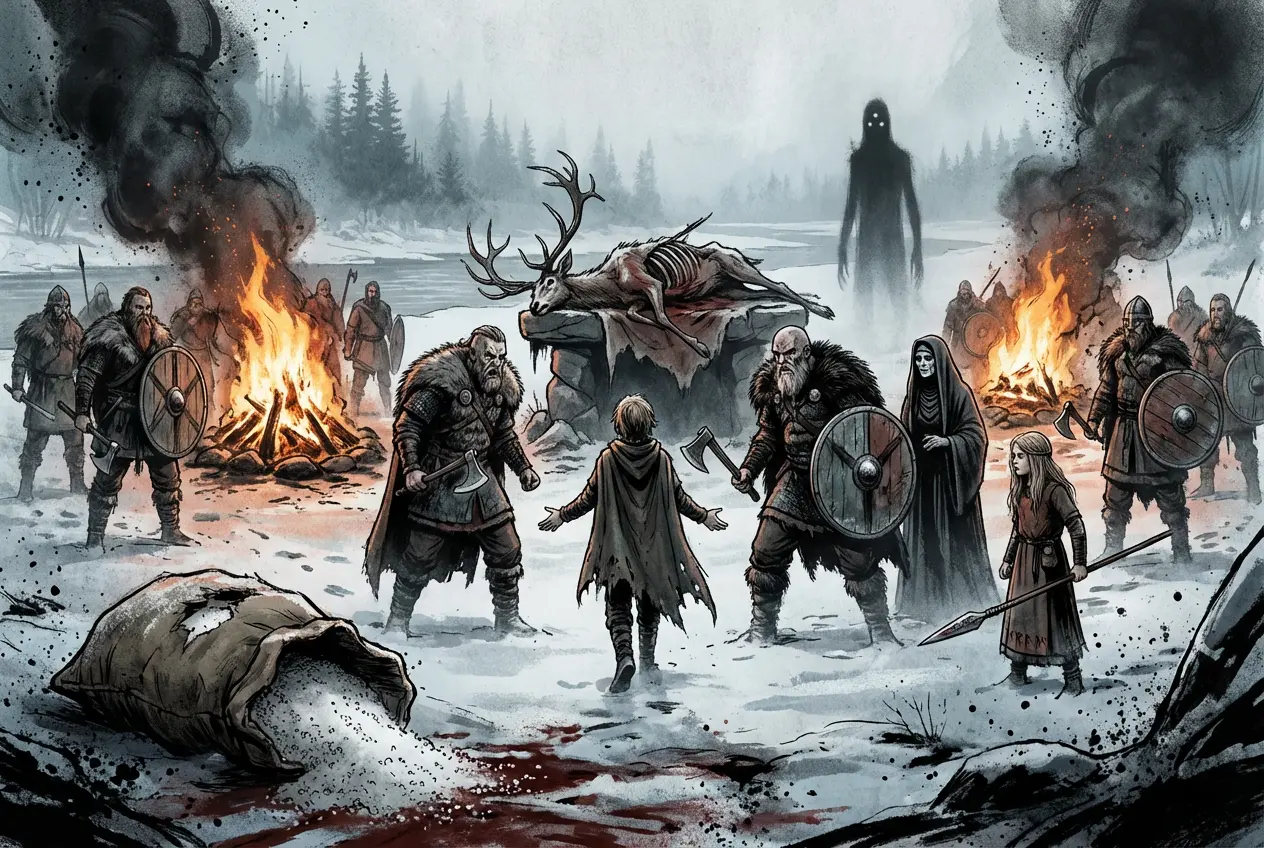
The dividing of a kill is a ritual, and rituals draw people hardest when they are afraid, because a ritual promises that the world still has an order in it. They gathered on the wide clearing by the ford, between two fires, so no clan could say the ground was theirs. The Raven Shields stood on one side with their heavy axes, calm only because discipline made them calm. The Deer Spears stood on the other, quieter, hands never far from the shafts. Between them lay the quartered Hrimkron, its antlers set up on a flat stone — trophy, and a word to the gods that men would not lie down and starve. Brynja Runeblood began to sing, low and slow, gratitude braided with a plea for pardon. For as long as the song lasted, people who had come ready to argue stood still.
Eirik stood at Jorund's shoulder and watched the chieftain's pride pull against his good sense. Across the fire Haldor Deerhorn stood with a stillness like river ice — smooth, thick, and one hard knock from splitting.
The first crack came the way most disasters come: through the small word how much. A young Raven Shield — soft face, old eyes — said the wounded Deer Spear had near enough missed his strike, that the risk had therefore fallen heavier on Hrafnvík, and that their share should run larger for it. The words dropped into the quiet and the rings went out from them. Haldor's man with the bandaged arm, white-faced, stepped up and leveled a finger at Eirik and Sigrún where they stood closest to the beast. "If not for our girl, Hrimkron would've painted the rock with you."
That was not an argument. It was a spear with words for a shaft. Jorund's chin worked — not fear, but the feel of a hand closing on his name. Eirik drew breath to smother it.
Then an older voice cut in, rougher, a man who had known hunger as a thing with fingers of its own. Styr Wolf-belly, who had once lived a winter on bark and thought it made him right about everything. "What about the print?" he said. "The three-moon track. Things like that don't walk our shore. They carried it here. Or they called it."
The word track changed the air. Eirik's gut turned over. This was the moment men would rather hold a story than a fact, and the print was the best kind of story — unknown, and so able to hold whatever you nailed to it. Blame. Fear. An old insult. A plan. Haldor did not move, but his warriors drew in a half-step, the way a snare draws. Brynja lifted a hand to speak.
Sigrún spoke first. Not a girl pleading. A person holding a weight no one was going to lift off her. "The print is a sign," she said. "Not Hjorthegn's. Not Hrafnvík's. It came from the sky that cracked. Turn it into a weapon against each other and you do the one thing Nóttfadir wants — the Father of Three Moons, who takes back whatever is taken. Break yourselves for him, and the winter carries you off a piece at a time."
A few people shifted where they stood and would not meet her eye.
Styr laughed, short and ugly, and jerked his chin at the runes on her spear. "You talk of signs because you carry them on a stick, girl. Your mother talks to hot water. Maybe you two called this down yourselves — to scare a bargain out of us that feeds Hjorthegn on Hrafnvík's meat." A hiss ran round the fire. A Deer Spear turned his shaft and the point took the light. A Raven Shield laid a palm flat on his axe-head.
And far off, under the wind, Eirik thought he heard the true sound of the winter coming — not the gust, but a thin creak, the noise a thing makes just before it breaks inside a man.
He stepped into the gap. Arms wide, palms open, empty. He spoke fast and hard, the way you throw mud on a fire. "The meat gets split by mouths and by wounds. The print does not get used as a club to crack a stranger's head. Anyone with the belly for it comes with me and we find whose it is. The rest of you shut your mouths and start salting."
It was rude. That was why it landed. Fear does not always hear a reasonable voice; sometimes it only hears a louder one.
Jorund got to his feet, slow. For a breath Eirik saw past the chieftain to the man — someone frightened for his children who had only hardness to say it with. "We split it," Jorund said. "But I want collateral." In their tongue, collateral was mostly just the polite way to say hostage. Haldor held his eyes a long moment, then nodded. "There'll be surety. Mutual. And no child. Someone who reads words as clean as blood." Eirik's throat closed. He could already see where the road ran.
Brynja smiled — not in triumph. Sadly, like someone who had watched this happen once already in the steam off the springs. "Sigrún goes to your shore," she said. "You send one of yours to ours. Not a prisoner. An eye. To keep the agreement from turning into a lie." Sigrún did not look away. Something in Eirik pulled two directions at once, and he shoved it down.
Then it happened — not the blow he was braced for, but something colder and neater. A bag of salt went over. The big one. White spilling into the trampled snow, into ash and dirt and slaughter-blood, ruined in a heartbeat. Salt was not just food for the dark months; salt was the thing that held meat against rot, that carried a family from the first snow to the thaw. Eirik saw the rope-end. Cut clean. A knife, not an accident.
Everyone went still. For a moment even the fire seemed to hold its breath. Styr Wolf-belly let out a sound like a man punched, and looked round too fast, too keen to find a guilty face. The Deer Spears squared their shoulders. The Raven Shields set their jaws. Brynja shut her eyes as though listening to footsteps a long way off. This was no longer a question of who got how much meat. It was whether the treaty would outlast the first quiet needle someone had slid into it.
Out on the Skjaldra the fog thickened, and a shape stood up out of its white belly — tall, thin, far too calm. No one else marked it, or no one would own to it, because to say it aloud would be to call it closer. It did not move the way a man moves. It moved like a shadow that had chosen, at last, to wear a body. Where its eyes should have sat, three pale points caught the light — three moons on dark water.
And Eirik understood, all at once, that the print had never been a warning about the winter. It was an invitation. Something stood out there watching them, and every time they turned on each other it grew a little fatter.
Sigrún stood in the middle of the ring, two fingers resting on the runes of her spear, gentling the wood the way you gentle a dog that might bolt. The treaty had caught fire before anyone had put a name to it, and the flame made no sound at all.